
The Second Punic War (218–201 BC): Hannibal against Rome
Sumeru & Seed Editorial BoardFor seventeen years Rome and Carthage fought for the western Mediterranean. Hannibal crossed the Alps and destroyed three Roman armies; Rome refused to make peace, and ended the war at the gates of Carthage.
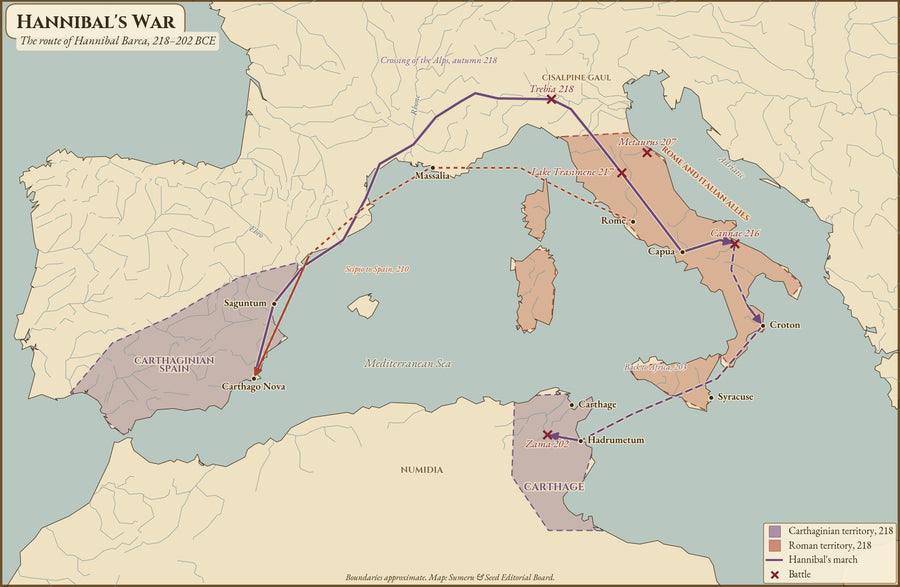
Short answer: The Second Punic War (218–201 BC) was the second and greatest of the three wars between Rome and Carthage. It began when Hannibal took Saguntum in Spain and marched over the Alps into Italy, where he won at the Trebia, Lake Trasimene and Cannae. Rome held on, took Spain under Scipio, carried the war to Africa and defeated Hannibal at Zama in 202 BC. The peace of 201 BC left Rome the master of the western Mediterranean.
Why did the Second Punic War begin?
Carthage had lost Sicily in the First Punic War (264–241 BC) and Sardinia soon after. To recover its strength the Barcid family, Hamilcar, his son-in-law Hasdrubal and his son Hannibal, built a new dominion in Spain, rich in silver and soldiers. A treaty set the river Ebro as its northern limit. South of the Ebro lay Saguntum, a town under Roman protection. In 219 BC Hannibal besieged and took it after eight months. Rome demanded that Carthage hand him over; Carthage refused, and war was declared in 218 BC.1
How did Hannibal cross the Alps?
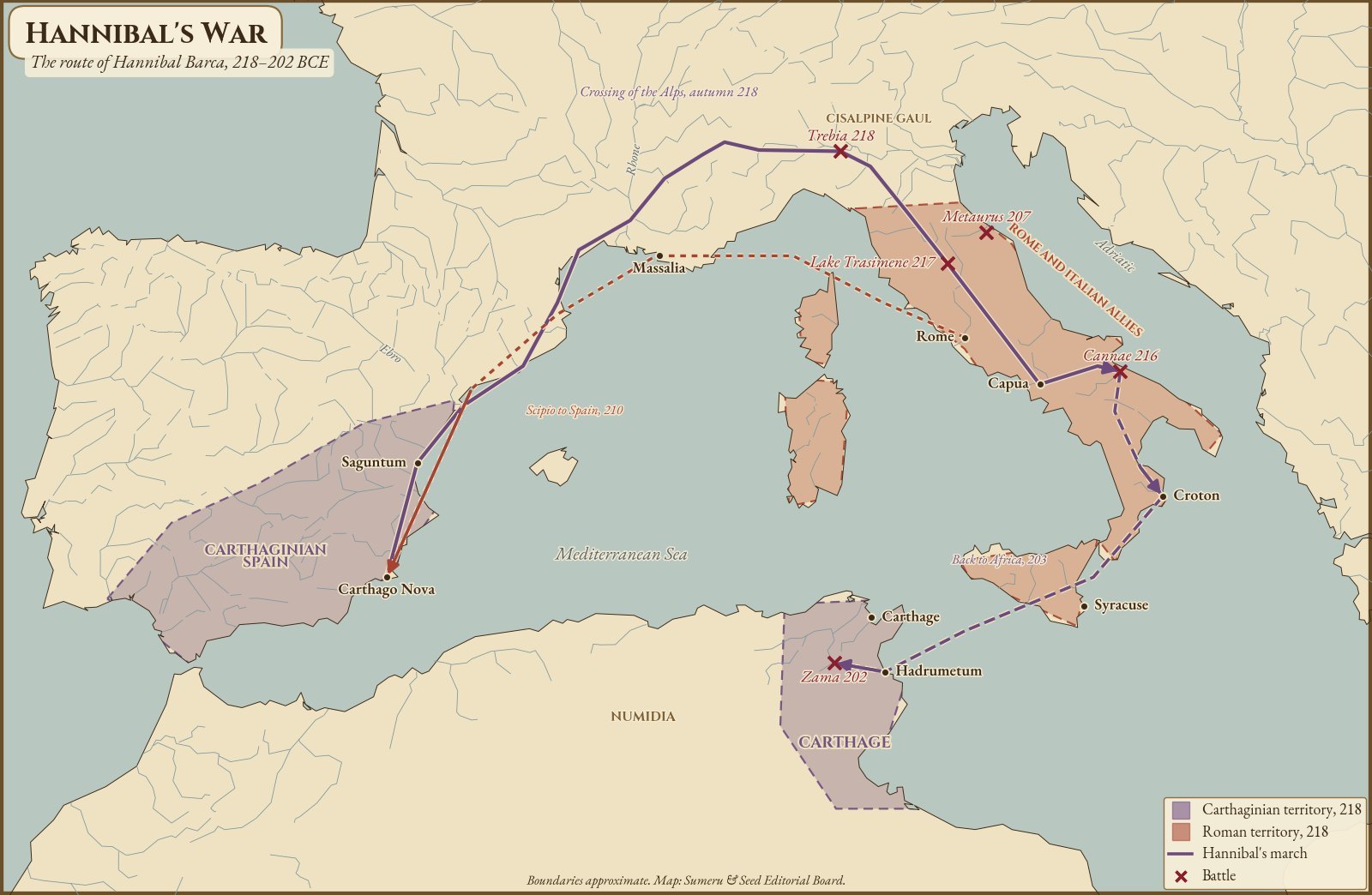
Rome expected to fight in Spain and Africa. Hannibal instead marched overland to Italy. He left New Carthage in the spring of 218 BC, crossed the Pyrenees and the Rhône, and climbed the Alps in the autumn, fighting mountain tribes and early snow. Polybius, who later walked the route, says that he came down into the Po valley with 20,000 infantry and 6,000 cavalry, less than half of the army that had set out.2 The Gauls of northern Italy, recently conquered by Rome, joined him.
What were the main battles in Italy?
- The Trebia, December 218 BC. Hannibal drew a Roman army across an icy river and struck it from an ambush.
- Lake Trasimene, June 217 BC. He hid his army in the hills above the lake road and destroyed the army of the consul Flaminius in the morning mist.
- Cannae, 2 August 216 BC. Facing the largest army Rome had ever fielded, he let his centre give way and closed his African infantry and cavalry around it. Polybius puts the Roman dead at about 70,000; Livy at about 48,000.3
After Trasimene the dictator Quintus Fabius Maximus refused battle and shadowed Hannibal instead, which earned him the name Cunctator, the Delayer. After Cannae Rome returned to his method.
Why did Hannibal not win the war?
Cannae brought Capua and much of southern Italy over to Hannibal, and later Syracuse and Tarentum. But the Latin allies at the heart of Rome's system stayed loyal, Rome would not negotiate, and it could always raise new legions. Hannibal had no siege train to take Rome and received little help from Carthage. Rome retook Syracuse (212 BC) and Capua (211 BC), and in 207 BC destroyed his brother Hasdrubal's relieving army at the Metaurus.
How did Scipio end the war?
The young Publius Cornelius Scipio took command in Spain, seized New Carthage in 209 BC and won the decisive battle at Ilipa in 206 BC. In 204 BC he invaded Africa. Carthage recalled Hannibal after fifteen years in Italy, and in 202 BC the two met at Zama. Scipio's legions opened lanes for the elephants, and the Numidian cavalry of Masinissa, now on the Roman side, returned to strike Hannibal's veterans in the rear.
By the peace of 201 BC Carthage gave up Spain, surrendered all but ten warships, paid 10,000 talents over fifty years and promised to make no war without Rome's leave.4 Scipio took the name Africanus.
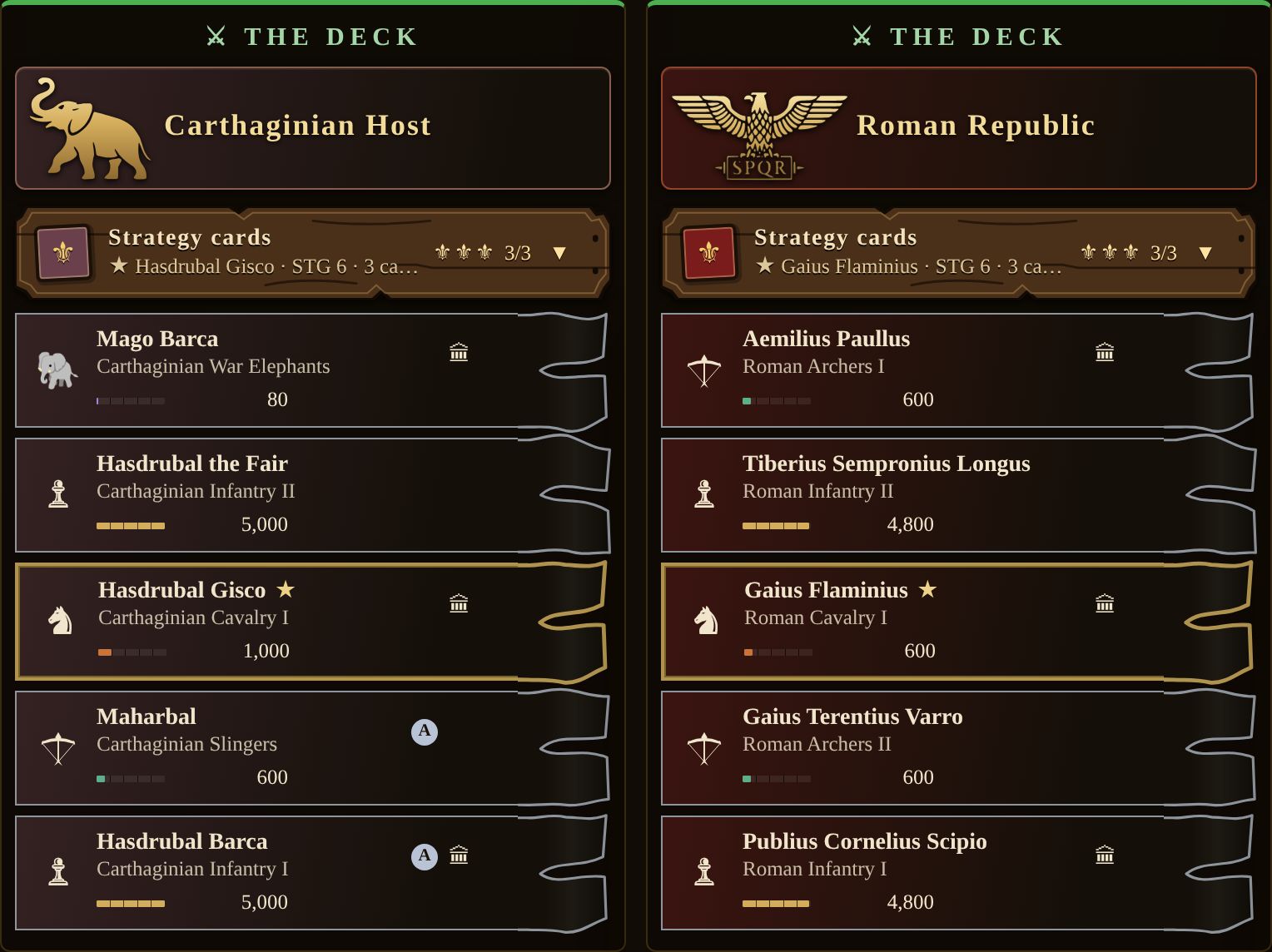
You can read the life of Hannibal Barca, follow the history of Rome and Carthage in the Civilization Index, see the whole struggle in The Punic Wars, or hold the war in your hand: the Imperion Cards core set The Second Punic War.
 Rome
 Carthage
Card backs of Chapter III. Each opens the civilization's page.
Questions people ask
When was the Second Punic War?
From 218 to 201 BC. The fighting ended at Zama in 202 BC and peace was made the next year.
Who won the Second Punic War?
Rome. Carthage lost Spain, its fleet and its freedom to make war, and paid 10,000 talents.
Why is the Second Punic War also called the Hannibalic War?
Because the Romans saw it as the war of one man, Hannibal Barca, who invaded Italy and stayed there undefeated for fifteen years.
Did Hannibal really cross the Alps with elephants?
Yes. He set out with 37 elephants. Most survived the crossing, but nearly all died in the winter that followed.
Why did Hannibal not attack Rome after Cannae?
He had no siege equipment and no secure supply, and Rome's walls and allies were intact. He hoped that Rome's allies would desert it instead; most did not.
Notes
- Polybius, Histories 3.15–33; Livy 21.5–19.
- Polybius 3.56.
- Polybius 3.117; Livy 22.49.
- Polybius 15.18; Livy 30.37.
Further reading
- Polybius, The Histories, books 3 and 7–15, trans. W. R. Paton, Loeb Classical Library.
- Livy, History of Rome, books 21–30.
- Adrian Goldsworthy, The Fall of Carthage: The Punic Wars 265–146 BC (Cassell, 2003).
- J. F. Lazenby, Hannibal's War: A Military History of the Second Punic War (Aris & Phillips, 1978).
- Dexter Hoyos, Hannibal's Dynasty (Routledge, 2003).