
The Battle of Ilipa, 206 BC: Scipio's Masterpiece in Spain
Sumeru & Seed Editorial BoardField Report · Chapter III · 206 BC · Near Seville, Spain
For days the two armies formed up, stared at each other and went back to camp — always in the same order. Then one morning Scipio came out early, with his line turned inside out, and broke the last Carthaginian army in Spain before its men had eaten.
Part I · The battle
Result A decisive Roman victory that ended Carthaginian power in Spain.
Why it is remembered
- A habit used as a weapon. Scipio let the enemy learn his order of battle — legions in the centre — for several days, then reversed it.
- Strength against weakness. On the day, his Spanish allies faced the best Carthaginian troops in the centre and only had to stand; the Roman legions fell on the weaker wings.
- Hungry men lose. Scipio fed his army before dawn and attacked at first light; the Carthaginians formed up without breakfast and fought all morning on empty stomachs.
Since his capture of New Carthage in 209 BC, Scipio had been taking Spain from Carthage piece by piece. In 206 Hasdrubal son of Gisco and Mago gathered every man they could find and camped at Ilipa on the Baetis, with elephants and the Numidian cavalry of the young prince Masinissa.1
For several days both armies offered battle late in the day without fighting: Hasdrubal's Africans in his centre, the Roman legions in Scipio's. Then Scipio gave his orders the night before — breakfast before dawn, armour on, out of the camp at first light.2
The battle, step by step
- The surprise sortie. Roman cavalry and light troops rush the Carthaginian outposts at dawn; Hasdrubal must form up in haste and in his usual order, unfed.3
- The reversed line. Scipio has his Spanish allies in the centre and the legions on both wings — the opposite of every day before.
- The wings swing in. The Roman wings advance in columns, turn outward into line and fall on the Carthaginian flanks, where the Spanish levies and the elephants stand; the panicked elephants trample their own side.4
- The centre waits. Scipio's own centre advances slowly and never closes. Hasdrubal's African veterans stand idle, unable to help either wing for fear of being attacked in front.
- The collapse. The Carthaginian wings break and the whole army falls back to its camp; a sudden storm stops the Romans. That night the Carthaginian army begins to melt away.5
What followed
Hasdrubal escaped to Gades and sailed for Africa; Mago held out at Gades for a while, then left Spain for good. Masinissa changed sides soon after — four years later he would command Scipio's cavalry at Zama. Spain became Roman, and Scipio went home to carry the war to Africa.6
Part II · Play it with Imperium Cards
Ilipa with the physical cards
Ilipa is one of the battles of Edition I · The Second Punic War. Set Scipio's reversed line against Hasdrubal's predictable one — or take Carthage and try to turn the trap around. The card battle below has been with the set since its first printing.


In 206 BC, Scipio spent days marching in identical formations, lulling Hasdrubal into complacency. On the day of battle he reversed his order, sending elite troops to the wings while allies pinned the center. The flanks collapsed, and Carthaginian power in Hispania was extinguished forever.
Order of battle
Battle sequence
- Phase IScipio feigns a strong center to fix Carthaginian attention
- Phase IIRoman elite infantry and cavalry shift to the wings
- Phase IIIRoman wings overwhelm Carthaginian flanks
- Phase IVCarthaginian center collapses — total Roman victory
A decisive Roman victory through tactical deception and flank superiority — Scipio's masterpiece that ended Carthaginian power in Hispania.
Could you have held the line?
Recreate Scipio's greatest tactical deception with Edition I


Part III · Play it in Sumeru Chess
Ilipa on the chessboard
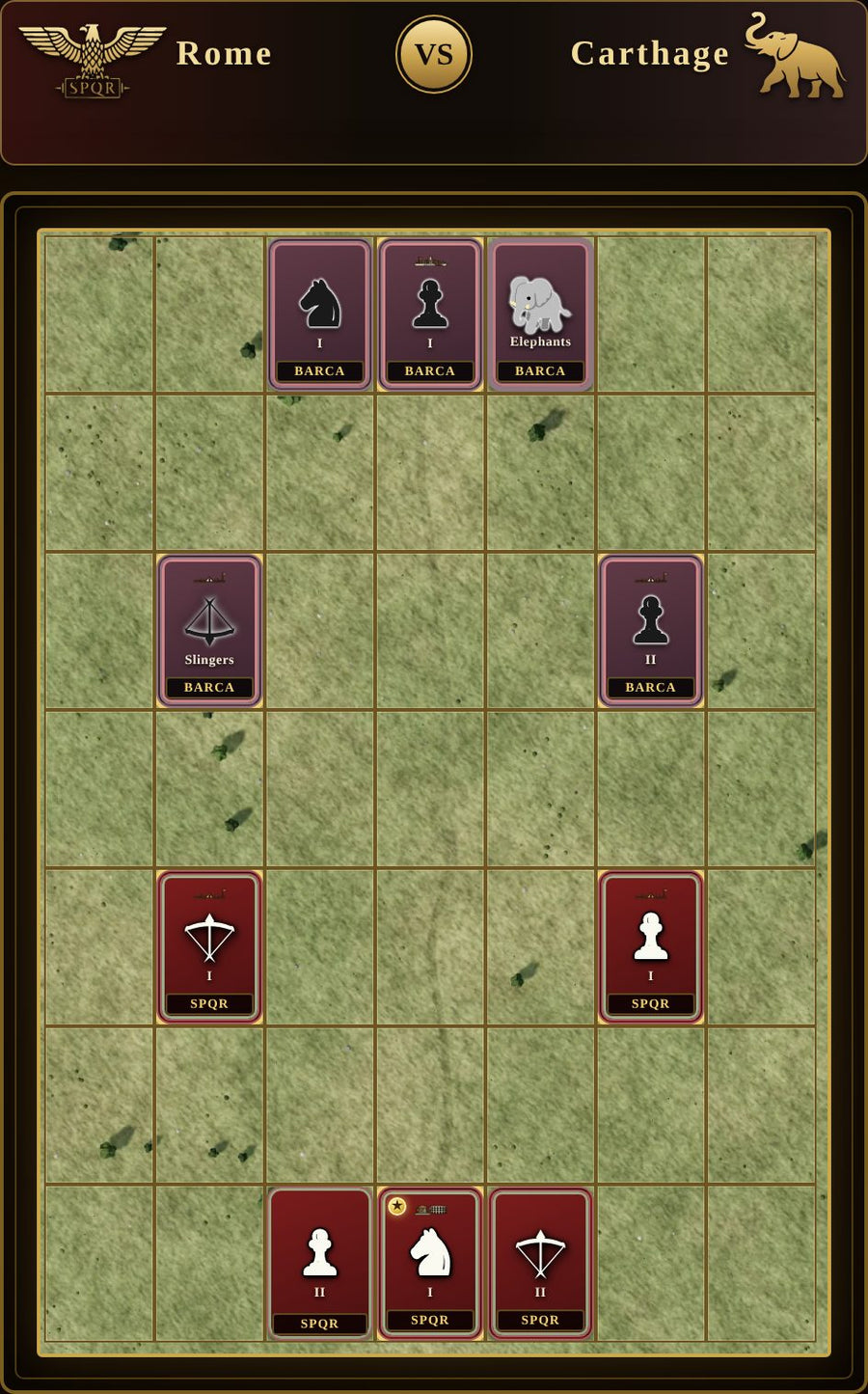
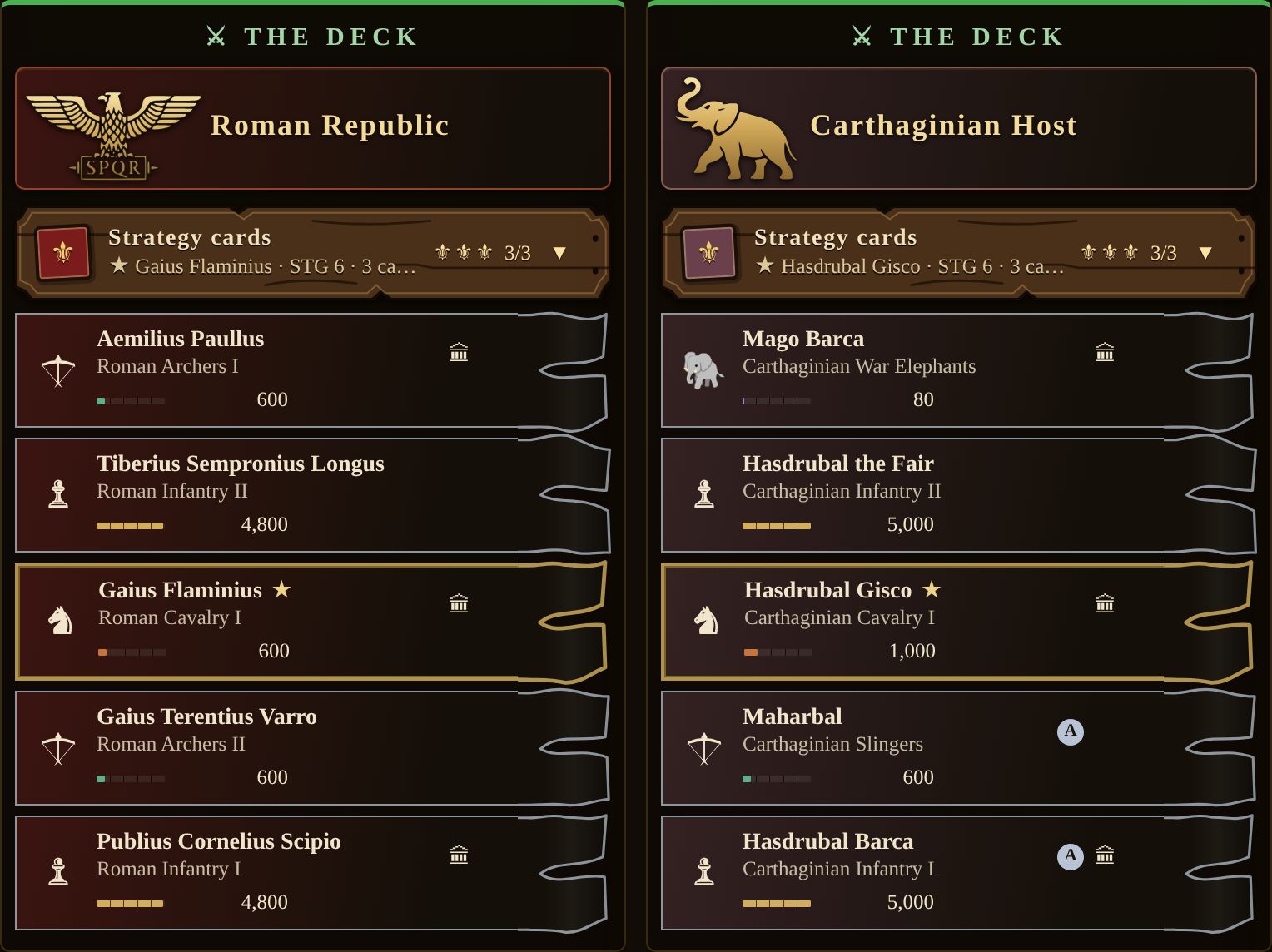
Ilipa has no battlefield of its own in Sumeru Chess yet. Rome and Carthage meet in Chapter III, the Age of Iron & Glory, and the open field shown here is where you can try Scipio's reversed deployment for yourself.
Where to find it
- Single Battle. Choose Rome against Carthage and keep Battlefield on Open field.
Fight it like history
- Put your best armies where the enemy is weakest. Scipio's legions went to the wings because the enemy's best troops were in the centre.
- Pin, don't fight. An army that stands in front of the enemy's best keeps it busy. You do not have to win everywhere at once.
- Kill the Chief Commander. If the enemy's ★ commander is routed, his side plays no more strategy cards and every army loses 2 MOR.
Chapter III is free to play in your browser, no download: Rome and Carthage are open to everyone; the other powers of the age come with Sumeru Premium.
Play Chapter IIIOpen the Card CollectionNotes and sources (6)
- Polybius 11.20; Livy 28.12–13. ↩
- Polybius 11.21–22; Livy 28.14. ↩
- Polybius 11.22; Livy 28.14. ↩
- Polybius 11.23–24; Livy 28.14–15. ↩
- Livy 28.15–16. ↩
- Livy 28.16–37; Polybius 11.24. ↩
Further reading
- Polybius, The Histories, Book XI.
- Livy, Hannibal's War, trans. J. C. Yardley (Oxford World's Classics), Book 28.
- Richard A. Gabriel, Scipio Africanus: Rome's Greatest General (Potomac Books, 2008).