
The Battle of Lake Trasimene, 217 BC: The Ambush in the Mist
Sumeru & Seed Editorial BoardField Report · Chapter III · June 217 BC · Umbria, Italy
A Roman army marched along a lake shore in the morning fog. The hills above it were full of Carthaginians. In about three hours the consul was dead and his army gone — the largest ambush in the history of the ancient world.
Part I · The battle
Result A complete Carthaginian victory: a consular army destroyed, the consul killed.
Why it is remembered
- An army hidden on a battlefield. Hannibal posted his whole force on the slopes above a narrow shore road — and the Romans walked into it in column, not in line.
- Fog did the rest. A morning mist off the lake hid the hills; the Romans were attacked from front, flank and rear before they could see who was there.
- Rome's nerve broke. After Trasimene the Republic named a dictator, Fabius Maximus, and stopped offering battle — for a while.
After the Trebia Hannibal crossed the Apennines through the marshes of the Arno — he lost an eye there to infection — and marched past the army of the consul Flaminius at Arretium, burning the country as he went. Flaminius, eager for battle, followed.1
Where the road ran between Lake Trasimene and the hills, Hannibal camped in plain view at the far end and hid everything else: the heavy infantry on the rise ahead, the light troops on the slopes, the cavalry at the entrance of the defile, ready to close it behind the Romans.2
The battle, step by step
- The column enters. At dawn Flaminius leads his army along the shore without scouting the hills; mist lies over the lake and the low ground.
- The trap closes. On Hannibal's signal every Carthaginian division charges downhill at once, and the cavalry seals the entrance behind the Romans.3
- No line, no orders. Caught in marching order, the Romans fight in knots where they stand. Flaminius is killed — Livy names the Insubrian horseman Ducarius.4
- Into the lake. Thousands are driven into the water and drown or are cut down wading; about 6,000 of the vanguard break through, only to surrender to Maharbal the next day.5
“We have been defeated in a great battle.” — the praetor Marcus Pomponius to the people of Rome, in Livy6
What followed
Days later Maharbal destroyed the 4,000 cavalry the other consul had sent ahead. Rome appointed Quintus Fabius Maximus dictator; his strategy of shadowing Hannibal without fighting earned him the name Cunctator, the Delayer — and was abandoned the next year, at Cannae.7
Part II · Play it with Imperium Cards
Lake Trasimene with the physical cards
Lake Trasimene is one of the battles of Edition I · The Second Punic War. Hide Hannibal's divisions on the slopes and spring them all at once — or take the Roman column and look for a way out of the defile. The card battle below has been part of the set since its first printing.


In 217 BC, Hannibal concealed his army in the hills above Lake Trasimene. As Flaminius's Roman column marched through the fog-shrouded corridor below, the Carthaginians struck from all sides, annihilating an entire army in under three hours.
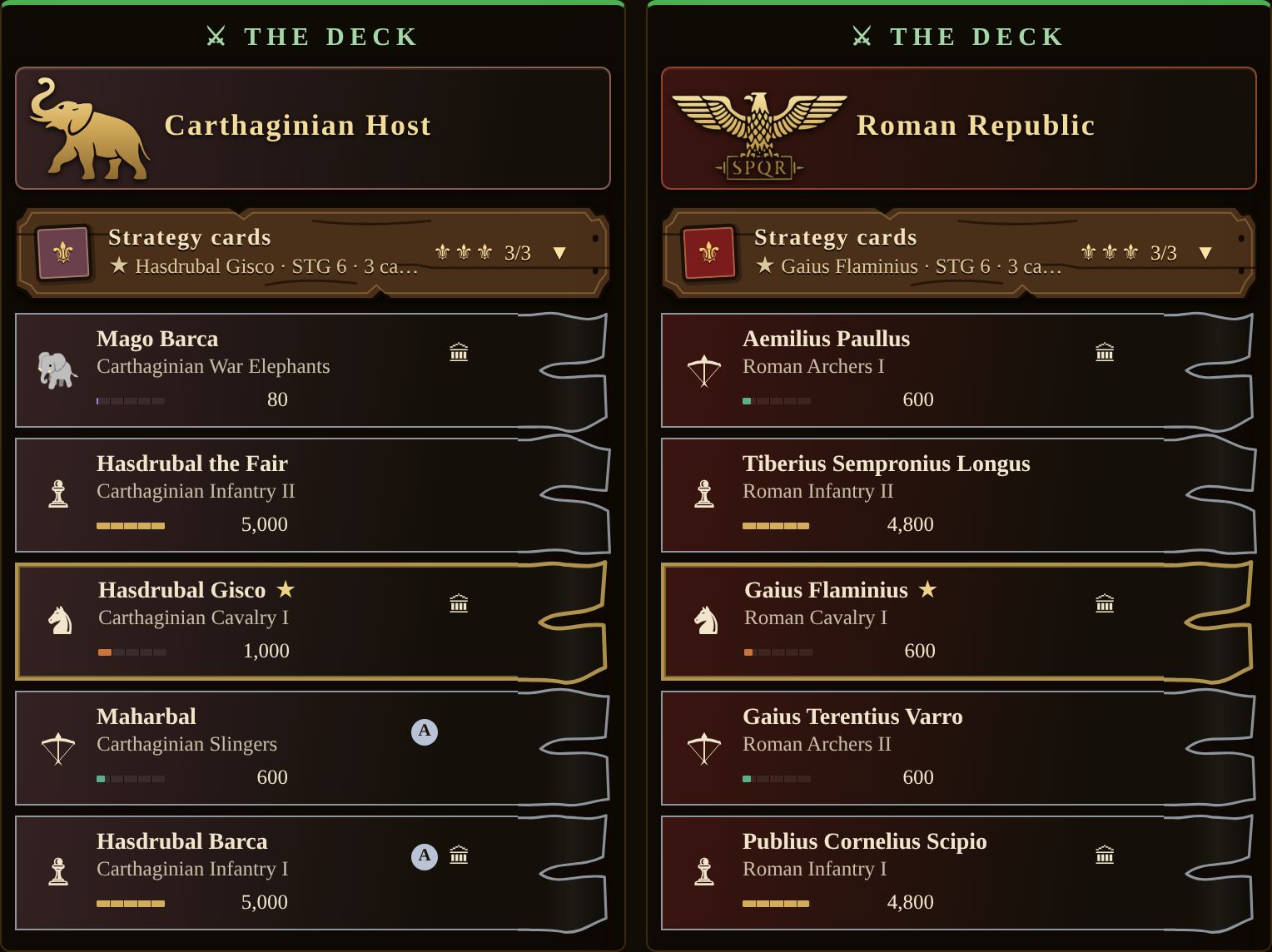
Order of battle
Battle sequence
- Phase IRoman column enters lake corridor
- Phase IIMorning fog conceals positions
- Phase IIIAmbush springs from all sides
- Phase IVRoman column collapses
One of history's greatest ambushes — a perfect terrain trap that erased an entire Roman army.
Could you have changed history?
Command this battle with Edition I — The Second Punic War

Part III · Play it in Sumeru Chess
Lake Trasimene on the chessboard
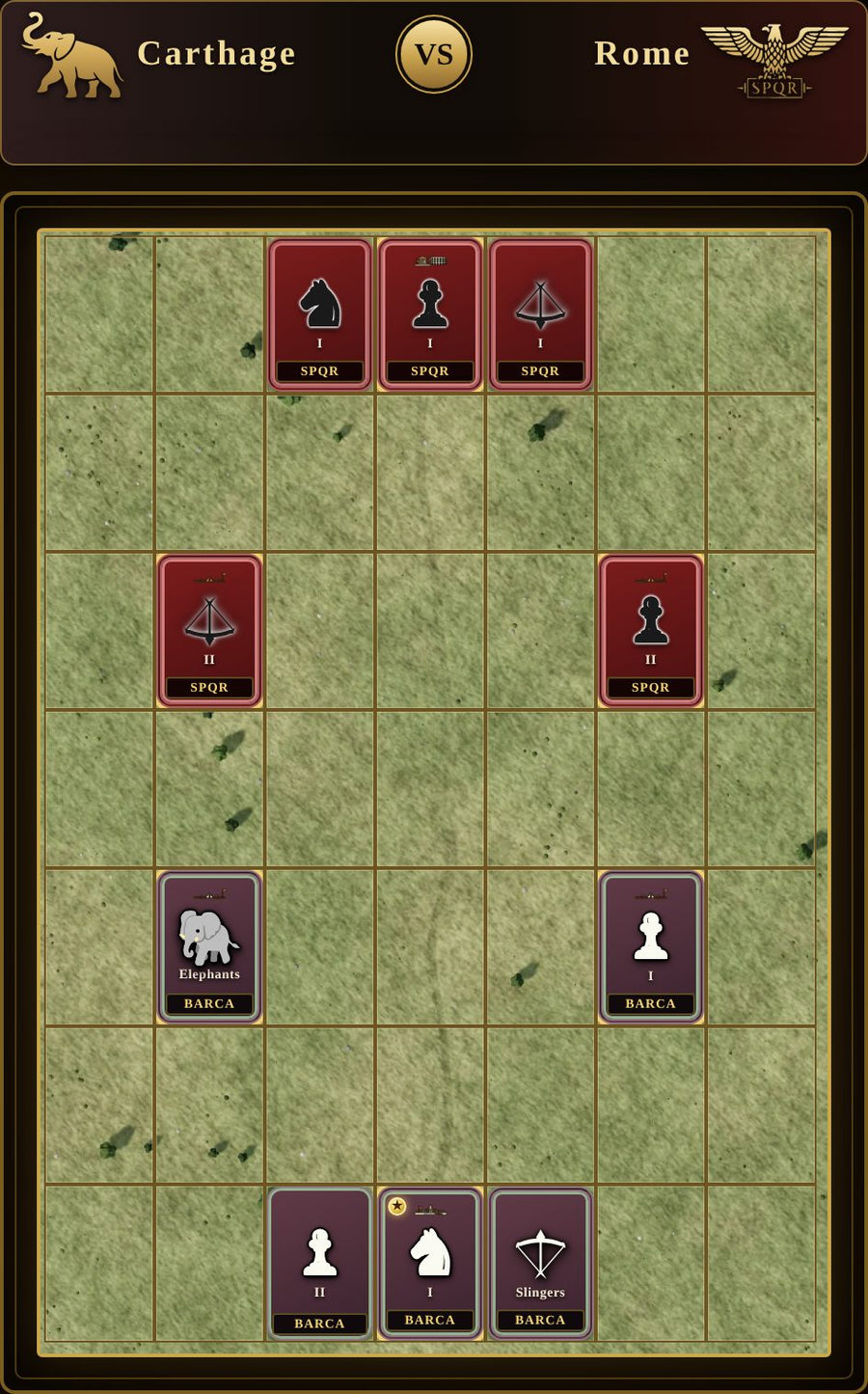
Lake Trasimene has no battlefield of its own in Sumeru Chess yet. Carthage and Rome meet in Chapter III, the Age of Iron & Glory, and the open field shown here is where you can try Hannibal's ambush for yourself.
Where to find it
- Single Battle. Choose Carthage against Rome and keep Battlefield on Open field.
Fight it like history
- Hold your armies back. Let the enemy come to you across the open board, then strike from several sides in the same turn.
- Use 2 vs 1. An enemy army already pinned by one of your melee armies can be struck by a second and destroyed outright, no card needed (unless it holds the line) — the way an ambush kills in Sumeru Chess.
- Spend your strategy points late. They never refill. Keep them for the turn the trap closes.
Chapter III is free to play in your browser, no download: Rome and Carthage are open to everyone; the other powers of the age come with Sumeru Premium.
Play Chapter IIIOpen the Card CollectionNotes and sources (7)
- Polybius 3.78–82; Livy 22.2–3. ↩
- Polybius 3.83. ↩
- Polybius 3.84; Livy 22.4–5. ↩
- Livy 22.6. ↩
- Polybius 3.84–85; Livy 22.6–7. ↩
- Livy 22.7. ↩
- Polybius 3.86–90; Livy 22.8–18. ↩
Further reading
- Polybius, The Rise of the Roman Empire, trans. Ian Scott-Kilvert (Penguin), Book III.
- J. F. Lazenby, Hannibal's War (Aris & Phillips, 1978).
- Adrian Goldsworthy, The Fall of Carthage (Cassell, 2000).