
The Battle of Zama, 202 BC: Scipio against Hannibal
Sumeru & Seed Editorial BoardField Report · Chapter III · 202 BC · North Africa
The two greatest generals of the age met at last. Hannibal led with eighty war elephants; Scipio had left lanes in his line to swallow them. The cavalry that won it had once ridden for Carthage.
Part I · The battle
Result A decisive Roman victory that ended the Second Punic War.
Why it is remembered
- Hannibal's only defeat in a great battle. The victor of Cannae was beaten in Africa, by a general who had survived Cannae as a young officer.
- The elephants were let through. Scipio drew up his maniples one behind the other, leaving clear lanes; the elephants ran down them and out of the battle.
- Cannae in reverse. Roman and Numidian horse drove off Hannibal's cavalry, then came back and fell on his last line from behind.
In 204 BC Scipio landed in Africa. Carthage recalled Hannibal from Italy, where he had fought for fifteen years, and he gathered an army of veterans, new levies, mercenaries and elephants. Masinissa — once Carthage's ally in Spain — brought Scipio thousands of Numidian horsemen.1
The two commanders met between the lines before the battle; Hannibal offered peace, Scipio refused. Hannibal drew up in three lines: mercenaries in front, the African and Carthaginian levies second, and his own veterans of Italy held back a long way behind.2
The battle, step by step
- The elephant charge. Roman trumpets and horns frighten many of the elephants, which turn on their own cavalry; the rest run down the lanes Scipio left open and are speared from both sides.3
- The cavalry clears the field. Laelius and Masinissa rout the Carthaginian horse on both wings and ride off in pursuit.
- Two lines broken. The Roman hastati beat the mercenaries, then the second line; the fleeing men are refused entry by Hannibal's veterans.
- The last struggle. Scipio re-forms on the corpse-strewn ground, principes and triarii out on the wings, and the two best infantry lines of the war meet on equal terms.4
- The horse comes back. Laelius and Masinissa return and charge Hannibal's veterans in the rear. Hannibal escapes to Hadrumetum; his army is destroyed.5
What followed
Carthage made peace in 201 BC: it gave up Spain and all but ten of its warships, paid 10,000 talents over fifty years and could make no war without Rome's leave. Scipio took the name Africanus. Hannibal went on to reform Carthage's government — and died in exile in 183 BC.6
Part II · Play it with Imperium Cards
Zama with the physical cards
Zama is one of the battles of Edition I · The Second Punic War, with Hannibal's elephants, his veterans and Scipio's lanes. Recreate it card by card, or try to win it for Carthage. The card battle below has been with the set since its first printing.


In 202 BC, Hannibal opened with a mass elephant charge, but Scipio had drilled his men to open lanes and let them pass. With elephants neutralized and Numidian cavalry defected to Rome, Scipio's horsemen swept the rear, crushing Hannibal's veterans from all sides and ending the Second Punic War.
Order of battle
Battle sequence
- Phase IElephants charge the Roman lines
- Phase IIRoman lanes open — elephants absorbed and routed
- Phase IIIInfantry clash — stalemate at center
- Phase IVCavalry returns — rear encirclement completes
A decisive Roman victory — Scipio turned Hannibal's own tactics against him, ending the Second Punic War.
Could you have broken the encirclement?
Recreate the battle that ended Carthage's power with Edition I


Part III · Play it in Sumeru Chess
Zama on the chessboard
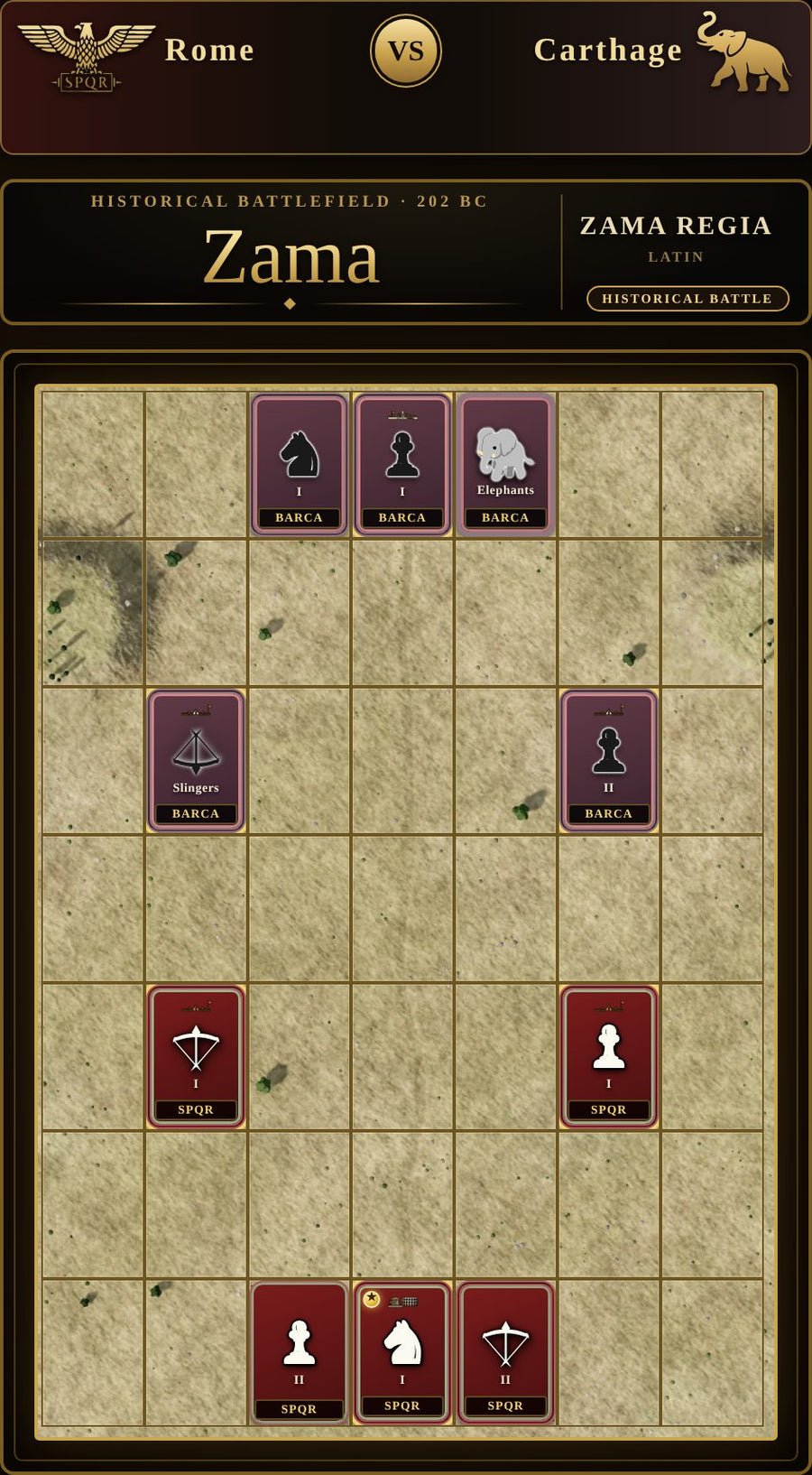
Zama is one of the historical battlefields of Chapter III of Sumeru Chess, the Age of Iron & Glory. It is a 7 × 7 board drawn from the real ground: the Carthage side deploys from Zama, the Rome side from Naraggara.
- Rocks are impassable.
Where to find it
- Conquest Campaign. Lead Rome against Carthage, or Carthage against Rome: Zama is the second of the two historical battles of that war (the other is Cannae), and the war ends at the enemy capital.
- Single Battle. Choose Rome against Carthage and set Battlefield to Random: Zama is one of the four historical fields the game draws for this pair.
Fight it like history
- Keep your cavalry for the second blow. At Zama it decided the battle only after it came back. Do not throw it away early.
- Elephants hit hard but cannot climb. The rocks of the Zama board are impassable; plan the lanes your armies will use.
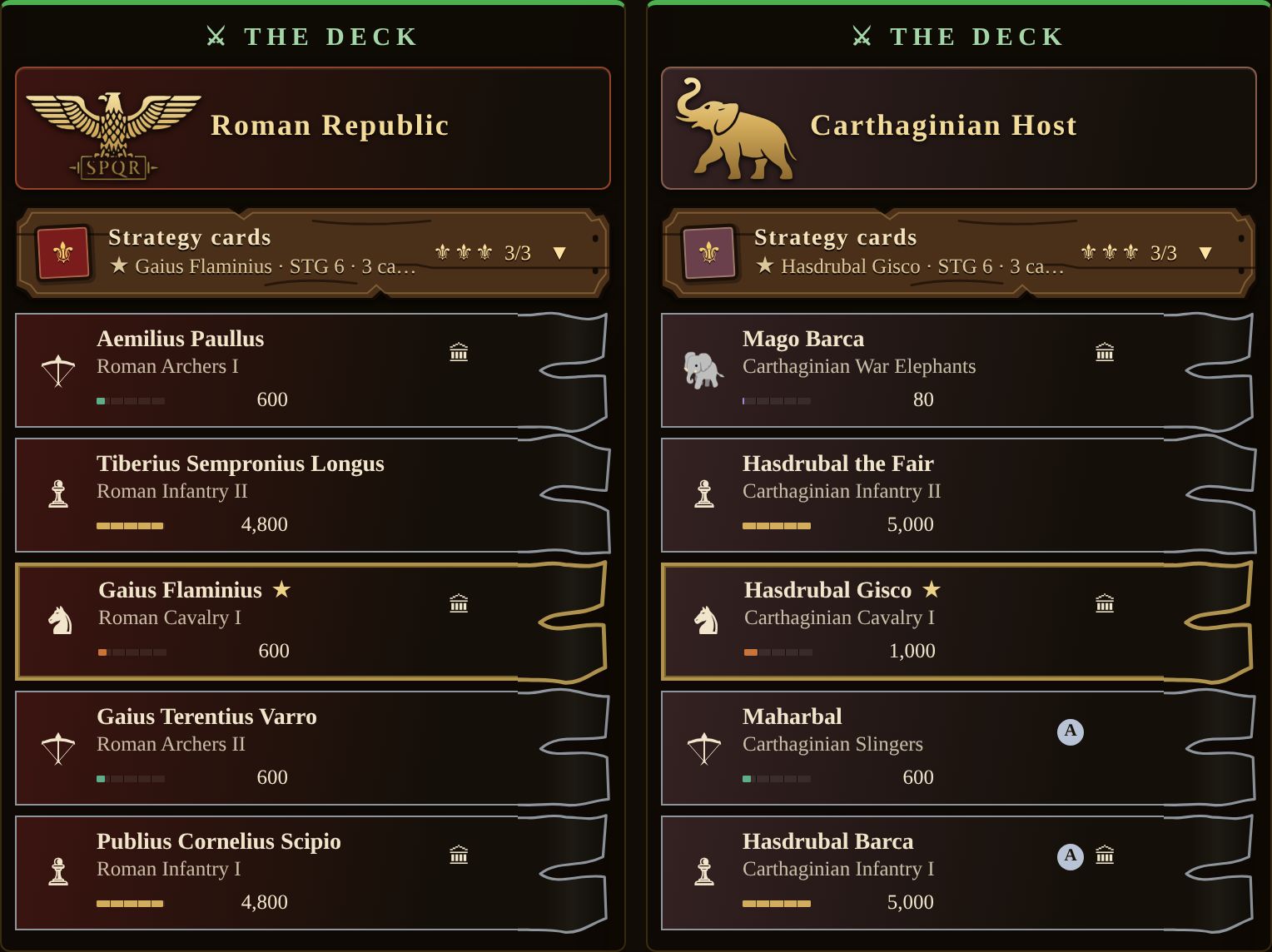
- Kill the Chief Commander. If the enemy's ★ commander is routed, his side plays no more strategy cards and every army loses 2 MOR.
Chapter III is free to play in your browser, no download: Rome and Carthage are open to everyone; the other powers of the age come with Sumeru Premium.
Play Chapter IIIOpen the Card CollectionNotes and sources (6)
- Livy 29–30; Polybius 15.3–5. ↩
- Polybius 15.6–11; Livy 30.29–33. ↩
- Polybius 15.12; Livy 30.33. ↩
- Polybius 15.13–14. ↩
- Polybius 15.14–15; Livy 30.35. ↩
- Polybius 15.18; Livy 30.37–44. ↩
Further reading
- Polybius, The Rise of the Roman Empire, trans. Ian Scott-Kilvert (Penguin), Book XV.
- Adrian Goldsworthy, The Fall of Carthage (Cassell, 2000).
- Patrick N. Hunt, Hannibal (Simon & Schuster, 2017).