

The Crusades (1095–1291): A History of the Wars for Jerusalem
Sumeru & Seed Editorial BoardIn 1095 a pope asked the knights of western Europe to march to Jerusalem. For two centuries afterwards armies went east, four Latin states rose on the coast of Syria and Palestine, and Muslim rulers from Zengi to Saladin and Baybars fought to remove them.
Short answer: The Crusades were a series of wars fought between 1095 and 1291 by armies from western Europe to win and hold Jerusalem and the Holy Land. The First Crusade took Jerusalem in 1099 and founded four Latin states. Saladin recovered Jerusalem in 1187, the Third Crusade failed to win it back, and the last crusader city, Acre, fell to the Mamluks of Egypt in 1291.
Why did the Crusades begin?
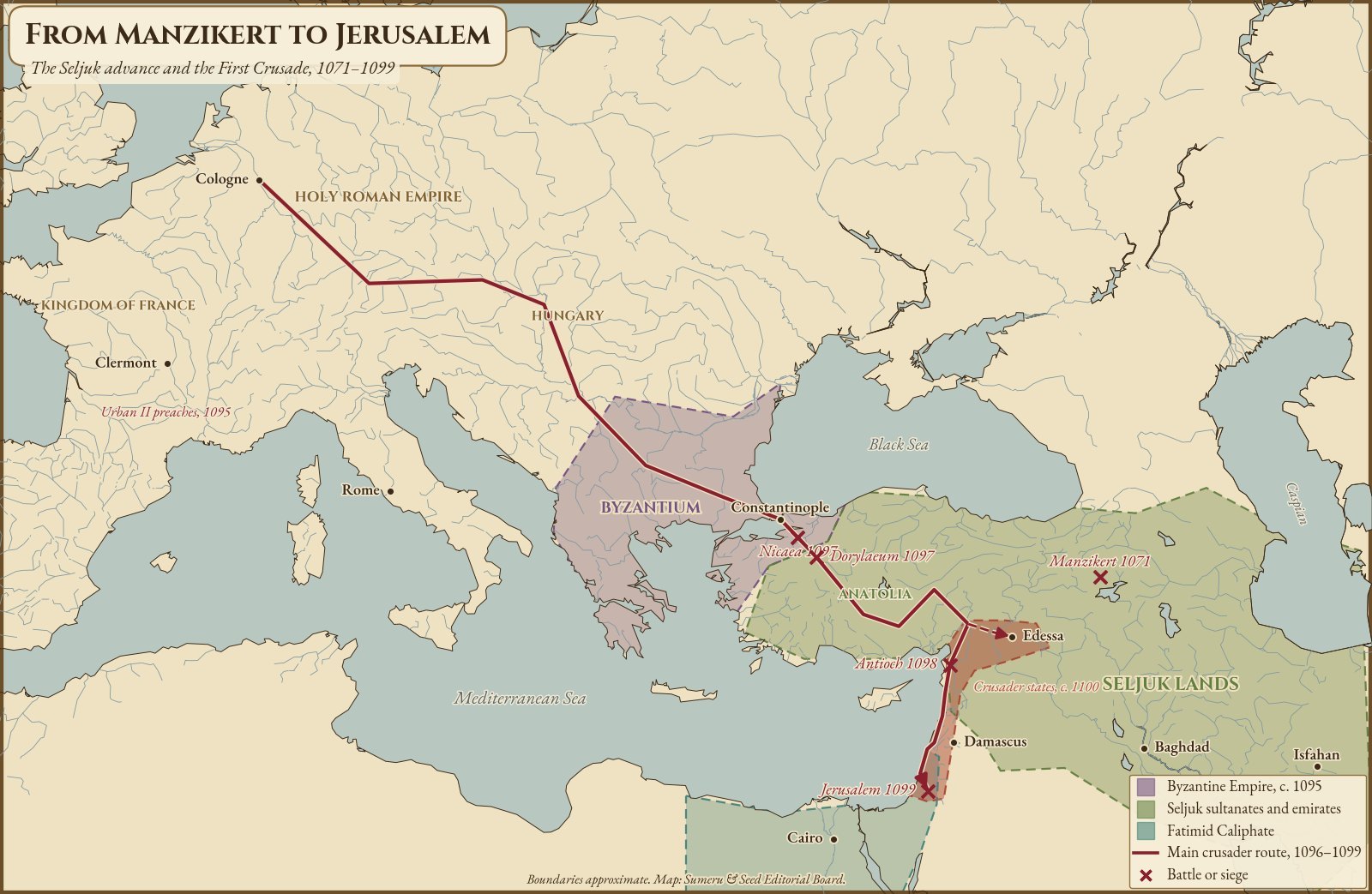
In 1071 the Seljuk Turks defeated the Byzantine emperor at Manzikert and overran most of Anatolia. In 1095 the emperor Alexios I Komnenos asked the West for soldiers. Pope Urban II answered at the Council of Clermont in November 1095 with something larger: a call to arms to free the Christians of the East and Jerusalem itself, with remission of penance for those who went.1 The response surprised everyone. See From Manzikert to Jerusalem.
What did the First Crusade achieve?
Everything it set out to do, against the odds. The armies of the princes gathered at Constantinople in 1096–1097, took Nicaea, won at Dorylaeum, and besieged Antioch for eight months. On 15 July 1099 they stormed Jerusalem and killed much of its population.2 Four states followed: the County of Edessa, the Principality of Antioch, the Kingdom of Jerusalem and the County of Tripoli. The crusaders had arrived when the Muslim powers of Syria were divided among themselves; that would not last.
How did the Muslim world answer?
By uniting. Zengi of Mosul took Edessa in 1144, which brought on the Second Crusade (1147–1149), led by the kings of France and Germany; it failed before Damascus. Zengi's son Nur al-Din joined Aleppo and Damascus, and his general's nephew Saladin added Egypt. By 1183 Saladin ruled from the Nile to the Tigris and the crusader states were surrounded. See Saladin and the Ayyubids.
While the young leper king Baldwin IV lived, the kingdom held: he beat Saladin at Montgisard in 1177 (see Baldwin IV, the Leper King). Two years after his death, on 4 July 1187, Saladin destroyed the army of Jerusalem at the Horns of Hattin. Jerusalem surrendered on 2 October.
What was the Third Crusade?
The answer of the West's three greatest rulers (1189–1192). The emperor Frederick Barbarossa drowned in a river in Anatolia. Philip II of France and Richard I of England took Acre in July 1191; Philip went home, and Richard marched down the coast, beat Saladin at Arsuf and twice came within sight of Jerusalem without attacking it. The Treaty of Jaffa in September 1192 left the coast to the Franks and Jerusalem to Saladin, with the city open to Christian pilgrims.3 See The Crusader Kings.
How did the Crusades end?
The Fourth Crusade (1202–1204) never reached the Holy Land: in debt to Venice, it sacked Christian Constantinople. The emperor Frederick II recovered Jerusalem by treaty in 1229; it was lost for good in 1244. Louis IX of France was captured in Egypt in 1250 and died at Tunis in 1270. By then a new power ruled in Cairo. The Mamluk sultans, who had stopped the Mongols at Ain Jalut, took the crusader castles one by one. Acre fell on 18 May 1291.
Why do the Crusades matter?
They failed in their aim, but they changed both sides. Italian merchant cities grew rich on the eastern trade; the military orders, the Templars and Hospitallers, became powers in Europe; Byzantium never recovered from 1204; and in the Muslim world the wars helped to bring to power the soldier states of the Ayyubids and Mamluks.
 Jerusalem
 Ayyubids
 Crusader Kings
 Seljuks
Card backs of Chapter V. Each opens the civilization's page.
Questions people ask
When were the Crusades?
The crusades to the Holy Land ran from 1095, when Pope Urban II called the First Crusade, to 1291, when Acre fell.
How many Crusades were there?
Historians usually number eight or nine major expeditions to the East between 1096 and 1272, with many smaller ones between them.
Who won the Crusades?
In the Holy Land, the Muslim powers. The crusaders held Jerusalem from 1099 to 1187 and again from 1229 to 1244, and lost their last city in 1291.
Why did the Crusades start?
The Byzantine emperor asked for help against the Seljuk Turks, and Pope Urban II turned the appeal into an armed pilgrimage to free Jerusalem.
Who was Saladin?
The sultan of Egypt and Syria (ruled 1174–1193), founder of the Ayyubid dynasty, who defeated the Kingdom of Jerusalem at Hattin and retook the city in 1187.
Notes
- Fulcher of Chartres, Historia Hierosolymitana 1.3; the versions of the speech differ.
- Gesta Francorum 10; Ibn al-Athir, al-Kamil, year 492.
- Baha al-Din Ibn Shaddad, The Rare and Excellent History of Saladin.
Further reading
- William of Tyre, A History of Deeds Done Beyond the Sea, trans. E. A. Babcock and A. C. Krey (New York, 1943).
- Francesco Gabrieli, Arab Historians of the Crusades (London, 1969).
- Christopher Tyerman, God's War: A New History of the Crusades (Allen Lane, 2006).
- Thomas Asbridge, The Crusades: The War for the Holy Land (Simon & Schuster, 2010).
- Jonathan Riley-Smith, The Crusades: A History, 3rd ed. (Bloomsbury, 2014).