

The Battle of Ain Jalut, 1260: The Mamluks Stop the Mongols
Sumeru & Seed Editorial BoardField Report · Chapter VI · 3 September 1260 · Jezreel Valley, Galilee
Baghdad had fallen and Damascus had surrendered. Then the Mongol main army went home, and the Mamluk sultan of Egypt rode out to meet the force it left behind. At the Spring of Goliath the Mongols chased a retreating vanguard into the hills — and into the Mamluk army.
Part I · The battle
Result A decisive Mamluk victory that saved Egypt and ended the Mongol advance in the west.
Why it is remembered
- The Mongols' first great defeat that stood. Others had beaten a Mongol army before; none had stopped them for good. The Mamluks did.
- Their own trick. Baybars used the Mongols' favourite tactic, the feigned retreat, to draw them into an ambush.
- The sultan's cry. When his left wing wavered, Qutuz threw down his helmet and shouted “O Islam!”, and led the charge himself.
After sacking Baghdad in 1258, Hülegü took Aleppo and Damascus in 1260 and sent envoys to Cairo demanding surrender. Qutuz executed them. Then news came that the Great Khan Möngke had died; Hülegü withdrew with most of his army and left Kitbuqa with a smaller force in Syria.1
Qutuz marched north through crusader territory with Frankish leave and met the Mongols in Galilee.2
The battle, step by step
- The bait. Baybars' vanguard meets the Mongols, fights, and falls back into the hills.
- The trap. The Mongols follow into the valley, where the main Mamluk army is waiting.3
- The crisis. A Mongol charge breaks the Mamluk left; Qutuz rallies his men in person.4
- The rout. The Mamluks counter-attack; the Syrian troops in the Mongol army desert, Kitbuqa is killed and the remnant is hunted down near Beisan.5
What followed
Weeks later Baybars murdered Qutuz and became sultan himself. The Mongols of Persia invaded Syria again and again, but the Mamluks held the line of the Euphrates for the rest of the century; Ain Jalut marked the western edge of the Mongol world.6
Part II · Play it in Sumeru Chess
Ain Jalut on the chessboard
Ain Jalut is one of the historical battlefields of Chapter VI of Sumeru Chess, the Age of Storm & Ashes. It is a 7 × 7 board drawn from the real ground: the Mamluk side deploys from The Spring of Goliath, the Mongols side from Kitbuqa's Camp.
- Hills give a defender +1 DEF, and cavalry cannot climb them.
- Forest stops movement, and an army inside is hidden unless one of yours stands next to it.
Where to find it
- Conquest Campaign. Lead Mamluk against Mongols, or Mongols against Mamluk: Ain Jalut is the second of the two historical battles of that war (the other is Gaza), and the war ends at the enemy capital.
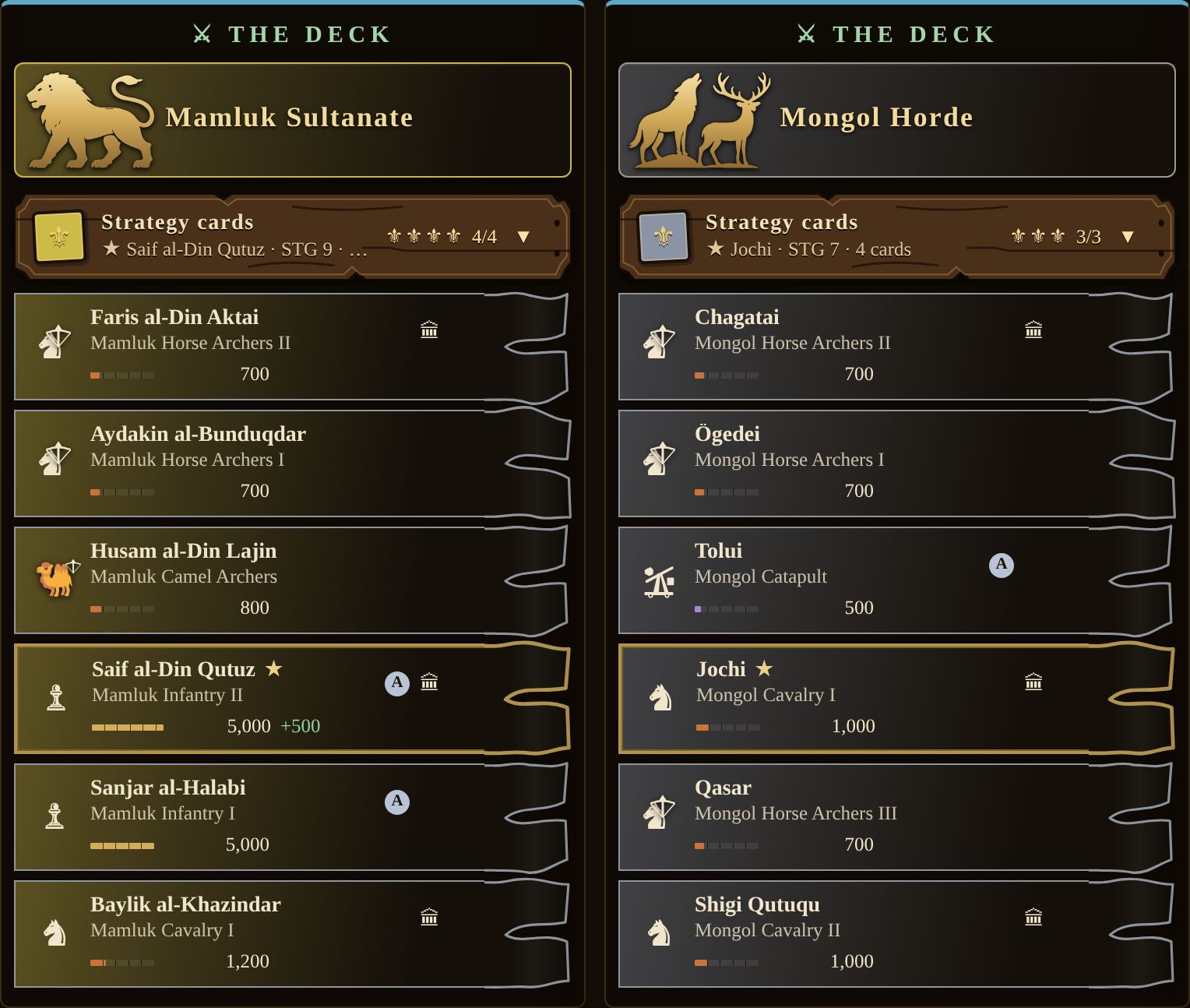
Fight it like history
- Bait with your vanguard. Pull an enemy army forward into the reach of your waiting armies, then strike it from two sides (2 vs 1).
- Hills favour the defender — +1 DEF, and cavalry cannot climb them.
- Kill the commander. If the enemy's ★ Chief Commander is routed, his side plays no more strategy cards and every army loses 2 MOR — Kitbuqa's death ended the battle.
Chapter VI is free to play in your browser, no download: the Mongols and Khwarazm are open to everyone; the other powers of the age come with Sumeru Premium.
Play Chapter VIOpen the Card CollectionNotes and sources (6)
- Rashid al-Din, Jami' al-Tawarikh; al-Maqrizi, Kitab al-Suluk. ↩
- al-Maqrizi; Rothelin Continuation of William of Tyre. ↩
- al-Maqrizi; Baybars al-Mansuri. ↩
- al-Maqrizi; Ibn Kathir. ↩
- Rashid al-Din; al-Maqrizi. ↩
- Reuven Amitai-Preiss, Mongols and Mamluks (Cambridge, 1995). ↩
Further reading
- Reuven Amitai-Preiss, Mongols and Mamluks: The Mamluk–Ilkhanid War, 1260–1281 (Cambridge, 1995).
- Peter Thorau, The Lion of Egypt: Sultan Baybars I (Longman, 1992).