

The Battle of Montgisard, 1177: The Leper King Defeats Saladin
Sumeru & Seed Editorial BoardField Report · Chapter V · 25 November 1177 · Near Ramla, Palestine
Saladin invaded with a great army and left a sick sixteen-year-old king shut up in Ascalon. The king broke out with a few hundred knights, caught the Ayyubid army scattered and unready, and sent Saladin fleeing back to Egypt on a racing camel.
Part I · The battle
Result A crusader victory and Saladin's worst defeat.
Why it is remembered
- A king who should not have been there. Baldwin IV was sixteen and already marked by leprosy. He rode into battle anyway.
- Caught on the march. Saladin's army had spread out to plunder, sure the Franks were shut up in Ascalon. It was attacked before it could form.
- Saladin's lesson. He fled with his guard and reached Egypt with a fraction of his army. He never again underestimated the kingdom — and ten years later came Hattin.
In late 1177, while much of the Frankish army was away in the north, Saladin invaded the kingdom of Jerusalem from Egypt. Baldwin IV rushed to Ascalon with the knights he could gather and was blockaded there.1
Saladin left a screen before Ascalon and marched on towards Jerusalem, letting his troops scatter to raid Ramla and Lydda. Baldwin slipped out along the coast, joined the Templars from Gaza and went after him.2
The battle, step by step
- The breakout. Baldwin leaves Ascalon and marches north along the coast with Raynald and the Templars.
- The surprise. Near Montgisard the Franks find Saladin's army crossing a stream, its baggage and troops spread out.3
- The charge. The knights charge before the Ayyubids can form; Saladin's Mamluk guard fights to protect him and is cut to pieces.4
- The flight. Saladin escapes on a racing camel; the Bedouin pick off the stragglers on the long road back across Sinai.5
What followed
Baldwin founded a Benedictine monastery dedicated to St Catherine on the battlefield. Saladin rebuilt his army and went on uniting Egypt and Syria around the kingdom. Baldwin IV died in 1185, at twenty-three; two years later Saladin destroyed the army of his successor at Hattin.6
Part II · Play it in Sumeru Chess
Montgisard on the chessboard
Montgisard is one of the historical battlefields of Chapter V of Sumeru Chess, the Age of Faith & Fire. It is a 7 × 7 board drawn from the real ground: the Ayyubids side deploys from Saladin's Camp, the Outremer side from Ascalon.
- Hills give a defender +1 DEF, and cavalry cannot climb them.
- The river stops movement; a defender standing in it fights at -1 DEF (horse) or -2 DEF (foot).
- Fords are the crossing places of the river.
- Marsh mires an army for 2 turns, and it defends there at -3 DEF.
- No army can enter the sea.
Where to find it
- Conquest Campaign. Lead Outremer against Ayyubids, or Ayyubids against Outremer: Montgisard is the first of the two historical battles of that war (the other is Hattin), and the war ends at the enemy capital.
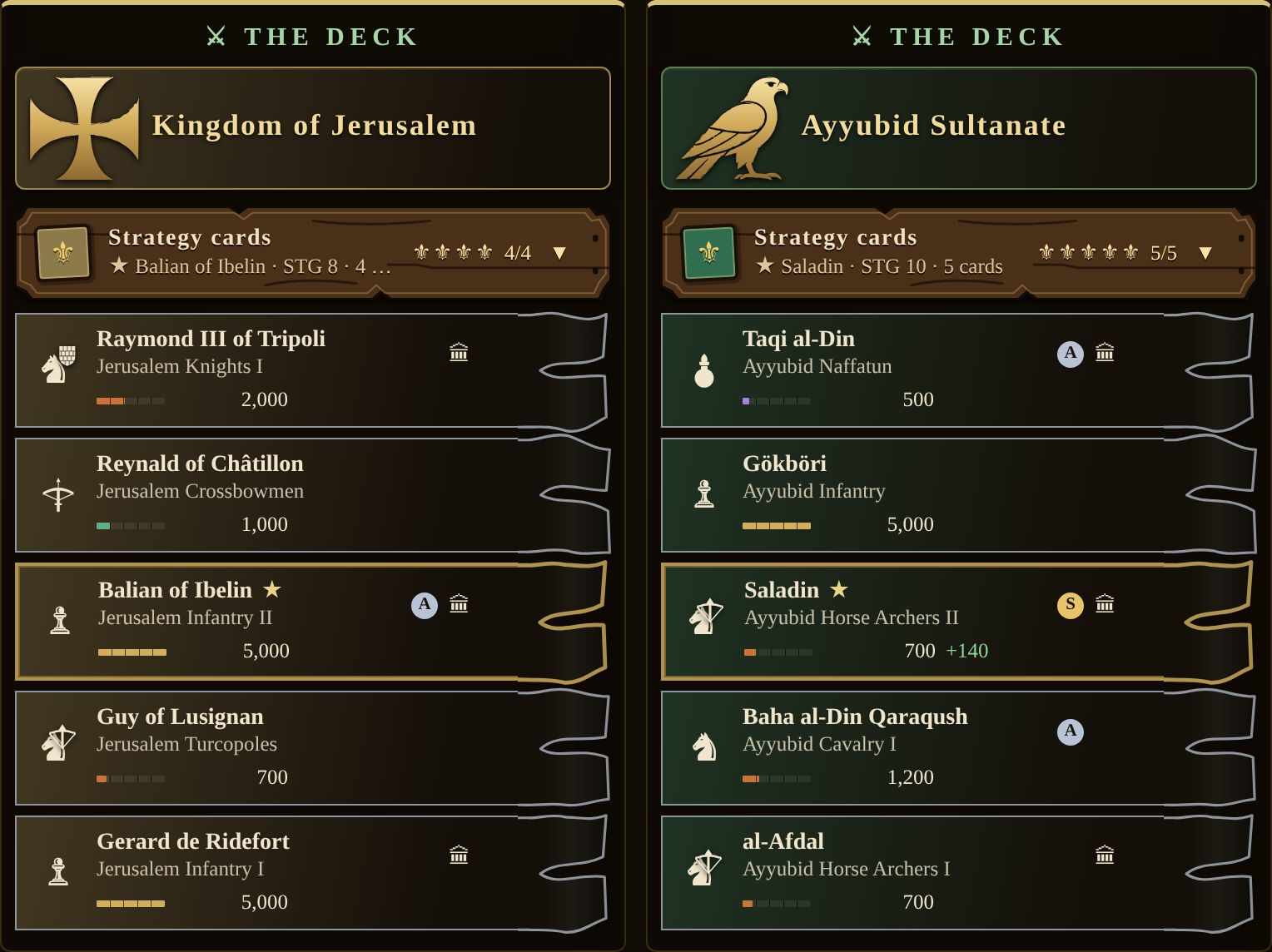
Fight it like history
- Strike before they form. In Sumeru Chess the first blow of a fast army can decide a fight. Hit the enemy's isolated armies before they join up.
- Avoid the marsh. An army that enters it is mired for 2 turns and defends at -3 DEF.
- The river stops movement. Cross at the fords; a defender standing in the river fights at -1 DEF (horse) or -2 DEF (foot).
Chapter V is for Sumeru Premium members — one membership opens every chapter of Sumeru Chess and Imperion 1776. Anyone can read its rulebook and browse its cards.
Play Chapter VOpen the Card CollectionNotes and sources (6)
- William of Tyre, Historia 21.19–20. ↩
- William of Tyre 21.20–21. ↩
- William of Tyre 21.22; Abu Shama, Kitab al-Rawdatayn. ↩
- William of Tyre 21.22. ↩
- William of Tyre 21.23; Ibn al-Athir. ↩
- William of Tyre 21.23. ↩
Further reading
- Bernard Hamilton, The Leper King and His Heirs (Cambridge, 2000).
- Malcolm Lyons and D. E. P. Jackson, Saladin: The Politics of the Holy War (Cambridge, 1982).