
The Battle of Hattin, 1187: Saladin Destroys the Army of Jerusalem
Sumeru & Seed Editorial BoardField Report · Chapter V · 3–4 July 1187 · Galilee
The whole army of the kingdom of Jerusalem marched across a waterless plateau in the July heat to relieve Tiberias. Saladin let it come, cut it off from the lake, set the dry grass alight — and the next day took its king, its relic of the True Cross and its kingdom.
Part I · The battle
Result A crushing Ayyubid victory that cost the crusaders Jerusalem.
Why it is remembered
- Water as a weapon. Saladin fought where the Franks had none. After a night without water, men and horses could hardly fight.
- Smoke and fire. The Muslims set the dry scrub burning upwind; the smoke drove into the Frankish ranks.
- The kingdom in one battle. The kingdom had stripped its castles to field this army. When it was lost, almost every town fell within months.
In 1187 Saladin, now master of Egypt and Syria, crossed the Jordan with the largest army he had ever led and besieged Tiberias, where Raymond of Tripoli's wife held the castle. The Frankish army gathered at the springs of Sephoria.1
Raymond himself advised waiting; Raynald and the Templars urged King Guy to march. On 3 July the army set out across the dry plateau towards the lake.2
The battle, step by step
- The march. Mounted archers harass the column all day; the rearguard is so pressed that the army halts for the night, still miles from water.3
- The night. Saladin's men surround the camp. They light the scrub; the smoke and thirst torment the Franks until dawn.
- The breakout. On 4 July Raymond of Tripoli charges; the Muslim ranks open, let his knights through and close again. He rides away to Tyre.4
- The Horns. The infantry breaks up and flees to the double hill of Hattin; the knights pitch the king's red tent and fight around it.
- The end. The True Cross is taken and the tent falls. Guy and the lords are led to Saladin, who strikes down Raynald with his own hand; the Templars and Hospitallers are executed.5
What followed
Acre, Ascalon and town after town surrendered. On 2 October 1187 Jerusalem itself opened its gates to Saladin. The news launched the Third Crusade of Richard the Lionheart, Philip Augustus and Frederick Barbarossa.6
Part II · Play it in Sumeru Chess
Hattin on the chessboard
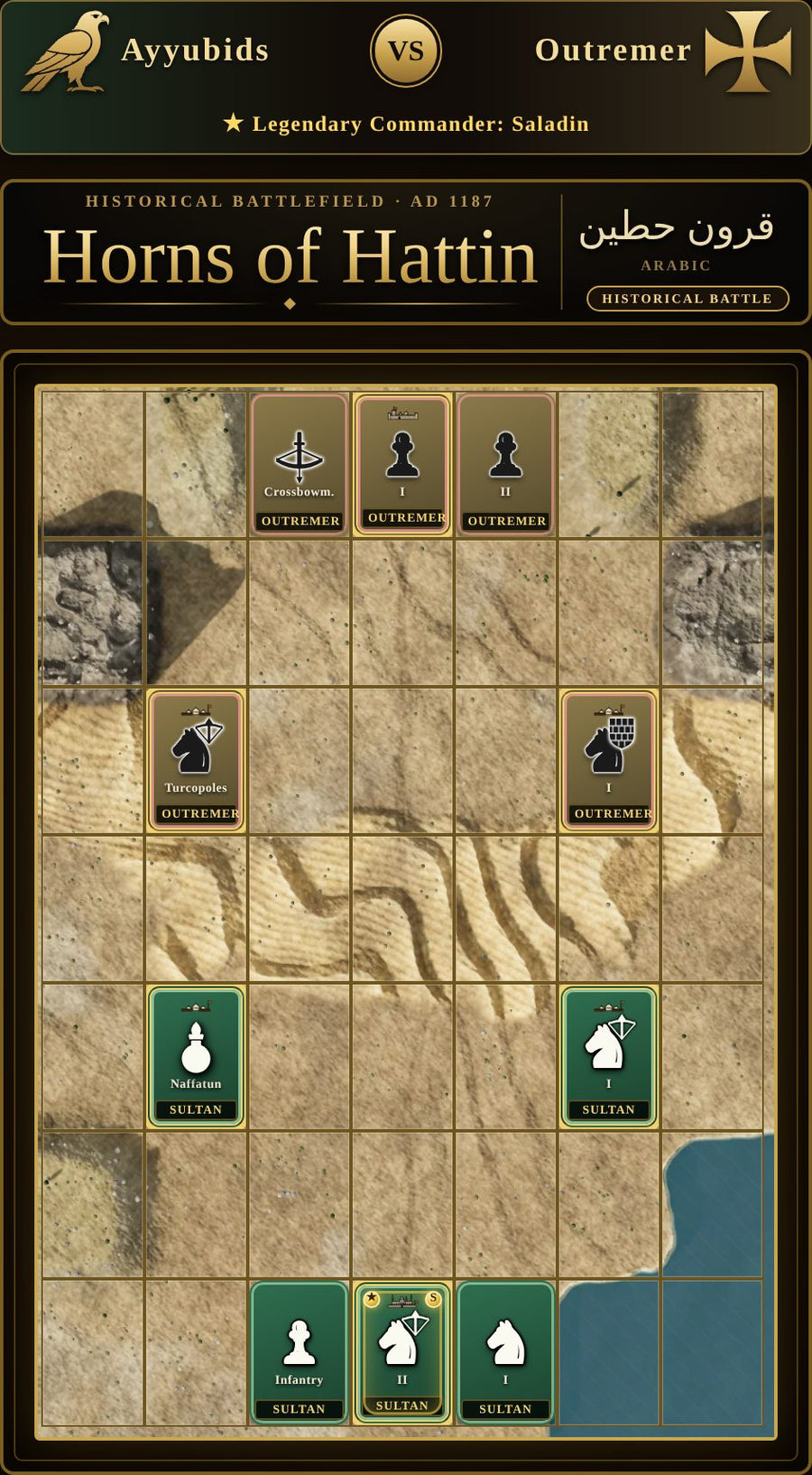
Hattin is one of the historical battlefields of Chapter V of Sumeru Chess, the Age of Faith & Fire. It is a 7 × 7 board drawn from the real ground: the Outremer side deploys from The Horns of Hattin, the Ayyubids side from Kafr Sabt.
- Hills give a defender +1 DEF, and cavalry cannot climb them.
- In the desert every army loses 2 MOR and 1 SPD.
- Rocks are impassable.
- No army can enter the sea.
Where to find it
- Conquest Campaign. Lead Ayyubids against Outremer, or Outremer against Ayyubids: Hattin is the second of the two historical battles of that war (the other is Montgisard), and the war ends at the enemy capital.
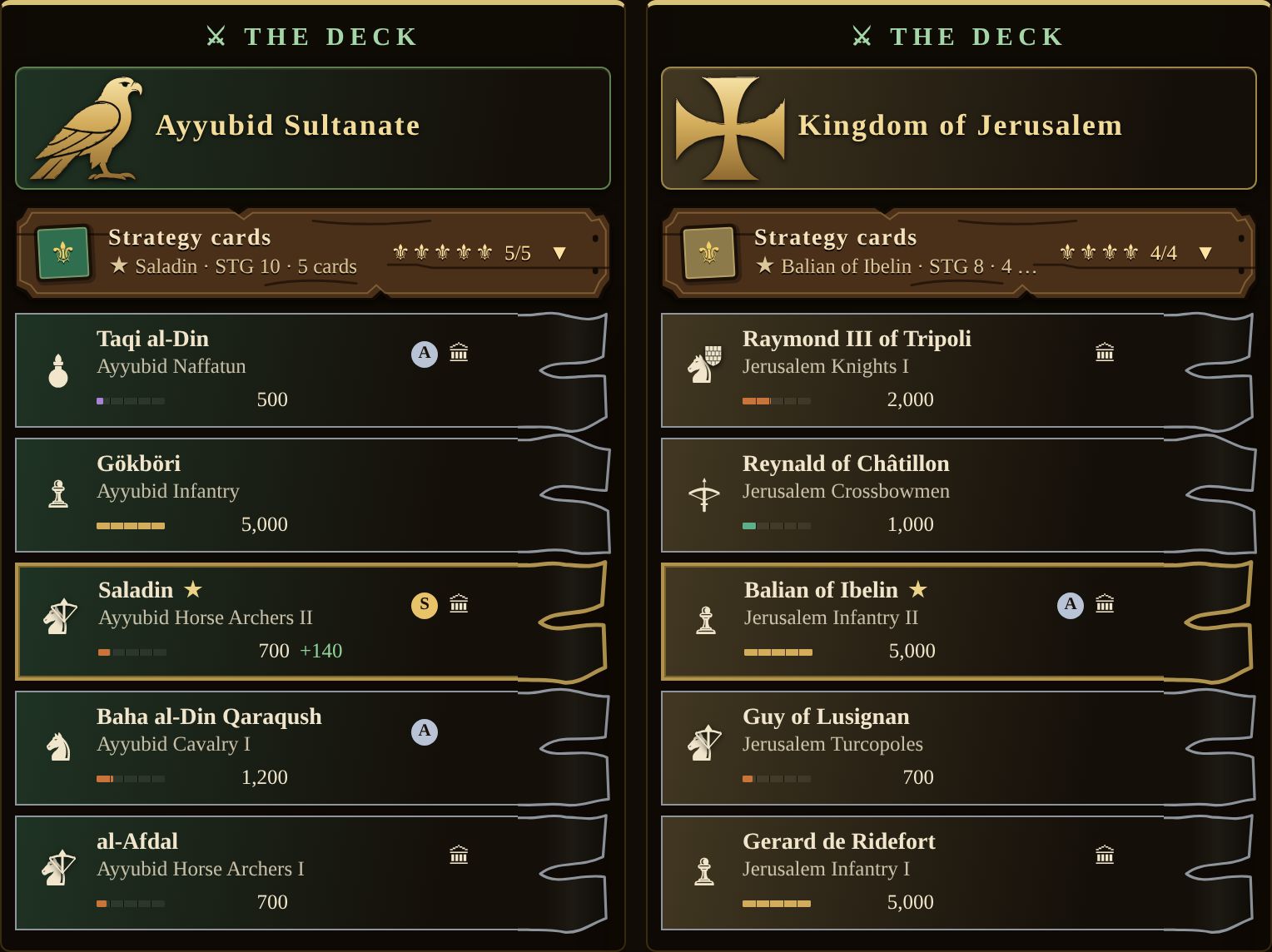
Fight it like history
- The desert drains you. Every army standing in the desert loses 2 MOR and 1 SPD — do not let the enemy fix you there.
- The sea and the rocks close the board. No army can enter the sea; rocks are impassable. Know your way out before you advance.
- Hills favour the defender — +1 DEF, and cavalry cannot climb them. The Horns were the Franks' last refuge.
Chapter V is for Sumeru Premium members — one membership opens every chapter of Sumeru Chess and Imperion 1776. Anyone can read its rulebook and browse its cards.
Play Chapter VOpen the Card CollectionNotes and sources (6)
- Ibn al-Athir, al-Kamil, s.a. 583; Itinerarium Peregrinorum 1.5. ↩
- Old French Continuation of William of Tyre (the Eracles), ch. 33–35. ↩
- Ibn Shaddad, The Rare and Excellent History of Saladin; Imad al-Din al-Isfahani. ↩
- Eracles 35; Ibn al-Athir. ↩
- Ibn Shaddad; Imad al-Din; Ibn al-Athir. ↩
- Ibn Shaddad; Itinerarium Peregrinorum 1.9–10. ↩
Further reading
- John France, Hattin (Oxford, 2015).
- Benjamin Z. Kedar (ed.), The Horns of Hattin (Jerusalem, 1992).
- Jonathan Phillips, The Life and Legend of the Sultan Saladin (Yale, 2019).