
From Manzikert to Jerusalem: The Seljuks, Byzantium and the Origins of the Crusades
Sumeru & Seed Editorial BoardThe First Crusade is usually told as a story that begins with a pope's sermon in France. It makes more sense if it begins twenty-four years earlier, on a battlefield in eastern Anatolia, where a Byzantine emperor became the prisoner of a Turkish sultan.
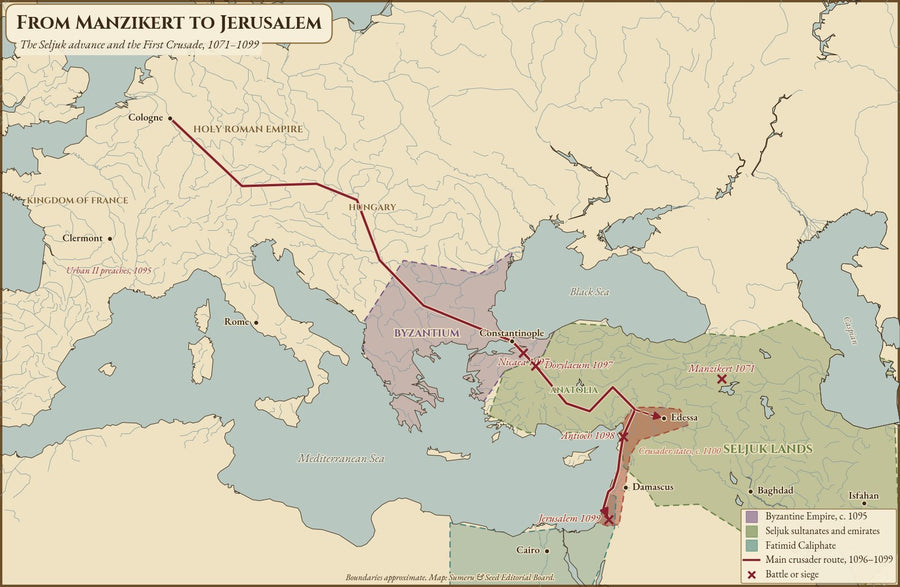
On 26 August 1071, near the town of Manzikert north of Lake Van, the Byzantine emperor Romanos IV Diogenes fought the Seljuk sultan Alp Arslan. The battle was lost when part of the Byzantine army withdrew — through treachery, according to the contemporary historian Michael Attaleiates, who was present.1 Romanos was captured, the first Roman emperor to fall into enemy hands since Valerian was taken by the Persians in 260. Alp Arslan treated him with courtesy and released him on terms, but in Constantinople a palace coup had already deposed him, and he was blinded by his rivals and died. In the civil wars that followed, Turkish bands spread across Anatolia almost unopposed. Within ten years Turkish emirs held Nicaea, barely 100 kilometres from the capital.
The Seljuk world
The Seljuks were a family of Oghuz Turks from the steppe north of the Aral Sea. In the early eleventh century they entered the eastern Islamic world as nomad warriors. In 1040, at Dandanaqan near Merv, they defeated the Ghaznavid sultan; in 1055 the Seljuk leader Tughril Beg entered Baghdad and was recognised by the Abbasid caliph as sultan, protector of Sunni Islam.2 Under Alp Arslan (r. 1063–1072) and Malik-Shah (r. 1072–1092), served by the great Persian vizier Nizam al-Mulk, the Seljuk sultanate ruled from Central Asia to Syria.
The Seljuk state combined Turkish military power with Persian administration and a strong commitment to Sunni Islam. Nizam al-Mulk founded the madrasas that bear his name, colleges of law and theology meant to train officials and counter the influence of the Shi'ite Fatimid caliphate of Cairo, which claimed leadership of the Muslim world. Palestine and Jerusalem changed hands between Seljuk emirs and the Fatimids several times in these decades.
The sultanate's strength depended on its rulers. In 1092 both Nizam al-Mulk — murdered, it was said, by an agent of the Ismaili Assassins — and Malik-Shah died. The empire fragmented among rival princes and emirs. When the crusaders arrived five years later, they faced not a united enemy but a mosaic of Turkish and Arab rulers who distrusted one another.3
The call from the East
Byzantium recovered under Alexios I Komnenos (r. 1081–1118), a soldier-emperor who fought off Normans from southern Italy and Pecheneg nomads from the north. But he lacked manpower. In March 1095 his envoys appeared at a church council at Piacenza and asked Pope Urban II for help against the Turks. Peter Frankopan has argued that this appeal, and Alexios' wider diplomacy, were central to launching the crusade, a point Western sources tend to underplay.4
In November 1095, at Clermont in central France, Urban II preached the sermon that began the crusade. No exact text survives; the accounts written afterwards differ, but all agree that he called on the knights of the West to go to the aid of the Eastern Christians and to liberate Jerusalem, promising remission of sins to those who went. The response exceeded anything he could have expected.5
The march
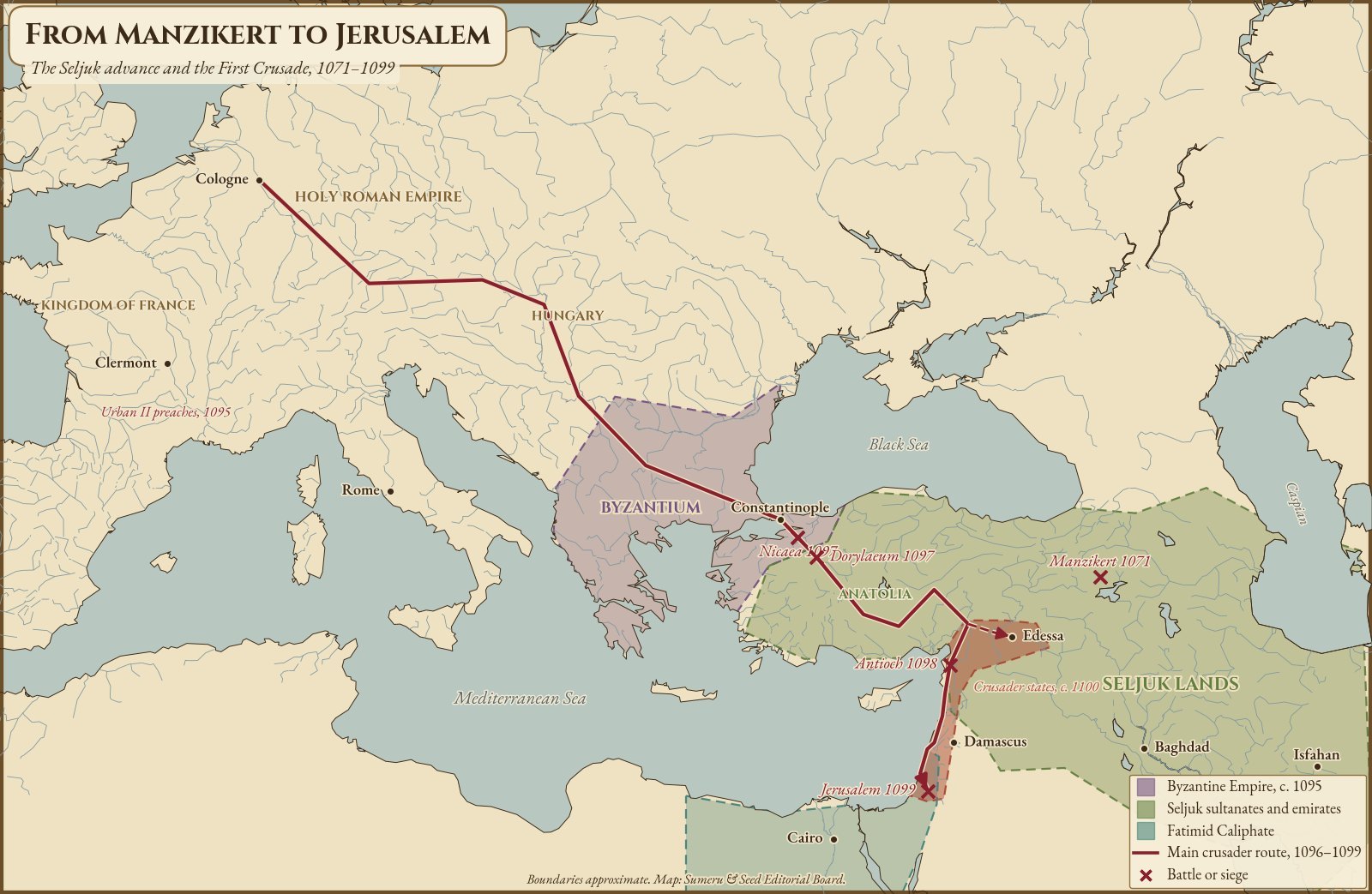
In 1096–1097 several armies, led by great nobles such as Godfrey of Bouillon, Raymond of Toulouse, Bohemond of Taranto and Robert of Normandy, made their way to Constantinople. A disorganised "People's Crusade" that went ahead of them was destroyed by the Turks in Anatolia. Alexios required the leaders to swear oaths to return former Byzantine lands to him, and ferried them across the Bosporus.
In June 1097 the crusaders and Byzantines took Nicaea from the Seljuk sultan of Rum, Kilij Arslan; a few weeks later they defeated him at Dorylaeum. The march across Anatolia in summer heat was terrible, but in October 1097 the army reached Antioch, one of the great cities of the East. The siege lasted until June 1098, when a traitor let Bohemond's men into the city — and only days later a huge relief army under Kerbogha, the atabeg of Mosul, besieged the crusaders in turn. On 28 June the starving crusaders marched out and, to almost everyone's surprise, routed Kerbogha's army, whose commanders were divided among themselves.6
After months of delay the army moved south. By the time it reached Jerusalem in June 1099 — a city the Fatimids had taken from the Seljuks only the year before — it numbered perhaps 1,300 knights and 12,000 foot soldiers.7 On 15 July 1099 they stormed the walls. The massacre that followed horrified Muslim writers and was celebrated by some Christian chroniclers. A month later the crusaders defeated a Fatimid relief army at Ascalon.
From the cards of Sumeru Chess, Chapter V.
Why did it succeed?
The success of the First Crusade surprised contemporaries on both sides. Muslim historians writing later, such as Ibn al-Athir, explained it by the divisions among Muslim rulers.8 Modern historians agree that disunity was crucial: the Seljuk princes of Aleppo and Damascus were rivals, the Fatimids were their enemies, and no one united against the newcomers until it was too late. The crusaders' own determination, fed by religious conviction and the fact that they had nowhere to retreat, also mattered, as did Byzantine help at the start and Genoese and Pisan ships at the end.
A clash of faiths?
The crusade gave rise to four Latin states — the County of Edessa, the Principality of Antioch, the Kingdom of Jerusalem and, from 1109, the County of Tripoli — which survived in some form for almost two centuries. For Western Christians the capture of Jerusalem seemed a miracle. For Muslims, as Carole Hillenbrand has shown, the initial reaction was muted; the idea of jihad against the Franks became a powerful political force only decades later, under Zangi, Nur al-Din and finally Saladin.9 For Byzantium, the crusade was both a rescue and a threat: the crusaders kept Antioch for themselves, and a later crusade, in 1204, would sack Constantinople itself.
The story that began at Manzikert, then, was not a simple war of two religions. It was a tangle of Byzantine diplomacy, Turkish migration, Sunni–Shi'ite rivalry and Western religious enthusiasm. The other essays in this chapter follow the story to its next great turning point, at Hattin in 1187, and look east to the very different clash of empires in China.
Notes
- Michael Attaleiates, The History, trans. Anthony Kaldellis and Dimitris Krallis (Cambridge, MA: Harvard University Press, Dumbarton Oaks Medieval Library, 2012). See also Carole Hillenbrand, Turkish Myth and Muslim Symbol: The Battle of Manzikert (Edinburgh: Edinburgh University Press, 2007). ↩
- A. C. S. Peacock, The Great Seljuk Empire (Edinburgh: Edinburgh University Press, 2015). ↩
- Peacock, Great Seljuk Empire; Hillenbrand, The Crusades: Islamic Perspectives (Edinburgh: Edinburgh University Press, 1999). ↩
- Peter Frankopan, The First Crusade: The Call from the East (London: Bodley Head, 2012). ↩
- The main versions of Urban's speech, by Fulcher of Chartres, Robert the Monk, Baldric of Bourgueil and Guibert of Nogent, are translated in Edward Peters, ed., The First Crusade: The Chronicle of Fulcher of Chartres and Other Source Materials, 2nd ed. (Philadelphia: University of Pennsylvania Press, 1998). ↩
- Gesta Francorum et aliorum Hierosolimitanorum, ed. and trans. Rosalind Hill (London: Thomas Nelson, 1962); Thomas Asbridge, The First Crusade: A New History (Oxford: Oxford University Press, 2004). ↩
- Jonathan Riley-Smith, The First Crusade and the Idea of Crusading (London: Athlone Press, 1986); Raymond of Aguilers gives similar figures. ↩
- Ibn al-Athir, The Chronicle of Ibn al-Athir for the Crusading Period from al-Kamil fi'l-Ta'rikh, Part 1, trans. D. S. Richards (Aldershot: Ashgate, 2006). ↩
- Hillenbrand, The Crusades: Islamic Perspectives. ↩
Further Reading
- Peter Frankopan, The First Crusade: The Call from the East (Bodley Head, 2012).
- Thomas Asbridge, The First Crusade: A New History (Oxford University Press, 2004).
- Carole Hillenbrand, The Crusades: Islamic Perspectives (Edinburgh University Press, 1999).
- A. C. S. Peacock, The Great Seljuk Empire (Edinburgh University Press, 2015).