

The Silk Road: How Rome and Han China Were Joined
Sumeru & Seed Editorial BoardNo one in antiquity called it the Silk Road, and no merchant travelled all of it. It was a chain of roads, oases and harbours along which silk, glass, horses and religions passed from hand to hand between China and the Mediterranean.
Short answer: The Silk Road was the network of trade routes that joined China with Central Asia, India, Persia and the Mediterranean from the second century BC. It began when the Han dynasty pushed west against the Xiongnu and opened the road through the Tarim basin. Chinese silk travelled west; horses, glass, gold, spices and ideas travelled east. The name is modern: the German geographer Ferdinand von Richthofen coined Seidenstraße in 1877.
How did the Silk Road begin?
With a diplomatic mission. In 139 BC Emperor Wu of Han sent Zhang Qian west to find the Yuezhi and win them as allies against the Xiongnu, the steppe empire on China's northern frontier. Zhang Qian was held prisoner by the Xiongnu for ten years, escaped, reached Ferghana and Bactria, and came home in 126 BC without an alliance but with the first report of the lands beyond the Pamirs.1 The life of Zhang Qian tells the story.
Han armies followed. In 121 BC Huo Qubing took the Hexi corridor, the strip of oases between the mountains and the desert, and the Han built walls and garrisons as far as Dunhuang. In 60 BC a Protector-General of the Western Regions was set over the oasis states of the Tarim basin.2 The road was open.
What were the routes?
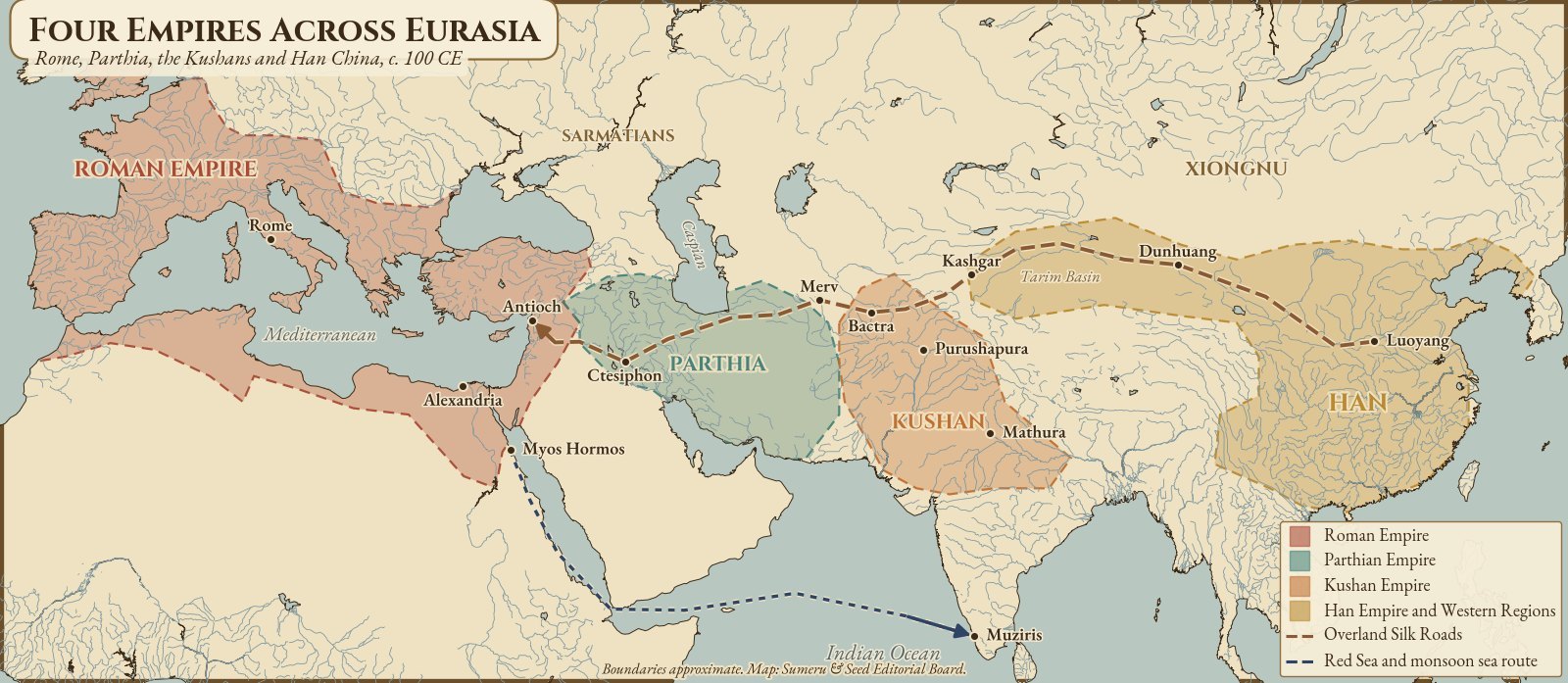
From the Han capital Chang'an the road ran through the Hexi corridor to Dunhuang and divided to pass north and south of the Taklamakan desert, meeting again at Kashgar. It then crossed the Pamirs to Ferghana, Sogdiana and Bactria, went on through Merv into Parthia, and reached the Mediterranean through Mesopotamia and the caravan city of Palmyra.
A second road ran by sea. Sailors from Roman Egypt learned to use the monsoon winds to cross from the Red Sea to India and back in a year. A Greek merchant's handbook of the first century CE, the Periplus of the Erythraean Sea, lists the harbours and what was bought and sold in each.
What was traded?
Silk above all, which for centuries only China could make. Pliny the Elder complained that India, China and Arabia together drained a hundred million sesterces a year from the Roman empire.3 In return China wanted the horses of Ferghana, and received glass, gold and silver, wool and linen, coral, amber and wine. Pepper, cotton and gems came from India. Buddhism reached China along the same roads in the first century CE, carried by monks from the Kushan empire.
Did Romans and Chinese ever meet?
Almost. In 97 CE the Han general Ban Chao sent his officer Gan Ying to reach Rome, which the Chinese called Da Qin. Gan Ying arrived at a great sea in Parthian territory, was told that the crossing could take two years, and turned back. In 166 CE men claiming to be envoys of “Andun”, the emperor Marcus Aurelius Antoninus, arrived at the Han court by sea.4 The Parthians and Kushans who held the middle of the road had every reason to keep the two ends apart: see A Roman Trade Mission to Han China and Four Empires across Eurasia.
How long did the Silk Road last?
It rose and fell with the empires that kept it safe. It flourished under the Han and again under the Tang, when Sogdian merchants ran the caravans, and was contested at Talas in 751. Its last great age came under the Mongols, when one power held the road from China to the Black Sea and Marco Polo travelled it: see Pax Mongolica. From the sixteenth century the sea route around Africa carried most of the trade between Europe and Asia.
 Han
 Kushan
 Parthia
 Rome
Card backs of Chapter III. Each opens the civilization's page.
Questions people ask
What was the Silk Road?
A network of trade routes by land and sea that joined China with Central Asia, India, Persia and the Mediterranean from the second century BC.
Who started the Silk Road?
The Han dynasty of China. The journey of the envoy Zhang Qian (139–126 BC) and the Han conquest of the Hexi corridor opened the road to the west.
Why is it called the Silk Road?
Because silk was its most famous cargo. The name was coined in 1877 by the German geographer Ferdinand von Richthofen.
How long was the Silk Road?
About 6,400 km (4,000 miles) overland from Chang'an to the Mediterranean.
What was traded on the Silk Road?
Silk from China; horses from Central Asia; glass, gold, silver and wine from the Roman world; pepper, cotton and gems from India; and with them religions, above all Buddhism.
Notes
- Sima Qian, Shiji 123; Ban Gu, Hanshu 61.
- Hanshu 96.
- Pliny, Natural History 12.84.
- Fan Ye, Hou Hanshu 88.
Further reading
- Sima Qian, Records of the Grand Historian: Han Dynasty II, trans. Burton Watson (Columbia, 1993), chapter 123.
- John E. Hill, Through the Jade Gate to Rome: A Study of the Silk Routes during the Later Han Dynasty (2009).
- Valerie Hansen, The Silk Road: A New History (Oxford, 2012).
- Lionel Casson, The Periplus Maris Erythraei (Princeton, 1989).
- 冯承钧原编,陆峻岭增订,《西域地名》(中华书局,1980)。