
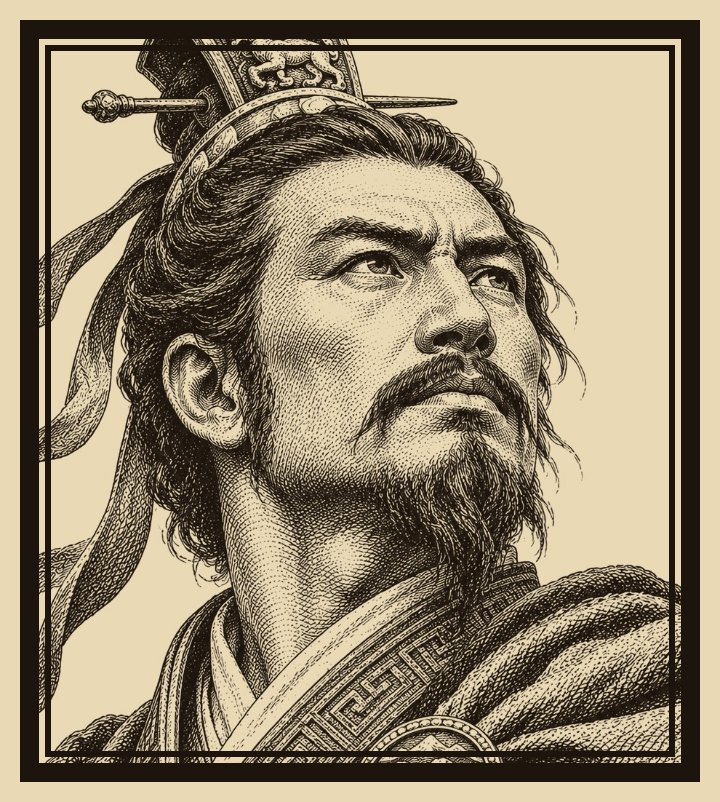
Zhang Qian: The Han Envoy Who Opened the Western Regions
Sumeru & Seed Editorial BoardSent west to find allies against the Xiongnu, Zhang Qian spent ten years as a captive, failed in his mission and came home with only one companion. What he brought back — knowledge — changed Chinese history.

The Grand Historian Sima Qian, writing within a generation of his death, used a striking word for Zhang Qian's achievement: záokōng, "to bore through the void" — to open a passage where there had been none.1 Zhang Qian is often called the man who opened the Silk Road. That is not quite right: goods had moved across Central Asia long before him, and the name "Silk Road" was invented in 1877 by the German geographer Ferdinand von Richthofen. But Zhang Qian was the first Chinese official to travel to Central Asia and return with a detailed report, and his journeys changed how the Han empire saw the world.
The Xiongnu problem
In the second century BCE the Han dynasty faced a formidable enemy on its northern frontier: the Xiongnu, a confederation of steppe peoples united under a ruler called the chanyu. Since the Han founder was surrounded and nearly captured by them in 200 BCE, the dynasty had bought peace through a policy called heqin, "peace and kinship," sending princesses and large annual gifts of silk, grain and wine to the chanyu. The raids continued anyway.2
The young Emperor Wu (r. 141–87 BCE) wanted to go on the offensive. He learned from Xiongnu prisoners that a people called the Yuezhi, once the Xiongnu's neighbours, had been driven far to the west; the Xiongnu ruler had made a drinking cup from the skull of their king. Surely, the emperor reasoned, the Yuezhi would want revenge. He asked for volunteers to find them. A palace attendant from Hanzhong named Zhang Qian stepped forward.
Ten years among the Xiongnu
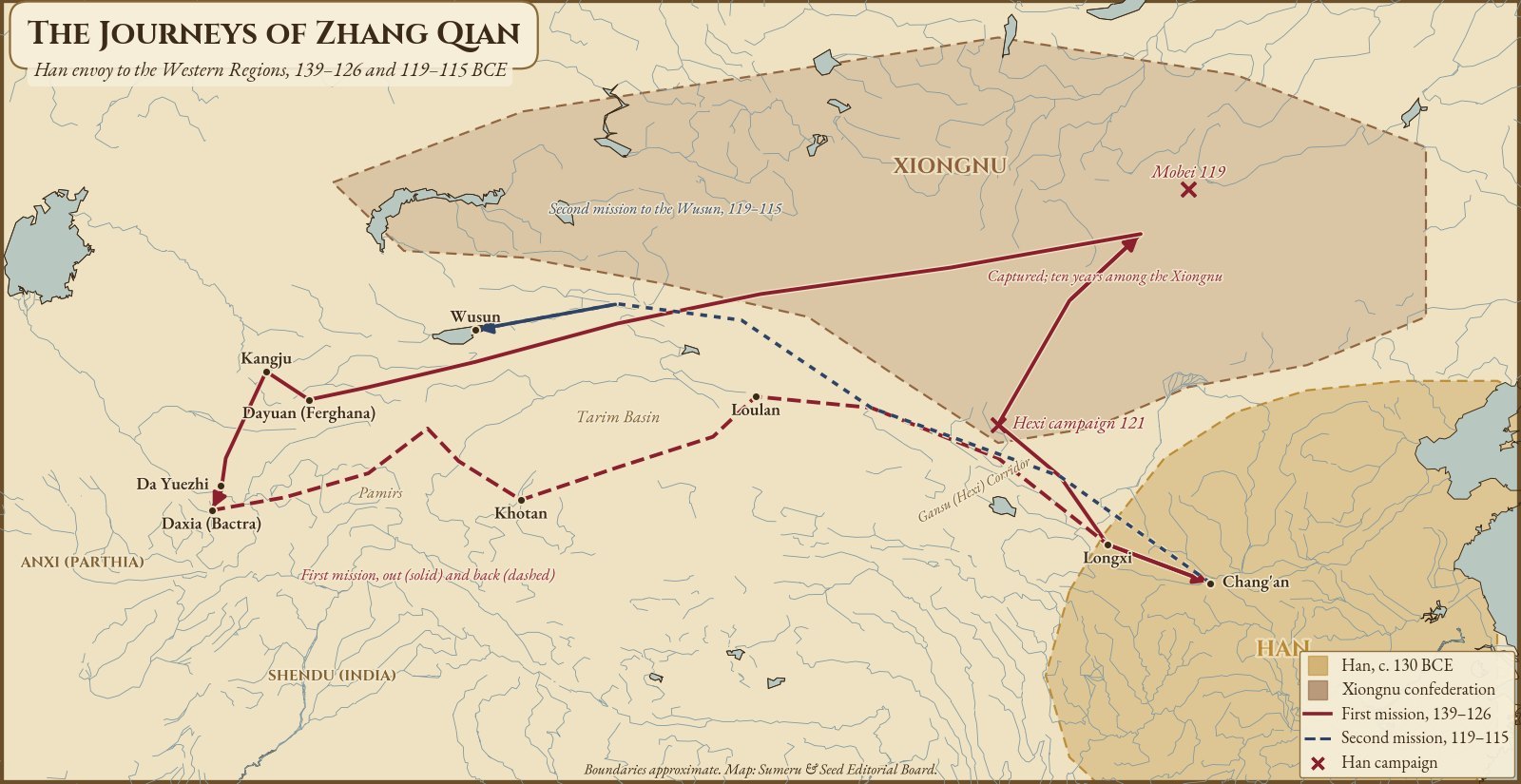
Zhang Qian set out around 139 BCE with about a hundred men, including a Xiongnu guide called Ganfu, an expert archer. To reach the Yuezhi they had to cross Xiongnu territory, and they were captured almost at once. The chanyu was blunt: if he sent envoys to the Yue kingdom in the south of China, would the Han let them pass?3 Zhang Qian was detained for about ten years. He was given a Xiongnu wife and had a son. But Sima Qian notes that he never let go of the emblem of his office, the envoy's staff.
Eventually he escaped with some of his companions and went west, crossing the Tarim Basin and the Pamirs to Dayuan (Ferghana). Its king, who had heard of the wealth of Han, gave him guides to Kangju (in the Tashkent region) and from there to the Yuezhi, who by now had settled north of the Oxus and dominated Daxia (Bactria).
A mission that failed
The Yuezhi were not interested. They had found a rich, peaceful land and had no wish to go back east to fight the Xiongnu. After more than a year Zhang Qian gave up and returned along the southern edge of the Tarim Basin, hoping to avoid the Xiongnu by passing through the lands of the Qiang. He was captured again. After another year, in the confusion following the death of the chanyu in 126 BCE, he escaped with his wife and Ganfu and finally reached Chang'an. Of the hundred men who had set out thirteen years earlier, only Ganfu came back with him.4
Diplomatically, the mission was a failure. In every other way it was a triumph. Zhang Qian's report to the emperor, which Sima Qian preserved in the Account of Dayuan, is the first Chinese description of Central Asia. He described the cities of Dayuan and their "blood-sweating" horses, the settled Bactrians who were good traders but poor fighters, Anxi (Parthia) with its silver coins bearing the king's face and its writing on leather in horizontal lines, and Tiaozhi (Mesopotamia or Syria) far to the west.5
Bamboo from Sichuan in the markets of Bactria
One detail in his report had large consequences. In the markets of Daxia, Zhang Qian saw bamboo staffs from Qiong and cloth from Shu — both products of Sichuan, in south-western China. When he asked how they had got there, he was told that merchants brought them from Shendu (India), several thousand li to the south-east. Zhang Qian concluded that there must be a route from Sichuan through the south-west to India, and that Han could reach Bactria that way without crossing Xiongnu land.6 The emperor sent several expeditions to find it; they were blocked by the peoples of Yunnan, but the attempt drew Han power into the south-west.
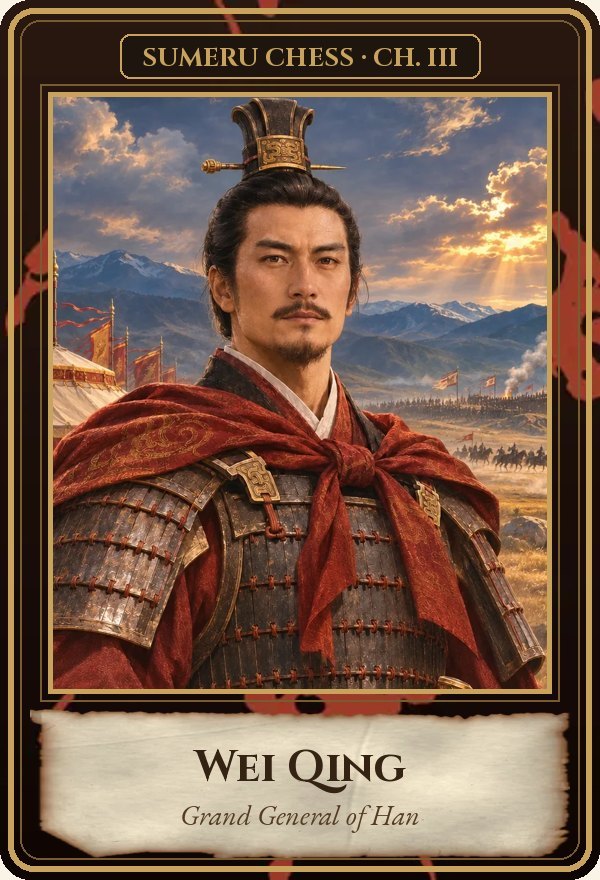
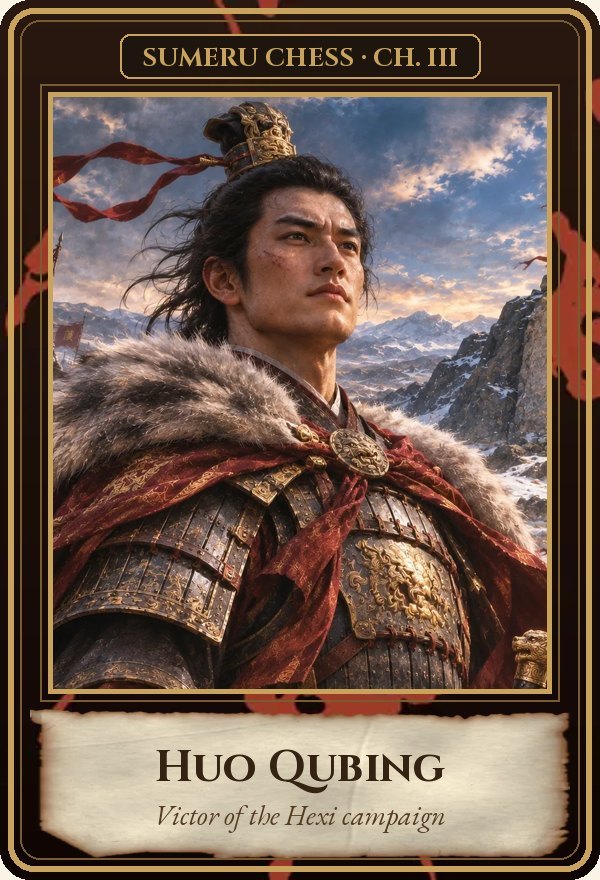
From the cards of Sumeru Chess, Chapter III.
The second mission
In 123 BCE Zhang Qian served as a guide on a campaign against the Xiongnu led by the Grand General Wei Qing, and his knowledge of where water and grass could be found was rewarded with the title Marquis of Bowang. Two years later he lost it when he arrived late for a rendezvous with the general Li Guang and was sentenced to death, a sentence commuted for a fine.
The decisive changes came on the battlefield. In 121 BCE the young general Huo Qubing drove the Xiongnu out of the Gansu (Hexi) corridor; in 119 Wei Qing and Huo Qubing crossed the Gobi and defeated the Xiongnu deep in Mongolia.7 The road west was open. In 119 BCE the emperor sent Zhang Qian again, this time to the Wusun, a nomadic people in the Ili valley, with three hundred men, two horses each, tens of thousands of cattle and sheep and gold and silk worth millions. The Wusun would not move east either, but Zhang Qian sent deputies to Dayuan, Kangju, the Yuezhi, Daxia, Anxi, India and other states. He returned with Wusun envoys in 115 and died about a year later.
Legacy
Within a few years of his death, embassies were travelling regularly between Chang'an and the states of the west, and Han armies were establishing garrisons along the Gansu corridor. Emperor Wu's desire for the "heavenly horses" of Ferghana led to the costly war against Dayuan in 104–101 BCE. Grapes and alfalfa were brought to China. Later Han envoys still used Zhang Qian's name to win the trust of foreign rulers.8
Zhang Qian did not open the Silk Road by himself, and the road he travelled was not paved with silk. But he gave the Han empire something it had never had: reliable knowledge of the world beyond the Pamirs. In that sense Sima Qian's word was exactly right. He bored a hole through the void, and the light came in.
Notes
- Sima Qian, Shiji 123 (Dayuan liezhuan, "Account of Dayuan"); trans. Burton Watson, Records of the Grand Historian: Han Dynasty II, rev. ed. (New York: Columbia University Press, 1993). ↩
- Nicola Di Cosmo, Ancient China and Its Enemies: The Rise of Nomadic Power in East Asian History (Cambridge: Cambridge University Press, 2002). ↩
- Shiji 123. ↩
- Shiji 123; Ban Gu, Hanshu 61. ↩
- Shiji 123. ↩
- Shiji 123 and 116 (Account of the South-western Barbarians). ↩
- Shiji 111 (biographies of Wei Qing and Huo Qubing). ↩
- Shiji 123. See Tamara T. Chin, Savage Exchange: Han Imperialism, Chinese Literary Style, and the Economic Imagination (Cambridge, MA: Harvard University Press, 2014), and Valerie Hansen, The Silk Road: A New History (Oxford: Oxford University Press, 2012). ↩
Further Reading
- Burton Watson, trans., Records of the Grand Historian: Han Dynasty II (Columbia University Press, rev. ed. 1993).
- Valerie Hansen, The Silk Road: A New History (Oxford University Press, 2012).
- Nicola Di Cosmo, Ancient China and Its Enemies (Cambridge University Press, 2002).
- Craig Benjamin, Empires of Ancient Eurasia: The First Silk Roads Era, 100 BCE–250 CE (Cambridge University Press, 2018).