

The Mongol Conquests (1206–1279): How the Largest Land Empire Was Made
Sumeru & Seed Editorial BoardIn 1206 a steppe chief named Temüjin took the title Genghis Khan. Within three generations his family ruled from Korea to Hungary, the largest connected land empire in history.
Short answer: The Mongol conquests were the campaigns by which Genghis Khan and his successors, between 1206 and 1279, built an empire from the Pacific to the Danube. They destroyed Xi Xia, the Jin, the Khwarazmian empire, the principalities of Rus, the Abbasid caliphate and the Song dynasty. They were stopped only at the edges: by the Mamluks at Ain Jalut in 1260 and by sea and storm off Japan.
How did the conquests begin?
In 1206 an assembly of the steppe peoples on the river Onon proclaimed Temüjin as Genghis Khan. He had spent twenty years uniting the tribes of Mongolia; he now organised them in units of ten, a hundred, a thousand and ten thousand that cut across the old clans, under commanders chosen for merit.1 The life of Genghis Khan tells how he came to that day.
He turned first against the settled states to the south: the Tangut kingdom of Xi Xia, which submitted in 1209, and from 1211 the Jin empire of north China, whose capital Zhongdu fell in 1215.
Why did the Mongols go west?
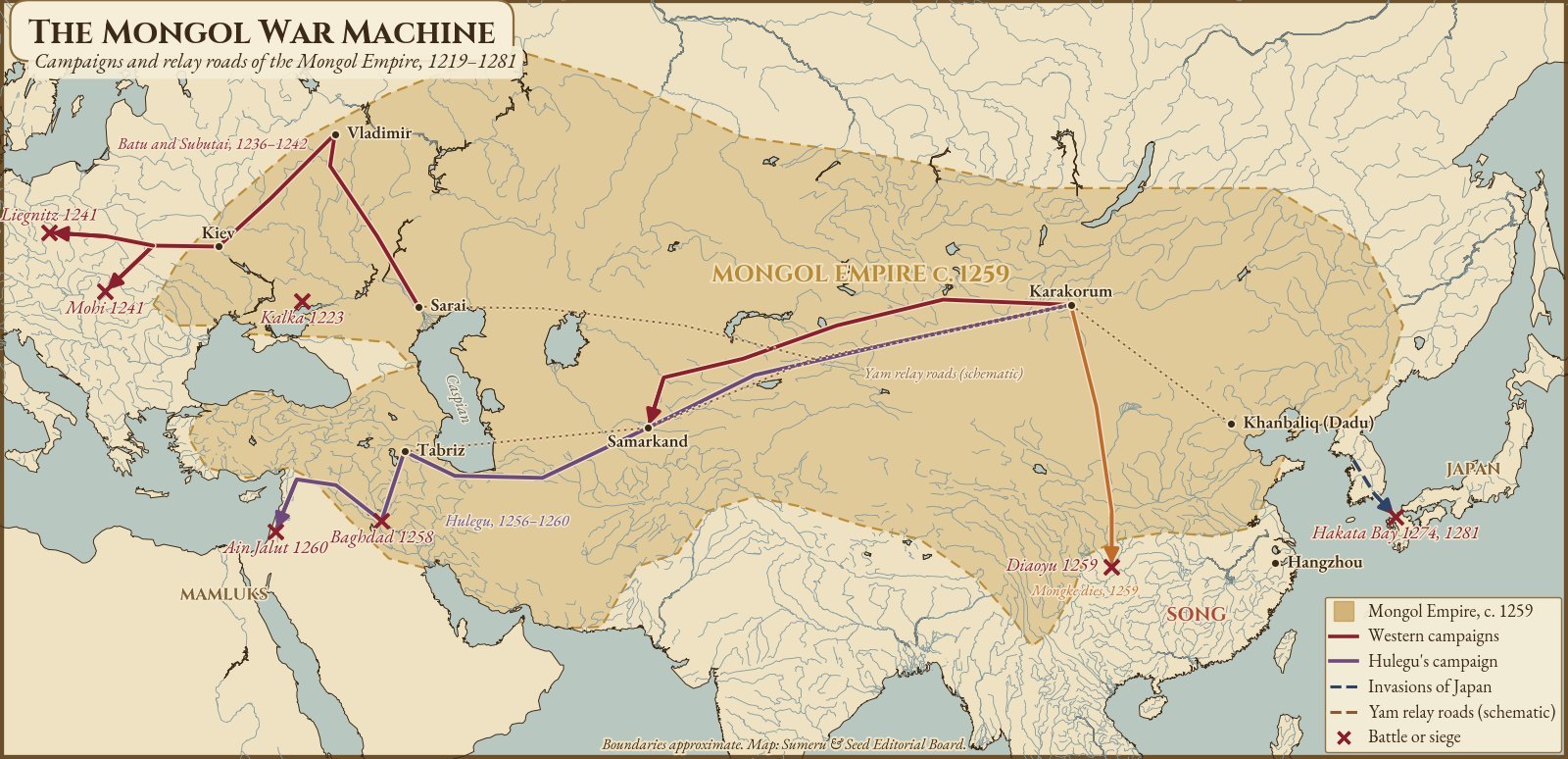
Because of a massacre. In 1218 the governor of Otrar, a frontier city of the Khwarazmian empire, seized a Mongol trading caravan and killed its merchants; the shah then killed an envoy sent to protest. Genghis Khan invaded in 1219. Bukhara and Samarkand fell in 1220, and within two years the richest state of the Islamic East had ceased to exist.2 See The Fall of Khwarazm. His generals Jebe and Subutai rode on around the Caspian and beat the princes of Rus on the Kalka in 1223. Genghis Khan died in August 1227, during the final destruction of Xi Xia.
How far did his successors go?
- Ögedei (1229–1241) ended the Jin in 1234 and sent Batu and Subutai west. They took Ryazan and Vladimir in the winter of 1237–1238 and Kiev in 1240, and in April 1241 won two battles within three days, at Legnica in Poland and at Mohi in Hungary. News of Ögedei's death reached them the next year, and the armies withdrew to the steppe.
- Möngke (1251–1259) sent his brother Hülegü into the Middle East. Baghdad fell in February 1258 and the last Abbasid caliph was put to death.
- Kublai (1260–1294) conquered the Song. The five-year siege of Xiangyang opened the Yangtze; the Song capital surrendered in 1276 and the last Song fleet was destroyed at Yamen in 1279.
Why were the Mongols so successful?
Every man was a mounted archer who had ridden and hunted since childhood, and each took several horses on campaign. Armies moved in separate columns over great distances and met on the day of battle. Discipline was severe, commanders were promoted for ability, and engineers taken in China and Persia gave the Mongols the siege machines that steppe armies had always lacked. A relay system of post stations, the yam, carried orders across the empire. Terror was policy: cities that resisted were destroyed, so that others would open their gates. See The Mongol War Machine.
Where were the Mongols stopped?
At Ain Jalut in Palestine, on 3 September 1260, where the Mamluks of Egypt defeated the force Hülegü had left in Syria; and in Japan, where the invasion fleets of 1274 and 1281 were broken by resistance on the beaches and by storms. By then the empire was dividing into four: the Yuan in China, the Chagatai Khanate in Central Asia, the Ilkhanate in Persia and the Golden Horde on the western steppe. The peace that followed, and the trade it carried, is the subject of Pax Mongolica. The whole history is in the Mongol Empire page of the Civilization Index.
 Mongols
 Khwarazm
 Xi Xia
 Mamluks
 Japan
Card backs of Chapter VI. Each opens the civilization's page.
Questions people ask
How big was the Mongol Empire?
At its greatest extent, about 1279, it covered roughly 24 million square kilometres, from Korea to Hungary: the largest connected land empire in history.
Who started the Mongol conquests?
Temüjin, proclaimed Genghis Khan in 1206, who united the peoples of the Mongolian steppe.
Who stopped the Mongols?
The Mamluks of Egypt, at Ain Jalut in 1260. The invasions of Japan in 1274 and 1281 also failed.
Why did the Mongols leave Europe?
The armies of Batu and Subutai withdrew in 1242 after the death of the great khan Ögedei. Historians still debate how far that news, the pastures of Hungary or the stone castles of Europe decided it.
When did the Mongols conquer China?
The Jin of the north fell in 1234 and the Song of the south in 1279. Kublai Khan had proclaimed the Yuan dynasty in 1271.
Notes
- The Secret History of the Mongols §§202–234.
- Juvaini, History of the World Conqueror, part 1.
Further reading
- The Secret History of the Mongols, trans. Igor de Rachewiltz (Brill, 2004).
- 'Ala-ad-Din 'Ata-Malik Juvaini, The History of the World-Conqueror, trans. J. A. Boyle (Manchester, 1958); 志费尼著,何高济译,《世界征服者史》(内蒙古人民出版社,1980)。
- 多桑著,冯承钧译,《多桑蒙古史》(中华书局,1962)。
- 冯承钧原编,陆峻岭增订,《西域地名》(中华书局,1980)。
- David Morgan, The Mongols, 2nd ed. (Blackwell, 2007).
- Timothy May, The Mongol Conquests in World History (Reaktion, 2012).