
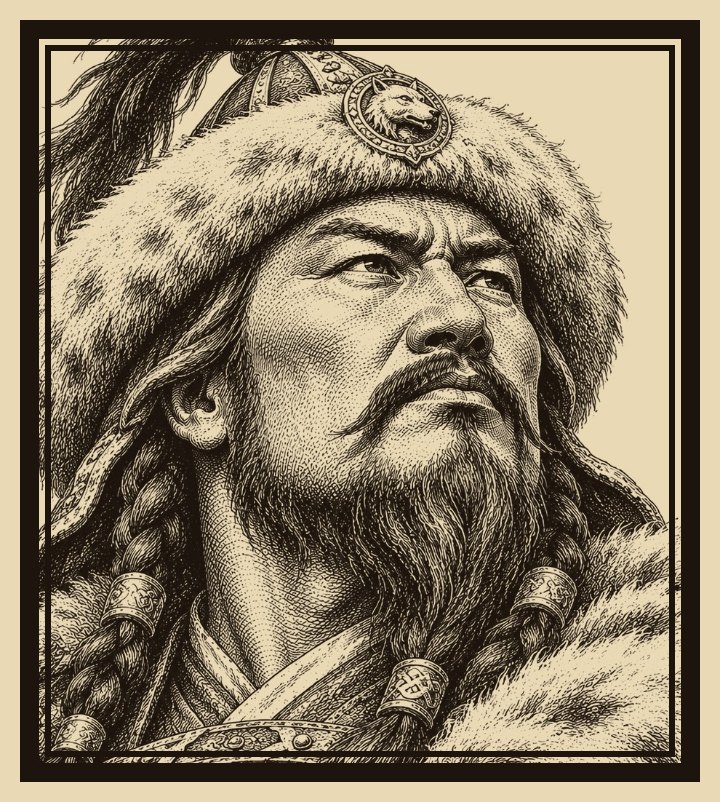
Genghis Khan: From Outcast to Ruler of the Steppe
Sumeru & Seed Editorial BoardAbandoned by his clan as a boy, Temüjin survived hunger, captivity and betrayal to unite the peoples of the steppe in 1206. The empire he left behind would reach from Korea to Hungary. Who was the man behind the legend?

In the West he is Genghis Khan, a name that has stood for conquest and terror for eight hundred years. In Mongolia he is Chinggis Khaan, father of the nation, whose face appears on banknotes and vodka bottles and whose giant equestrian statue stands on the steppe east of Ulaanbaatar. Both images contain truth. But the man himself, Temüjin, is best approached through the one source written by his own people: the Secret History of the Mongols, composed in the thirteenth century, probably within a generation of his death.1
A hard childhood
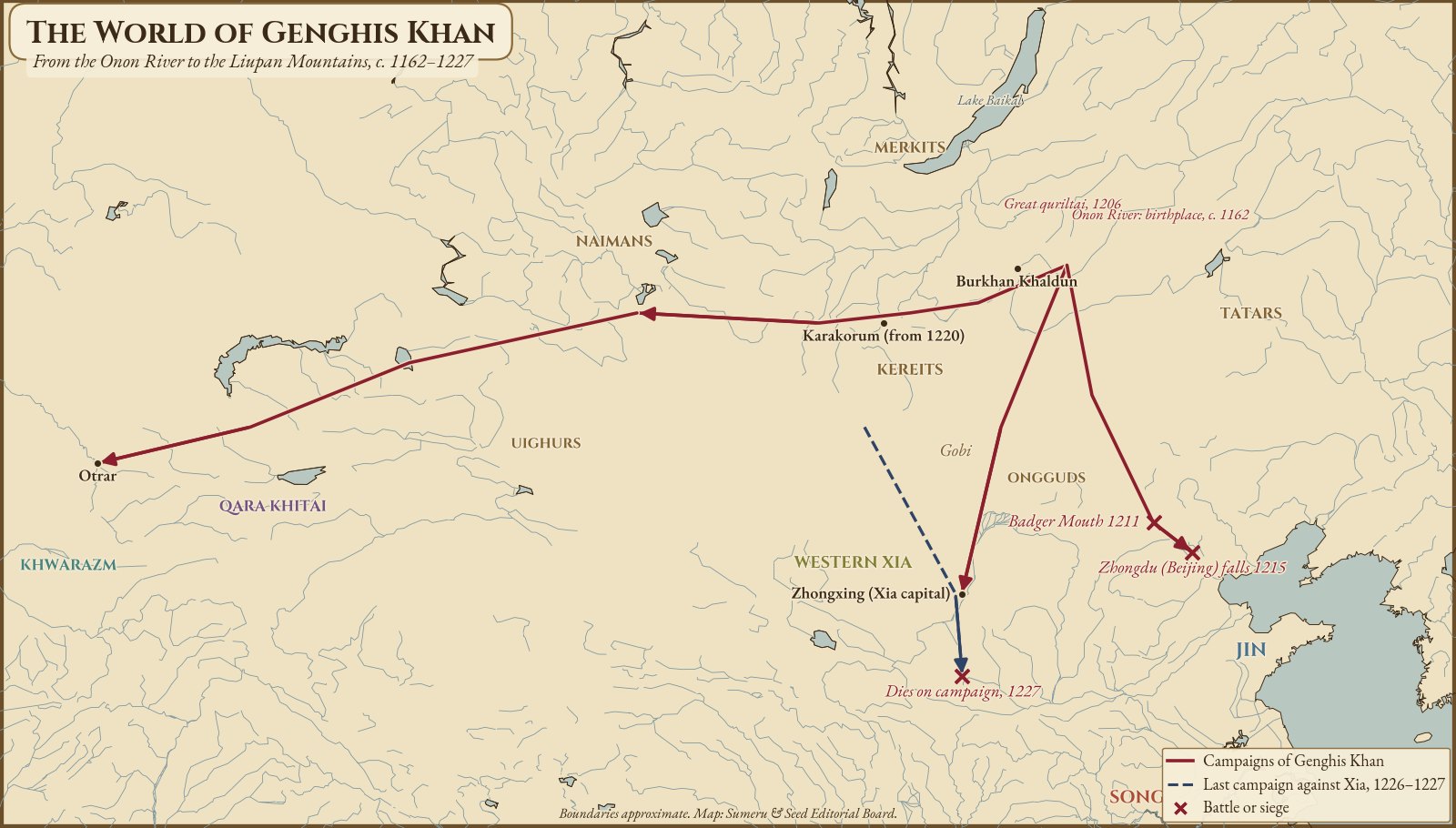
Temüjin was born on the Onon River in north-eastern Mongolia. The year is uncertain: Persian sources suggest 1155, Chinese sources 1162, and some modern scholars prefer 1167.2 His father Yesügei was a chief of the Borjigin lineage; according to the Secret History, Temüjin was born clutching a clot of blood in his hand, an omen of a warrior's destiny.
When Temüjin was about nine, his father took him to find a bride among the Onggirat people and arranged his betrothal to a girl called Börte. On the way home Yesügei stopped at a camp of Tatars, who recognised him as an old enemy and poisoned his food. He died soon after. His followers abandoned his widow, Hö'elün, and her children, leaving them to survive by gathering roots and berries and fishing in the Onon.3 The Secret History does not hide the brutality of this childhood: it tells how Temüjin and his brother Qasar killed their half-brother Begter in a quarrel over a fish, and how Hö'elün furiously rebuked them.
As a youth Temüjin was captured by the Tayichi'ut, his father's former followers, and held in a wooden cangue; he escaped with the help of a family who hid him in a cart of wool. He later married Börte; soon afterwards she was kidnapped by the Merkits, and Temüjin recovered her with the help of his father's sworn brother, Toghrul, khan of the Kereits, and his own sworn brother (anda), Jamukha.
Rise to power
Over the next twenty years Temüjin built a following. He was not born to rule a great tribe; his power came from personal loyalty. He attracted men from many clans — Bo'orchu, Jelme, Muqali, Jebe, Subutai — and rewarded them according to merit and faithfulness rather than birth. This set him against the aristocratic order of the steppe, and against Jamukha, who became his great rival.4
One by one, the peoples of the steppe were defeated. The Tatars, his father's murderers, were crushed in 1202; Temüjin ordered that all their males taller than the linchpin of a cart be killed. In 1203 he turned on his old patron Toghrul and destroyed the Kereits. In 1204 he defeated the Naimans of western Mongolia; soon afterwards Jamukha, betrayed by his own men, was handed over and executed.5 From the Naimans' captured seal-keeper, a Uighur called Tata-tonga (as the History of the Yuan tells it), Temüjin learned the value of writing; the Uighur script became the script of the Mongol language.
1206
In the spring of 1206, at a great assembly at the source of the Onon, Temüjin was proclaimed Genghis Khan. The meaning of the title is debated; it may mean something like "fierce" or "firm" ruler. He reorganised the steppe peoples into decimal military units under commanders loyal to him, created a large imperial guard, appointed a supreme judge — his adopted brother Shigi Qutuqu — and ordered his decisions written down.6 Whether this amounted to a law code, the famous Yasa, is now doubted: David Morgan has argued that no single written code ever existed, though Genghis Khan's rulings were remembered and respected as binding.7
The conquests
Genghis Khan spent the rest of his life at war. He attacked the Tangut kingdom of Xi Xia in 1209, forcing its submission. In 1211 he invaded the Jin empire of northern China, defeating its armies at Badger Mouth (Yehuling); in 1215 its central capital, Zhongdu (Beijing), fell. From 1219 to 1223 he destroyed the Khwarazmian Empire in Central Asia and Iran. He returned to Mongolia and in 1226 marched against Xi Xia, which had refused to send troops for the western war. He died during this campaign, in August 1227, probably after a fall from his horse. The Tangut capital fell shortly after his death, and its people were massacred.8 His burial place, by his own wish, was kept secret and has never been found.
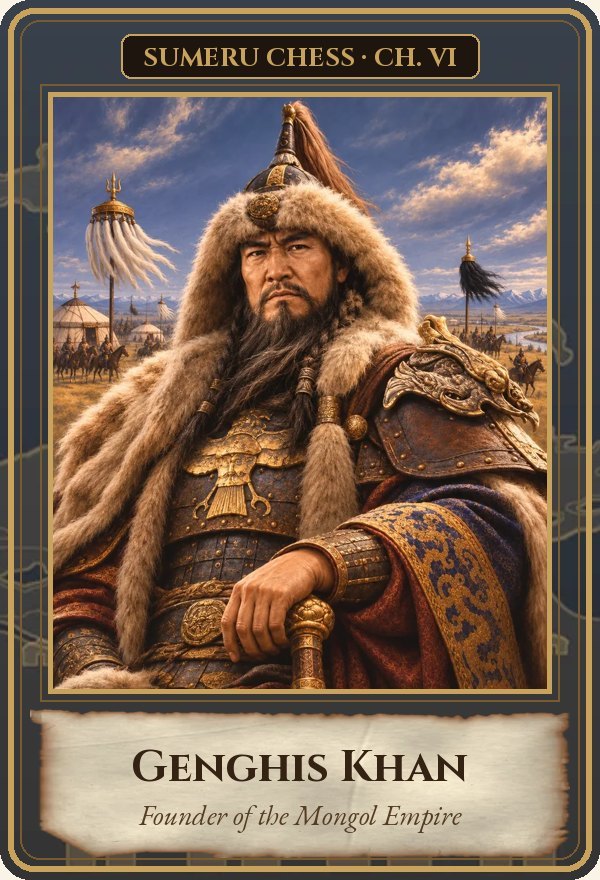
From the cards of Sumeru Chess, Chapter VI.
The man
What kind of man was he? The Secret History shows a leader who could be generous to loyal followers, who listened to advice — including from his mother and his wife, Börte — and who valued courage in his enemies. It also shows a man capable of ruthless cruelty, who killed his own half-brother and ordered whole populations destroyed. Paul Ratchnevsky's biography stressed his political intelligence: his ability to bind men to him personally, to break the old tribal structures and to learn from the settled peoples he conquered.9 Michal Biran has emphasised his openness to foreign expertise — Uighur scribes, Khitan administrators, Muslim merchants, Chinese engineers — which turned a steppe confederation into a world empire.10
Legacy
Genghis Khan's sons and grandsons expanded the empire to its greatest extent, from Korea to Hungary and from Siberia to the Persian Gulf. The destruction was immense; so, later, were the exchanges of goods and ideas across Eurasia. In 2003 a team of geneticists suggested that about 8 percent of men in a large region of Asia — roughly 0.5 percent of all men in the world — carry a Y-chromosome lineage that may descend from Genghis Khan and his male relatives, though this interpretation remains debated.11
For Mongolia, he is the founder of the state. For the peoples he conquered, he was a catastrophe. For historians, he remains one of the most consequential individuals who ever lived: a boy abandoned on the steppe who changed the map of the world.
Notes
- Igor de Rachewiltz, trans., The Secret History of the Mongols: A Mongolian Epic Chronicle of the Thirteenth Century, 2 vols. (Leiden: Brill, 2004). ↩
- Paul Ratchnevsky, Genghis Khan: His Life and Legacy, trans. Thomas Nivison Haining (Oxford: Blackwell, 1991), discusses the evidence. ↩
- Secret History §§ 59–89. ↩
- Ratchnevsky, Genghis Khan; Timothy May, The Mongol Conquests in World History (London: Reaktion Books, 2012). ↩
- Secret History §§ 154 (Tatars), 185–188 (Kereits), 189–201 (Naimans and Jamukha). ↩
- Secret History §§ 202–234. ↩
- David O. Morgan, "The 'Great Yasa of Genghis Khan' Revisited," in Reuven Amitai and Michal Biran, eds., Mongols, Turks, and Others: Eurasian Nomads and the Sedentary World (Leiden: Brill, 2005). ↩
- Ruth W. Dunnell, Genghis Khan: World Conqueror (Boston: Longman, 2010). ↩
- Ratchnevsky, Genghis Khan. ↩
- Michal Biran, Genghis Khan (Oxford: Oneworld, 2007). ↩
- Tatiana Zerjal et al., "The Genetic Legacy of the Mongols," American Journal of Human Genetics 72, no. 3 (2003): 717–721. ↩
Further Reading
- Igor de Rachewiltz, trans., The Secret History of the Mongols (Brill, 2004).
- Paul Ratchnevsky, Genghis Khan: His Life and Legacy (Blackwell, 1991).
- Michal Biran, Genghis Khan (Oneworld, 2007).
- Ruth W. Dunnell, Genghis Khan: World Conqueror (Longman, 2010).