
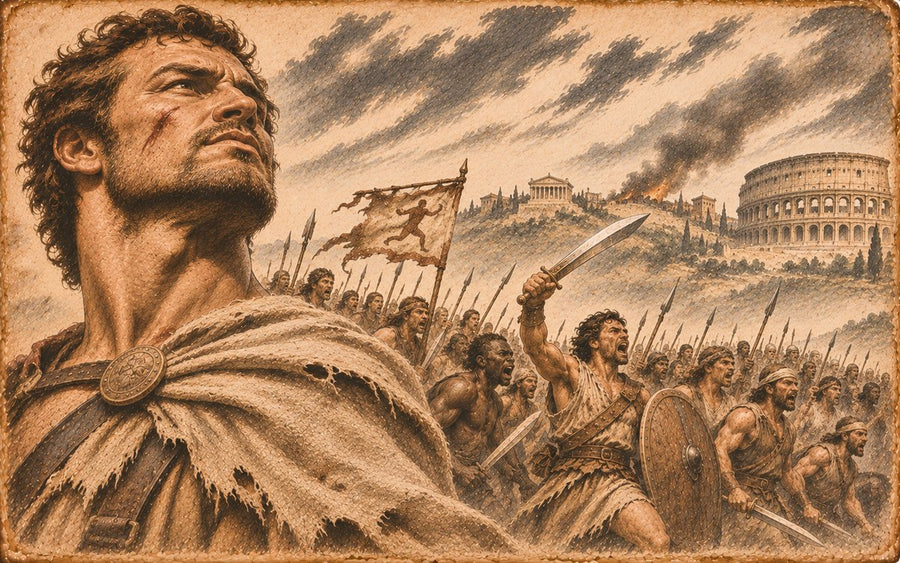
The Third Servile War (73–71 BC): Spartacus against Rome
Sumeru & Seed Editorial BoardIn 73 BC some seventy gladiators broke out of a school at Capua. Within a year they led an army of tens of thousands up and down Italy. It took Rome eight legions and its richest man to end the war.
Short answer: The Third Servile War (73–71 BC) was the last and most dangerous of the three great slave revolts against the Roman Republic. It was led by Spartacus, a Thracian gladiator who escaped from a training school at Capua. His army defeated several Roman commanders, marched the length of Italy twice, and was destroyed by Marcus Licinius Crassus in Lucania in 71 BC.
Who was Spartacus?
Spartacus was a Thracian, from the lands north of Greece, who had been sold to the gladiator school of Lentulus Batiatus at Capua. Plutarch calls him a man of great spirit and strength, more intelligent and more humane than his fortune.1 Nothing certain is known of his earlier life. With him in command were the Gauls Crixus and Oenomaus.
How did the revolt begin?
In 73 BC about two hundred gladiators planned an escape. The plan was betrayed, and some seventy got out, armed with kitchen knives and spits, and then with gladiators' weapons from a wagon they met on the road.2 They camped on Mount Vesuvius, where runaway slaves and herdsmen joined them.
Rome sent the praetor Gaius Claudius Glaber with about 3,000 men. He blocked the single path up the mountain and waited. The rebels twisted ropes from wild vines, climbed down a cliff on the far side and took his camp from behind. This was the Battle of Mount Vesuvius. A second praetor, Publius Varinius, was beaten in turn.
How large did the army become?
Large enough to frighten the Senate. Appian gives figures as high as 120,000, counting those who followed the army.3 Ancient numbers of this kind are uncertain, but the rebels were strong enough in 72 BC to meet consular armies in the field. They were never one united force. Crixus went his own way with part of the army and was killed near Mount Garganus. Spartacus defeated both consuls, marched north to the edge of the Alps at Mutina, and then turned back into Italy. Why he turned back is not known: the ancient writers suggest that his men preferred plunder to escape.
How did Crassus defeat Spartacus?
The Senate gave the command to Marcus Licinius Crassus with eight legions. When one of his units ran from the enemy he revived the old punishment of decimation, executing one man in ten.4 He drove Spartacus into the toe of Italy. There Spartacus bargained with Cilician pirates to carry his men to Sicily; the pirates took the payment and sailed away. Crassus then shut him in with a wall and ditch across the peninsula. In the winter of 72–71 BC Spartacus broke through.
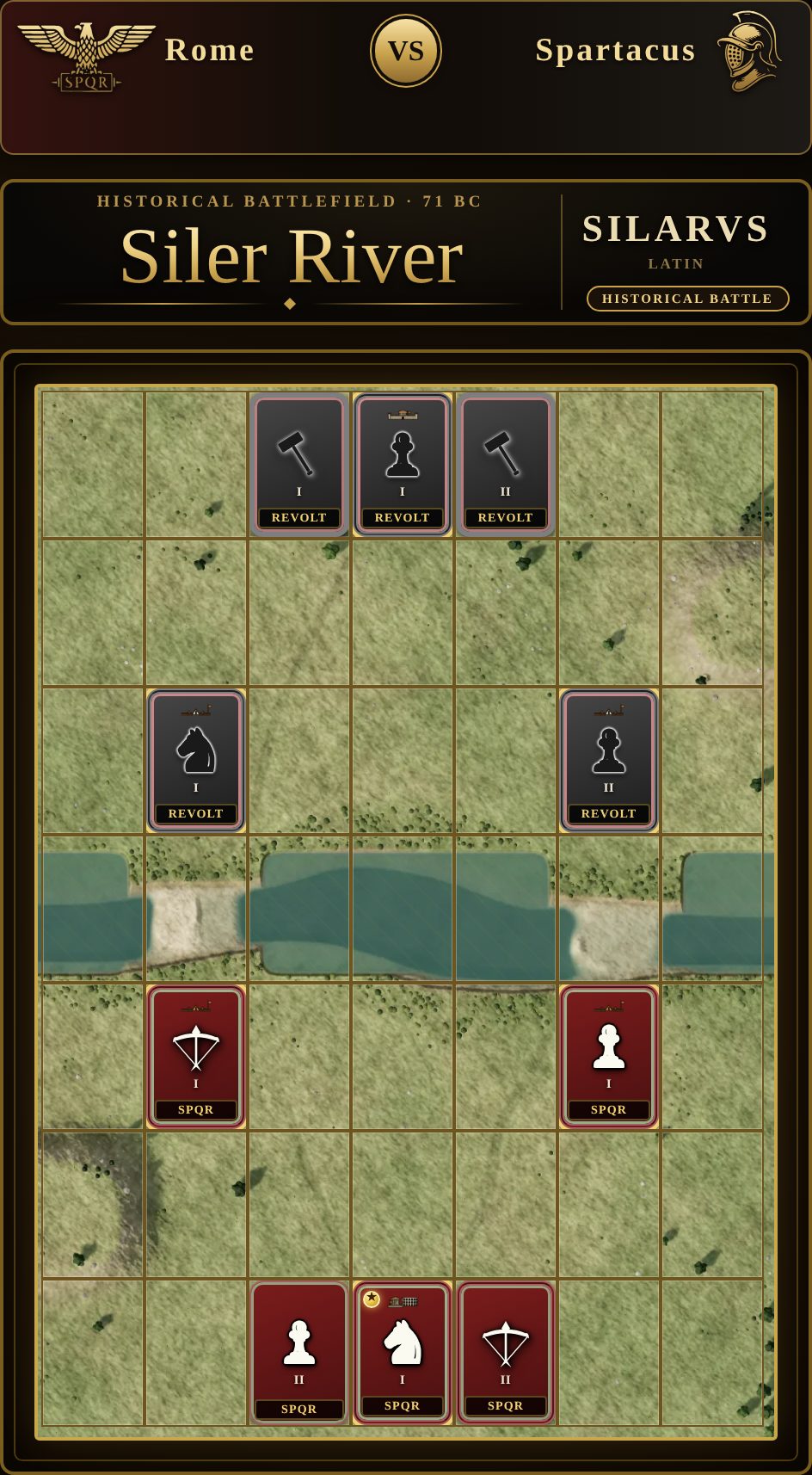
The end came in Lucania in 71 BC. Castus and Gannicus, who had separated from the main army, were destroyed first. Spartacus then turned and fought near the river Silarus. Plutarch says that he killed his own horse before the battle and tried to cut his way to Crassus. He died fighting, and his body was never found. This is the Battle of the Silarius River.
What happened to the survivors?
Crassus crucified 6,000 prisoners along the Appian Way from Capua to Rome.5 Pompey, returning from Spain, caught about 5,000 fugitives in the north and claimed a share of the victory. Both men became consuls for 70 BC.
Why is it called the “Third” Servile War?
Because two earlier slave wars had been fought in Sicily: the first in 135–132 BC under Eunus, the second in 104–100 BC under Salvius and Athenion. The third was the only one fought in Italy itself, and the only one led by gladiators. No later revolt came near it in size.
Read more on Spartacus, the history and the legend, on the Spartacus revolt and Rome in the Civilization Index, or see the Imperion Cards core set The Third Servile War.
 Spartacus
 Rome
Card backs of Chapter III. Each opens the civilization's page.
Questions people ask
When was the Third Servile War?
From 73 to 71 BC.
Who won the Third Servile War?
Rome. Marcus Licinius Crassus destroyed Spartacus' army in Lucania in 71 BC.
How did Spartacus die?
In the last battle against Crassus in 71 BC. The ancient writers say that he died fighting and that his body was never found. He was not crucified.
How many slaves were crucified after the revolt?
About 6,000, along the Appian Way between Capua and Rome, according to Appian.
Did Spartacus want to end slavery?
No ancient source says so. The aims they describe are escape from Italy and, for many of his followers, plunder.
Notes
- Plutarch, Life of Crassus 8.
- Plutarch, Crassus 8–9; Appian, Civil Wars 1.116.
- Appian, Civil Wars 1.117.
- Plutarch, Crassus 10; Appian, Civil Wars 1.118.
- Appian, Civil Wars 1.120.
Further reading
- Plutarch, Life of Crassus 8–11, trans. Bernadotte Perrin, Loeb Classical Library.
- Appian, The Civil Wars 1.116–120.
- Brent D. Shaw, Spartacus and the Slave Wars: A Brief History with Documents (Bedford/St. Martin's, 2001).
- Barry Strauss, The Spartacus War (Simon & Schuster, 2009).
- Keith Bradley, Slavery and Rebellion in the Roman World, 140 B.C.–70 B.C. (Indiana, 1989).