
The Battle of the Silarius River, 71 BC: Spartacus' Last Stand
Sumeru & Seed Editorial BoardField Report · Chapter III · 71 BC · Lucania, Italy
Cornered between Crassus' legions and two more Roman armies on the way, Spartacus killed his own horse before the battle — he would win and take the enemy's, or need none. He died fighting his way towards Crassus.
Part I · The battle
Result A decisive Roman victory: Spartacus killed and the revolt ended.
Why it is remembered
- A general who would not run. Spartacus chose to fight a larger, better army rather than be caught between three.
- The charge at Crassus. He cut his way towards the Roman commander, killing two centurions, before he was surrounded and cut down.
- The Appian Way. Six thousand captives were crucified along the road from Capua to Rome — the end of the greatest slave revolt in Roman history.
After two years of victories, Spartacus' army was penned in the toe of Italy by Crassus' ditch across Bruttium. It broke out in a winter storm, but quarrels split the rebels and Crassus destroyed one breakaway band after another.1
Pompey was coming back from Spain and Lucullus had landed at Brundisium. Crassus wanted the glory for himself; Spartacus, with nowhere left to go, turned and offered battle near the river Silarus.2
The battle, step by step
- The horse. Before the battle Spartacus kills his horse: if he wins he will have many, and if he loses he will need none.3
- The clash. The rebel army attacks the Roman line across open ground and the infantry fight along the whole front.
- The charge at Crassus. Spartacus drives into the Roman ranks looking for Crassus and kills two centurions who stand in his way.
- The end. Wounded in the thigh, he fights on his knees until he is cut down. His body is never found; the rebel army breaks.4
What followed
Crassus crucified 6,000 prisoners along the Appian Way. Pompey caught 5,000 fugitives in the north and wrote to the Senate that he had pulled the war out by the roots — taking the credit Crassus had earned. The rivalry of the two men shaped Roman politics until Carrhae.5
Part II · Play it with Imperium Cards
The Silarius River with the physical cards
The Silarius River is part of Edition II · The Third Servile War, with the Champion of the Arena booster. Fight Spartacus' last battle — or command Crassus' legions. The card battle below has been with the set since its first printing.


In 71 BC, Spartacus led his last army against Crassus on the open plains of Campania. Outnumbered and cornered, he drove directly toward Crassus himself in a desperate bid to kill the Roman commander. The charge fell short, the rebel formation collapsed, and Spartacus died fighting — ending the Third Servile War.
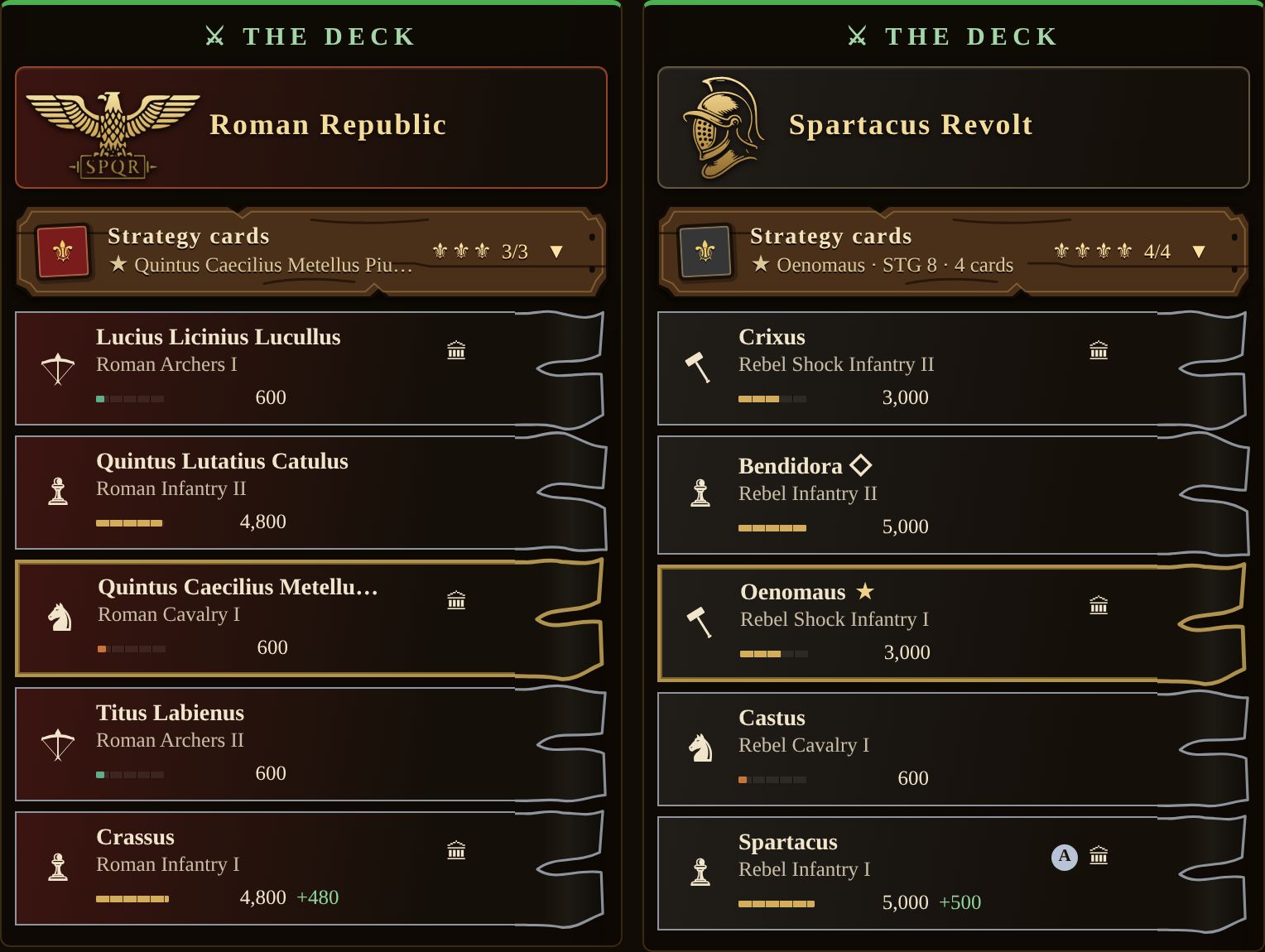
Order of battle
Battle sequence
- Phase IRebels launch full assault across open ground
- Phase IIHeavy infantry clash along the entire Roman line
- Phase IIISpartacus drives directly toward Crassus
- Phase IVBreakthrough fails — rebel formation collapses
A decisive Roman victory — Spartacus died on the field and the Third Servile War ended. Six thousand survivors were crucified along the Appian Way.
Could you have broken the Roman line?
Relive the last stand of Spartacus with Edition II


Part III · Play it in Sumeru Chess
The Silarius River on the chessboard
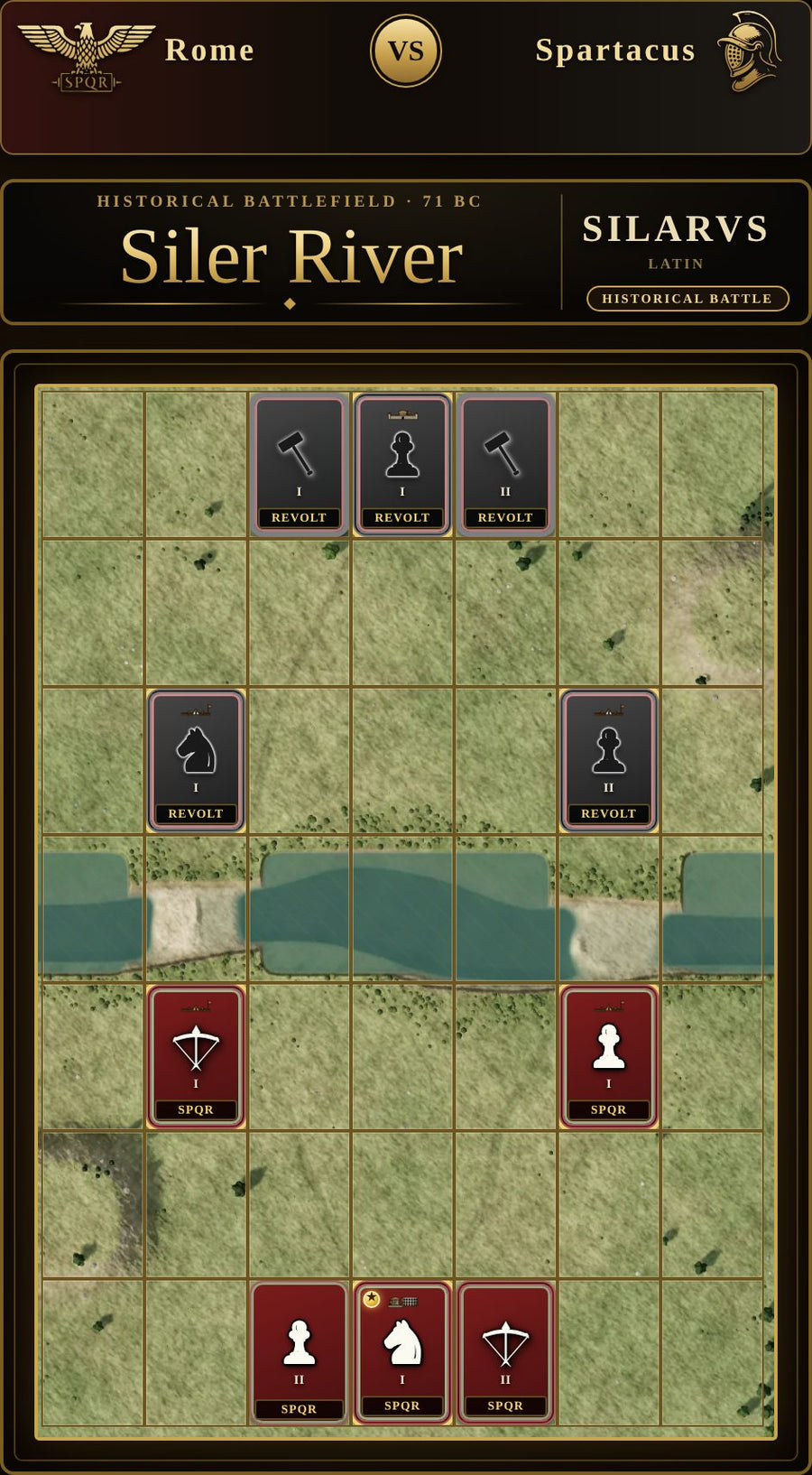
The Silarius River is one of the historical battlefields of Chapter III of Sumeru Chess, the Age of Iron & Glory. It is a 7 × 7 board drawn from the real ground: the Spartacus side deploys from Petelia, the Rome side from Paestum.
- Hills give a defender +1 DEF, and cavalry and elephants cannot climb them.
- The river stops movement; a defender standing in it fights at -1 DEF (horse) or -2 DEF (foot).
- Fords are the crossing places of the river.
Where to find it
- Conquest Campaign. Lead Rome against Spartacus, or Spartacus against Rome: the Silarius River is the second of the two historical battles of that war (the other is Mount Vesuvius), and the war ends at the enemy capital.
- Single Battle. Choose Rome against Spartacus and set Battlefield to Random: the Silarius River is one of the four historical fields the game draws for this pair.
Fight it like history
- The river stops you. Movement ends on a river square, and a defender standing in it fights at -1 DEF (horse) or -2 DEF (foot). Cross at the fords.
- Go for the ★. If the enemy's Chief Commander is routed, his side plays no more strategy cards and every army loses 2 MOR — Spartacus' plan in the rules of the game.
- Hills help the defender. They give +1 DEF, and cavalry cannot climb them.
Chapter III is free to play in your browser, no download: Rome and Carthage are open to everyone; the other powers of the age come with Sumeru Premium.
Play Chapter IIIOpen the Card CollectionNotes and sources (5)
- Plutarch, Crassus 10–11; Appian, Civil Wars 1.118–120. ↩
- Plutarch, Crassus 11; Appian, Civil Wars 1.120. ↩
- Plutarch, Crassus 11. ↩
- Plutarch, Crassus 11; Appian, Civil Wars 1.120. ↩
- Appian, Civil Wars 1.120; Plutarch, Crassus 11, Pompey 21. ↩
Further reading
- Barry Strauss, The Spartacus War (Simon & Schuster, 2009).
- Brent D. Shaw, Spartacus and the Slave Wars (Bedford/St. Martin's, 2001).