

Was Odysseus Real? The Bronze Age World Behind The Odyssey
Sumeru & Seed Editorial BoardNo tablet or tomb names Odysseus. But Troy was a real city, the palaces of his fellow kings have been dug up, and the world Homer describes left ruins from Ithaca to the Dardanelles.
Short answer: there is no evidence that Odysseus lived, and none that he did not. No inscription, tablet or tomb names him. What archaeology has shown is that the world of the Odyssey was real: Troy existed and burned, the Greek kings had palaces and scribes, and the Hittites wrote letters to them.
Christopher Nolan's film The Odyssey (2026), with Matt Damon as Odysseus, has sent many people back to the same question the Greeks themselves asked. This article sets out what is known.
When was the Odyssey composed, and when is it set?
The poem took its present form about 750–650 BCE. It tells of events placed some five hundred years earlier, at the end of the Bronze Age. Ancient Greek scholars put the fall of Troy at 1184 BCE. The poems were sung for generations before they were written down, and they mix memories of the Bronze Age with the poet's own Iron Age world.
One detail shows how old some of those memories are. In the Iliad, Odysseus puts on a helmet covered with rows of boar's tusks. Such helmets have been found in graves at Mycenae and elsewhere. They went out of use centuries before Homer.
Was there a real Troy?
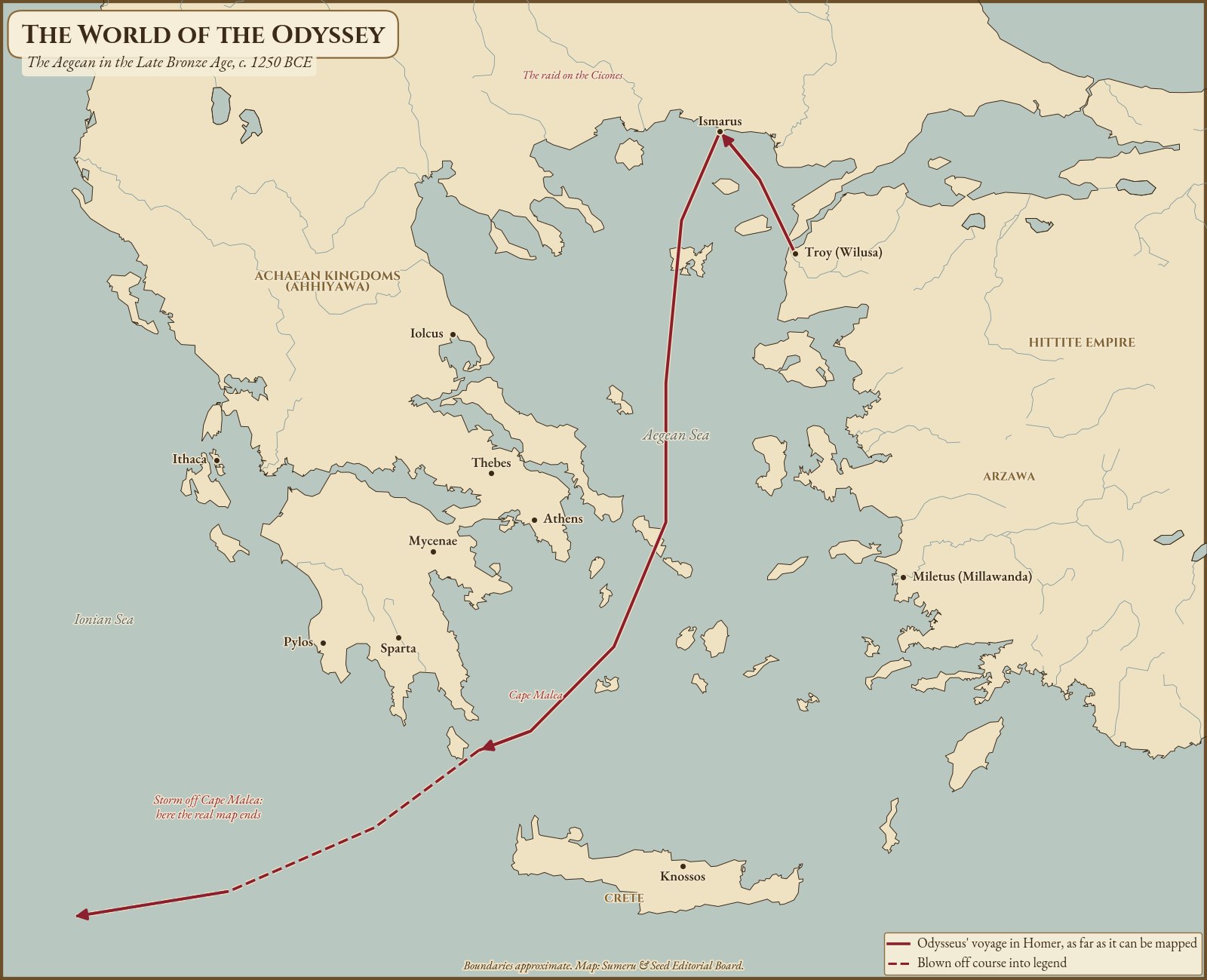
Yes. The mound of Hisarlik, near the Dardanelles in Turkey, holds nine cities built one on top of another. Heinrich Schliemann began digging there in 1871. The level called Troy VI had great sloping walls and was damaged about 1300 BCE, probably by an earthquake. Its successor, Troy VIIa, was destroyed by fire about 1180 BCE. Arrowheads and unburied bodies were found in the ruins.1
The Hittites, who ruled most of Anatolia, knew the place. Their records speak of a kingdom called Wilusa, which most scholars identify with Homer's Ilios. About 1280 BCE the Hittite king made a treaty with its ruler, Alaksandu. The same records mention a power across the sea called Ahhiyawa, generally read as the Achaeans, Homer's word for the Greeks. Hittite and Achaean kings quarrelled over Wilusa.2
That is not proof of a ten-year siege or a wooden horse. It is proof that Greeks and a real Troy were in conflict in the right century.
Did kings like Odysseus exist?
Kings like him did. In 1952 Michael Ventris showed that the clay tablets from Knossos and Pylos, written in the script called Linear B, were in an early form of Greek. They are palace accounts: lists of sheep, oil, bronze, rowers and chariot wheels. The ruler is called the wanax.3
At Pylos, Carl Blegen uncovered a palace with a throne room and a painted bath, which he named the Palace of Nestor after the old king who entertains Odysseus' son in the poem. It burned about 1180 BCE and was never rebuilt. In 2015 a single untouched grave was found beside it, with a bronze sword, gold rings and a carved sealstone: a warrior of exactly the class Homer sings about.
The tablets contain names known from Homer, such as Achilles and Hector, borne by ordinary men. The name Odysseus does not appear.
Has the palace of Odysseus been found on Ithaca?
Not with any certainty. Ithaca has Mycenaean remains, and a cave at Polis Bay held bronze tripods and a later dedication "to Odysseus", which shows he was worshipped there as a hero. In 2010 Greek archaeologists announced a large Mycenaean building in the north of the island and proposed it as his palace. Most specialists remain unconvinced. Others argue that Homer's Ithaca was really part of neighbouring Kefalonia.
Can the voyage be mapped?
Only its first stage. From Troy, Odysseus raids the Cicones in Thrace and sails south for home. Off Cape Malea, at the foot of the Peloponnese, a storm drives him away for nine days. After that come the Lotus-Eaters, the Cyclops, Circe and the Sirens. Ancient writers placed these in Sicily and Italy. The geographer Eratosthenes thought the search pointless: you will find where Odysseus wandered, he said, when you find the cobbler who stitched the bag of the winds.
What happened to that world?
It ended within a generation of the fall of Troy. Between about 1200 and 1150 BCE Pylos, Mycenae and Thebes burned, the Hittite empire collapsed, and writing was lost in Greece for four centuries. The Odyssey is a poem about the survivors of that age: a king who comes home to find his house occupied and his kingdom hanging by a thread.
From Homer's heroes to the age of the hoplite
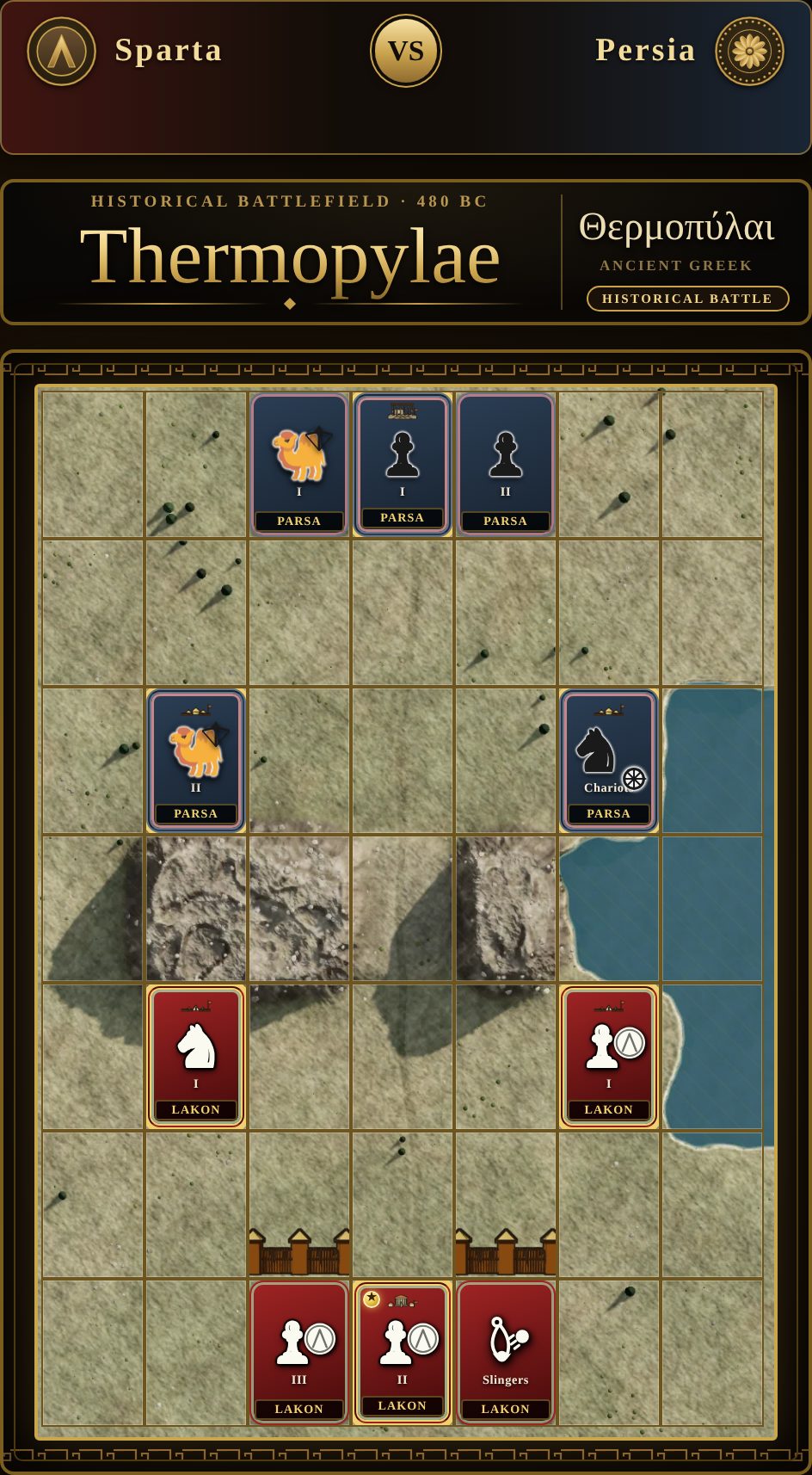
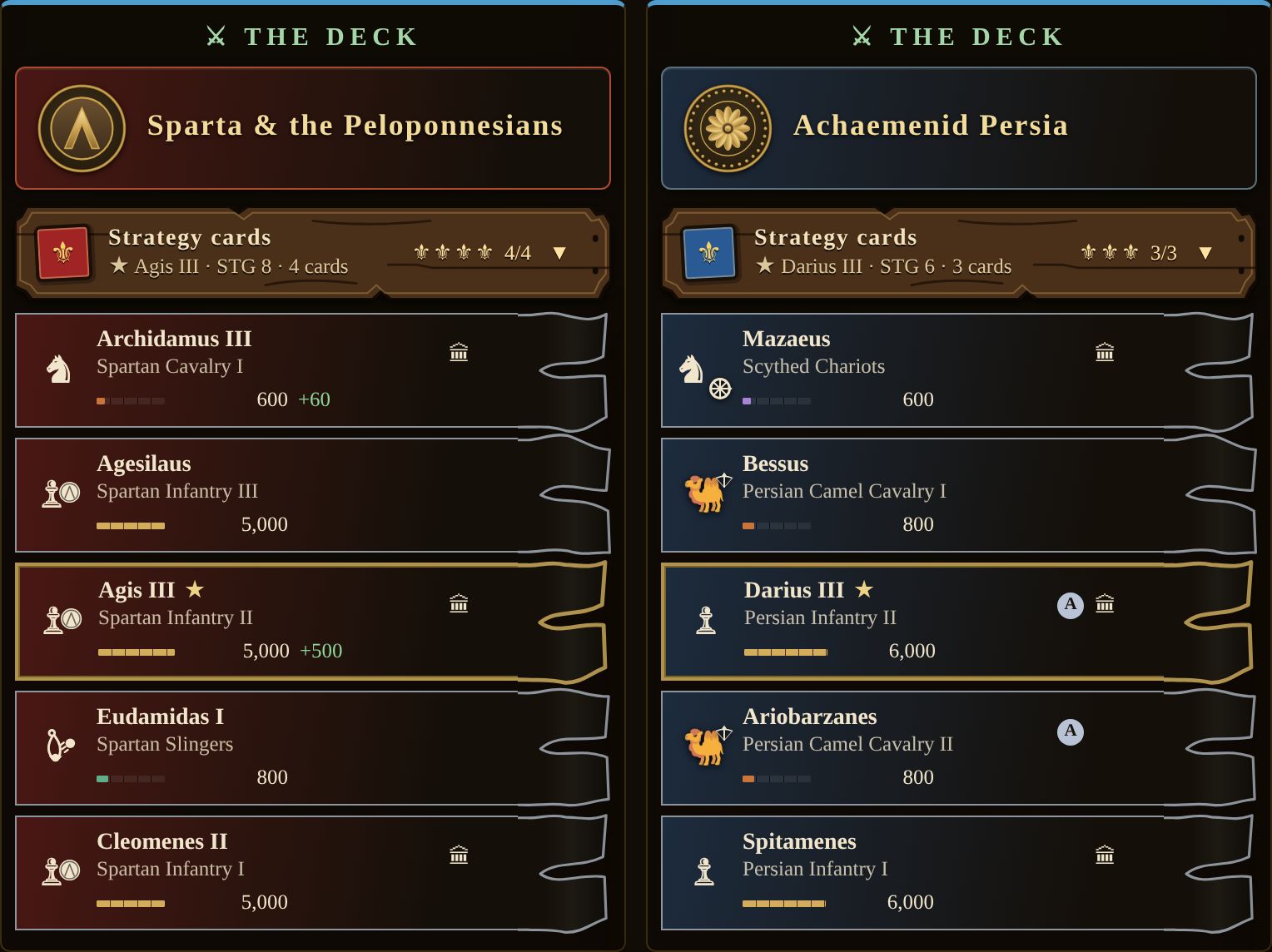
The Greeks who stopped Persia at Marathon and Thermopylae grew up reciting Homer. Their cities are the next chapter of the same story. You can read the full history of Athens and Sparta in the Civilization Index, and lead them yourself on the board below.
 Athens
 Sparta
 Macedon
 Persia
Card backs of Chapter II. Each opens the civilization's page.
Questions people ask
Was Odysseus a real person?
There is no evidence that he was. No Bronze Age text names him. He may preserve the memory of a real island king, or he may be a figure of story.
Did the Trojan War really happen?
A city at Troy was destroyed by fire about 1180 BCE, and Hittite records show Greeks and Troy in conflict in the thirteenth century BCE. A war of some kind is likely. The ten-year siege is poetry.
Where is Ithaca today?
Ithaca (Ithaki) is one of the Ionian Islands off the west coast of Greece. Some scholars think Homer's Ithaca was part of nearby Kefalonia.
How long was Odysseus away from home?
Twenty years in the poem: ten at Troy and ten on the voyage home.
Notes
- Manfred Korfmann's excavations (1988–2005) also traced a lower town around the citadel. How large it was is still debated.
- The identifications Wilusa = Ilios and Ahhiyawa = Achaeans are widely but not universally accepted.
- John Chadwick, The Decipherment of Linear B (Cambridge, 1958).
Further reading
- Eric H. Cline, 1177 B.C.: The Year Civilization Collapsed (Princeton, 2014).
- Trevor Bryce, The Trojans and Their Neighbours (Routledge, 2006).
- Joachim Latacz, Troy and Homer: Towards a Solution of an Old Mystery (Oxford, 2004).
- M. I. Finley, The World of Odysseus (1954; revised 1977).