
The Empire Alexander Inherited: Satrapies, Roads and Tribute in Achaemenid Persia
Sumeru & Seed Editorial BoardGreek writers called the Persians soft and decadent. Yet the Achaemenids ruled some thirty peoples from Libya to the Indus for two centuries — with roads, couriers, accountants and a remarkable tolerance for local custom.
Most of what Europeans long believed about Persia came from its enemies. To Aeschylus, Herodotus and the orators of fourth-century Athens, the Persian Empire was a vast, gilded despotism of slaves ruled by a king who did not fight his own battles. Alexander's victory seemed to prove the point. Over the last fifty years, however, historians reading Persian, Elamite, Babylonian and Aramaic documents alongside the Greek ones have drawn a very different picture: an empire that was efficient, durable and surprisingly flexible, and that Alexander took over largely intact.1
From Cyrus to Darius
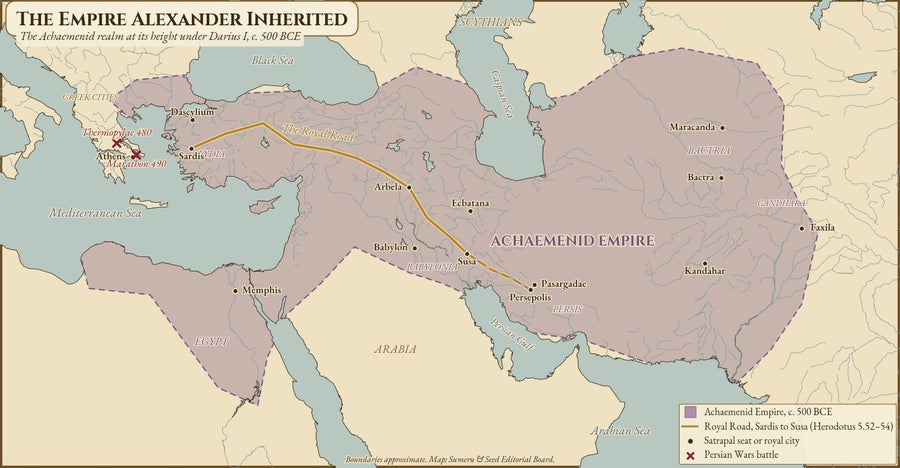
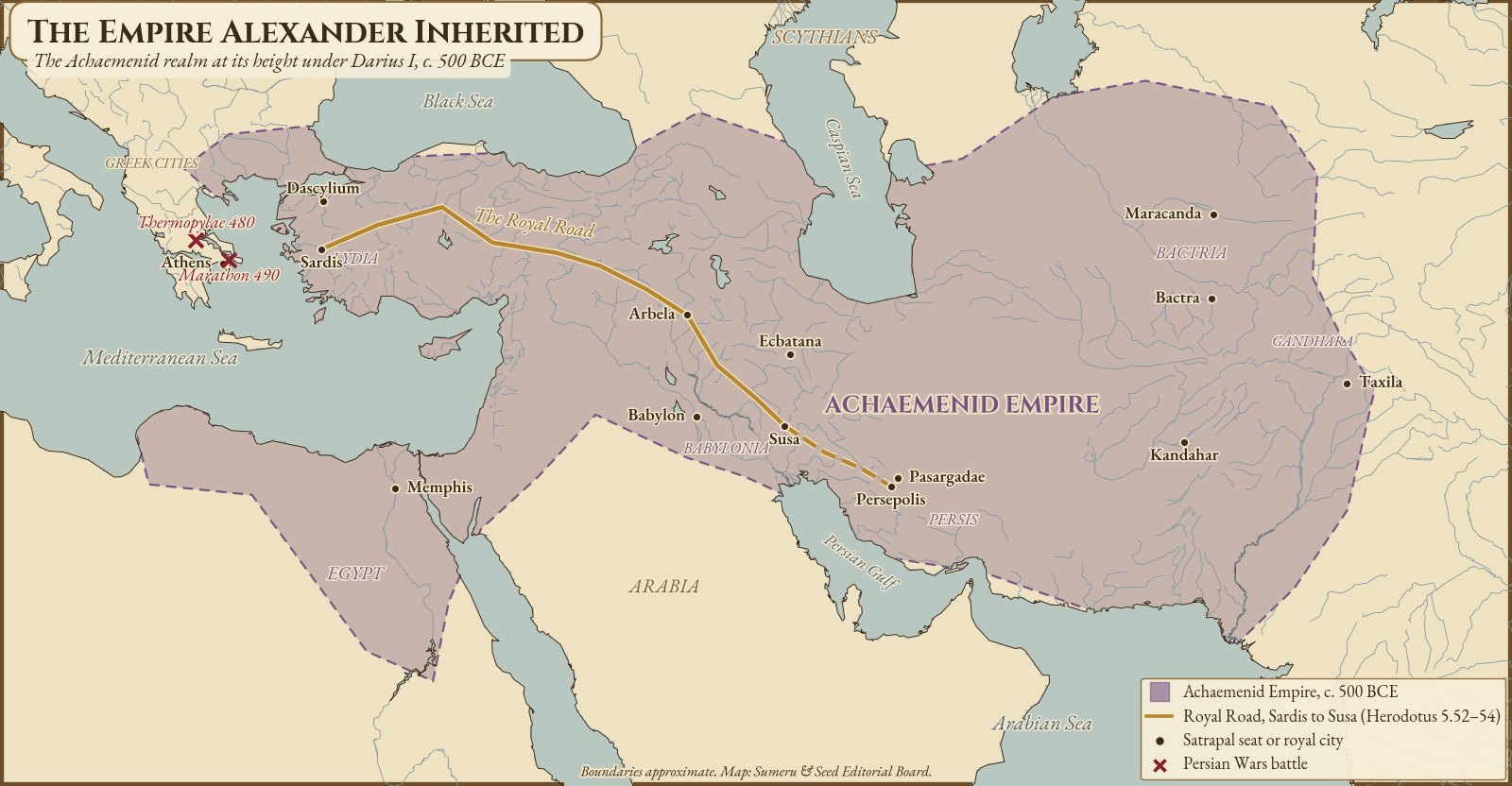
The empire was built with astonishing speed. Cyrus II, king of the small Persian state of Anshan in south-western Iran, defeated the Medes around 550 BCE, Croesus of Lydia around 547, and Babylon in 539. His son Cambyses added Egypt in 525. Darius I, who seized the throne in 522 after a crisis that he described at length in his trilingual inscription on the cliff at Behistun, pushed the frontiers to the Indus valley in the east and into Thrace in the west.2 At its height the empire stretched some 5,000 kilometres from Libya to the Punjab and from the Aral Sea to the First Cataract of the Nile.
The Behistun inscription is a key to the Achaemenid view of power. Darius lists the lands that obey him, insists that he rules "by the favour of Ahuramazda," and describes how he crushed nine rebel kings in a single year. The message was not that subjects were slaves, but that order — arta, truth — had been restored by a legitimate king against "the Lie."3
Satraps and tribute
The empire was divided into provinces governed by satraps (Old Persian xšaçapāvan, "protector of the realm"). Herodotus lists twenty tribute districts under Darius, each paying a fixed annual sum in silver — or, in the case of India, in gold dust — and gives the total as 14,560 Euboean talents.4 Historians debate how literally to take his list, but its principle is confirmed by other evidence: subjects paid in kind and in silver according to their resources, and the king's officials kept careful accounts.
Satraps were usually Persian nobles, often relatives of the king, and in their provinces they commanded troops, collected taxes and judged disputes. To keep them loyal the king used several checks. Royal secretaries and garrison commanders reported directly to the court. The "King's Eye" and "King's Ear" — inspectors whose very titles became famous among the Greeks — travelled the provinces.5 And satraps' sons were often raised at court, where they were both honoured and held as hostages.
Roads, couriers and accountants
Herodotus describes the Royal Road from Sardis, near the Aegean, to Susa, the winter capital: 111 staging posts over some 2,500 kilometres, with inns and guard posts along the way.6 Royal couriers riding in relays could cover in days a distance that took a walker some three months, a speed that impressed the Greeks so much that Herodotus wrote the famous line, later carved on the New York General Post Office, that neither snow nor rain nor heat nor gloom of night stayed them from their rounds.
We now know how this system worked from the inside. In the 1930s excavators at Persepolis found tens of thousands of clay tablets, mostly in Elamite, recording the issue of rations between about 509 and 493 BCE. They show travellers carrying sealed documents from the king or a satrap, drawing fixed amounts of flour, beer and wine at each station on their way to or from places as distant as India, Egypt and Sardis.7 Workers — men, women and children, Persians and foreigners — received graded rations; women who had just given birth received extra. This was not a chaotic oriental despotism but a bureaucracy with ledgers.
Tolerance as a policy
The Achaemenids did not try to make their subjects Persian. Cyrus presented himself in Babylon as a servant of the god Marduk, in a proclamation preserved on the clay cylinder now in the British Museum.8 In Egypt Darius was portrayed as a pharaoh and funded temples. The Hebrew Bible remembers Cyrus as the anointed king who allowed the exiles to return to Jerusalem and rebuild the Temple. Aramaic, the language of the chancery, allowed scribes from Elephantine to Bactria to read the same orders. Local elites who cooperated kept their position; those who rebelled — like the Ionian Greeks in 499–494 BCE — were crushed.
From the cards of Sumeru Chess, Chapter II.
The army of the Great King
The Persian army that Alexander fought was not the horde of reluctant conscripts described by Greek writers. Its core was Persian and Iranian cavalry, armoured and highly skilled with javelin and bow, together with the royal guard of 10,000 that Herodotus calls the "Immortals," because any man who fell was at once replaced.9 By the fourth century the Great King also relied heavily on Greek mercenary hoplites to provide the heavy infantry that Persia itself lacked. It was a powerful army for the wars it had usually fought — against rebels, nomads and Greek city-states — but it had no answer to Macedonian combined arms led by a king who was also its best cavalry officer.
What Alexander inherited
When Alexander burned the palace at Persepolis in 330 BCE, he seemed to announce the end of the empire. In practice he kept most of it running. He appointed Persian satraps in many provinces, adopted the Achaemenid court ceremonial of prostration, married Persian noblewomen and, at the mass wedding at Susa in 324, ordered his companions to do the same.10 The Seleucid kings who followed him in Asia governed through the same satrapies, used the same roads, and collected tribute in much the same way. Pierre Briant's verdict that Alexander was "the last of the Achaemenids" is deliberately provocative, but it captures something true: the conqueror took over an empire that already worked.
Notes
- For this reassessment see Pierre Briant, From Cyrus to Alexander: A History of the Persian Empire, trans. Peter T. Daniels (Winona Lake, IN: Eisenbrauns, 2002), and Amélie Kuhrt, The Persian Empire: A Corpus of Sources from the Achaemenid Period (London: Routledge, 2007). ↩
- Behistun inscription of Darius I (DB), translated in Kuhrt, Persian Empire. The dating of the conquests follows Matt Waters, Ancient Persia: A Concise History of the Achaemenid Empire, 550–330 BCE (Cambridge: Cambridge University Press, 2014). ↩
- DB, opening and closing sections; Bruce Lincoln, "Happiness for Mankind": Achaemenian Religion and the Imperial Project (Leuven: Peeters, 2012), discusses the opposition of truth and "the Lie." ↩
- Herodotus, Histories 3.89–97. ↩
- Herodotus 1.114 mentions the "King's Eye"; Xenophon, Cyropaedia 8.2.10–12, the king's "eyes and ears." Briant, From Cyrus to Alexander, discusses the evidence and its limits. ↩
- Herodotus 5.52–54; on the couriers, 8.98. ↩
- Richard T. Hallock, Persepolis Fortification Tablets (Chicago: University of Chicago Press, 1969); Wouter F. M. Henkelman, The Other Gods Who Are: Studies in Elamite-Iranian Acculturation Based on the Persepolis Fortification Texts (Leiden: Nederlands Instituut voor het Nabije Oosten, 2008). ↩
- The Cyrus Cylinder, British Museum BM 90920; translated in Kuhrt, Persian Empire. ↩
- Herodotus 7.83. ↩
- Arrian, Anabasis 3.18.11–12 (Persepolis), 4.10–12 (prostration), 7.4.4–8 (Susa weddings). ↩
Further Reading
- Pierre Briant, From Cyrus to Alexander: A History of the Persian Empire (Eisenbrauns, 2002).
- Amélie Kuhrt, The Persian Empire: A Corpus of Sources from the Achaemenid Period (Routledge, 2007).
- Matt Waters, Ancient Persia: A Concise History of the Achaemenid Empire, 550–330 BCE (Cambridge University Press, 2014).
- Lindsay Allen, The Persian Empire (University of Chicago Press, 2005).