

The Eastern Clash: Song, Jin, the Qara Khitai and the Legend of Prester John
Sumeru & Seed Editorial BoardWhile crusaders and Turks fought over Jerusalem, a different struggle reshaped East Asia. Jurchen horsemen took northern China, a Khitan prince founded an empire in Central Asia — and his victory over a Muslim sultan gave Europe the legend of Prester John.
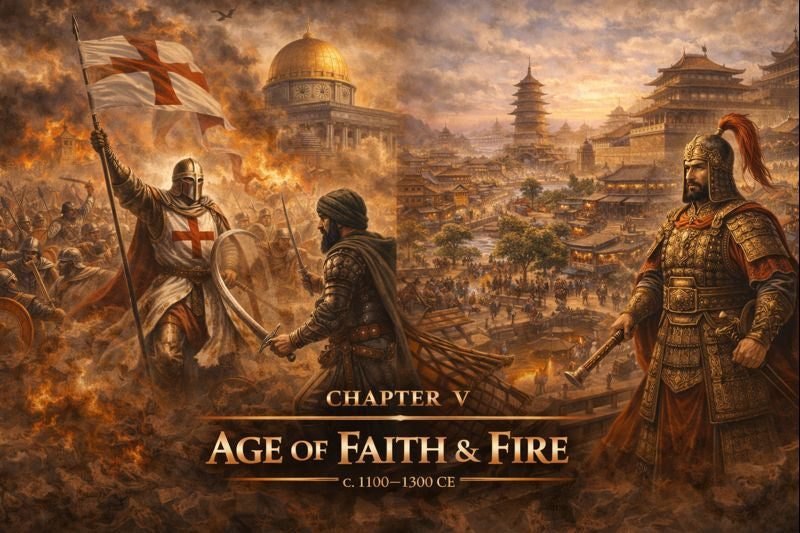
In 1145 a bishop from the crusader city of Jabala in Syria visited the pope at Viterbo. According to the chronicler Otto of Freising, who met him there, the bishop reported that a Christian king and priest called John, who ruled beyond Persia and Armenia, had recently defeated the Persian kings in a great battle and had tried to march to the aid of Jerusalem, but had been unable to cross the Tigris.1 This was the first appearance in Europe of the legend of Prester John, which would inspire explorers for four hundred years. The battle behind the rumour was real. But the victor was neither a Christian nor a priest: he was a Khitan prince from the borders of China. His story connects the crusading world of this chapter with a very different clash of empires in the East.
The fall of the Liao
For two centuries the Khitan, a people from the Liao River in what is now Inner Mongolia and Manchuria, had ruled a powerful empire, the Liao dynasty (907–1125), covering Mongolia, Manchuria and the northern edge of China, including the region of modern Beijing. To the south the Song dynasty (960–1279) ruled the rest of China and paid the Liao an annual subsidy in silk and silver under the treaty of Shanyuan of 1005. In the north-west, the Tangut kingdom of Western Xia controlled the Gansu corridor.2
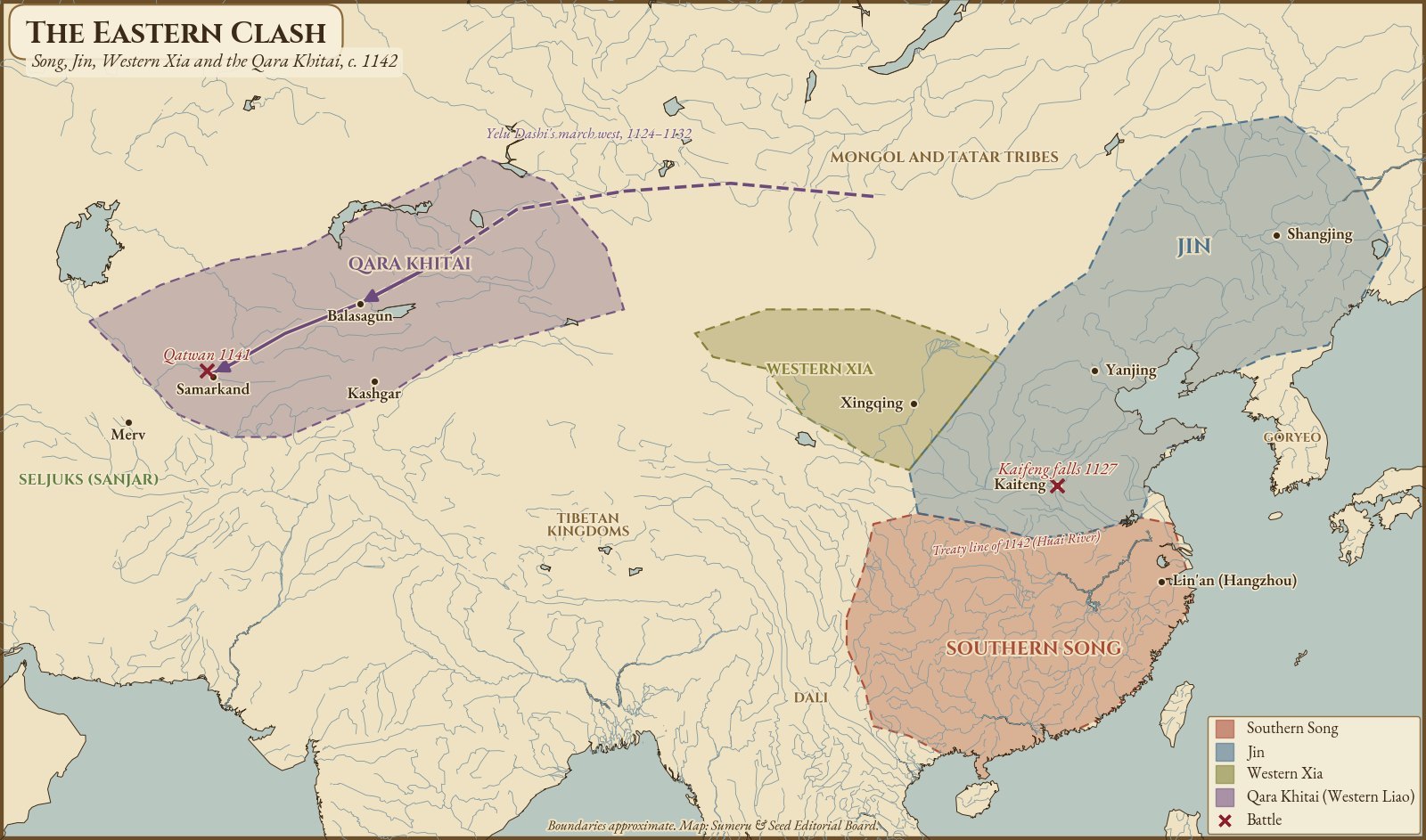
Early in the twelfth century the Jurchen, a forest and river people of Manchuria who had been Liao subjects, rebelled under their chieftain Aguda, who proclaimed the Jin ("Golden") dynasty in 1115. The Song, hoping to recover the lost northern territories, allied with the Jin against the Liao. It was a fatal mistake. By 1125 the Liao had collapsed; and in 1126–1127 the Jin turned on their Song allies, besieged the Song capital Kaifeng and carried off the retired emperor Huizong, the reigning emperor Qinzong and thousands of members of the court. The Chinese call this the Jingkang Incident, after the reign title of the year.3
Southern Song and Jin
A surviving son of Huizong re-established the dynasty in the south, eventually settling at Lin'an (Hangzhou). For fifteen years war continued between the Jin and what became the Southern Song. The Song general Yue Fei won a series of victories in the 1130s and 1140s, but the court, led by the chief minister Qin Gui, sought peace. In 1141–1142 a treaty fixed the border along the Huai River and the Qinling mountains; the Song agreed to pay an annual tribute of 250,000 taels of silver and 250,000 bolts of silk and to address the Jin emperor as a vassal. Yue Fei was arrested and put to death, and later became one of the great heroes of Chinese patriotism.4
The Southern Song, though smaller, was extraordinarily rich. Its population, its commercialised agriculture, its printing, its paper money and its maritime trade made it in many respects the most advanced economy in the world. Its armies relied on massed crossbows, fortified cities and river fleets, including paddle-wheel warships, and on gunpowder weapons that the Song had been developing since the eleventh century.5 The Jin, for their part, combined Jurchen cavalry, organised in hereditary military units, with the Chinese administration of the north.
Yelü Dashi and the Qara Khitai
When the Liao collapsed in 1124, a member of the imperial clan, Yelü Dashi, refused to submit to the Jin. He led a small following west across Mongolia, gathered Khitan and Mongolian tribes, and by the early 1130s had established himself at Balasagun, in what is now Kyrgyzstan. There he took the title Gürkhan, "universal khan," and founded a state that Muslim writers called the Qara Khitai and Chinese historians the Western Liao.6
The Qara Khitai expanded into Transoxiana, the land of the Muslim Qarakhanid dynasty, which was a vassal of the great Seljuk sultan Sanjar. On 9 September 1141, on the steppe of Qatwan near Samarkand, Yelü Dashi's army defeated Sanjar decisively. It was the worst defeat the Seljuks ever suffered, and it left the Qara Khitai the dominant power in Central Asia for seventy years.7

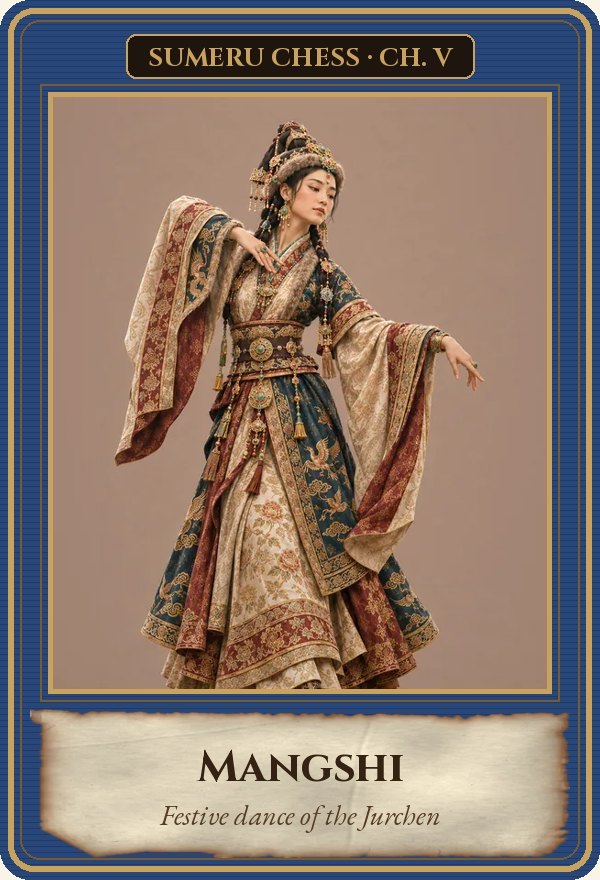
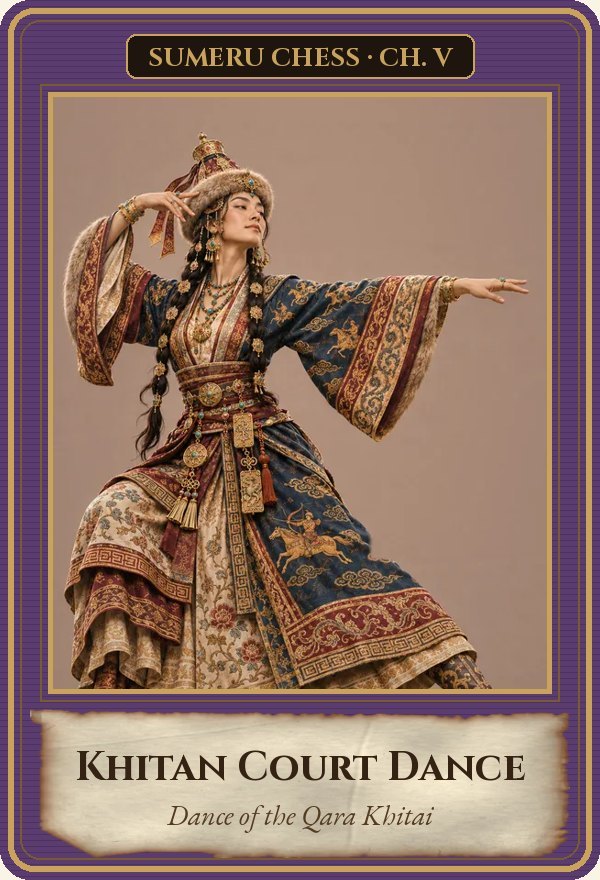
From the cards of Sumeru Chess, Chapter V.
A non-Muslim empire over Muslims
Michal Biran's study of the Qara Khitai has shown how unusual their empire was. A small Khitan elite, Buddhist and Chinese in its traditions of government, ruled a population that was overwhelmingly Muslim. The Gürkhans used Chinese titles and coinage, but left local Muslim dynasties in place as vassals, collected modest tribute and allowed religious freedom.8 Muslim writers, though they regretted the rule of "infidels," often praised the justice of the early Gürkhans.
How did such an empire become Prester John? News of a defeat of the Seljuk sultan by an eastern king reached the crusaders at the moment when they most needed hope: Edessa, the first crusader state, had fallen to Zangi in 1144. There were indeed Christians in Central Asia — members of the Church of the East, often called Nestorians — and some Turkic and Mongol tribes had Christian rulers. Combined with old legends of St Thomas in India, the rumour grew into the image of a Christian priest-king waiting to strike Islam from behind.9 In the next century, Europeans would hope that the Mongols themselves were Prester John's people.
The clash of faiths, seen from the East
The title of this chapter suggests religious conflict, and in the Middle East religion was indeed central to the wars of the twelfth century. In East Asia the conflicts were of a different kind. Song and Jin, Western Xia and Qara Khitai were divided by ethnicity, way of life and political legitimacy rather than by faith; Buddhists, Confucians, Daoists, Muslims and Christians lived under all of them. Yet the two stories met. The defeat of a Seljuk sultan by a Khitan prince shaped how crusaders imagined the East, and the collapse of the Liao set off the chain of events in Mongolia from which, two generations later, Genghis Khan would emerge to conquer both the Jin and the lands of the Qara Khitai.
Notes
- Otto of Freising, The Two Cities: A Chronicle of Universal History to the Year 1146 A.D., trans. Charles Christopher Mierow (New York: Columbia University Press, 1928), book 7, ch. 33. ↩
- Denis Twitchett and Paul Jakov Smith, eds., The Cambridge History of China, vol. 5, part 1, The Sung Dynasty and Its Precursors, 907–1279 (Cambridge: Cambridge University Press, 2009); Ruth W. Dunnell, The Great State of White and High: Buddhism and State Formation in Eleventh-Century Xia (Honolulu: University of Hawai'i Press, 1996). ↩
- Frederick W. Mote, Imperial China, 900–1800 (Cambridge, MA: Harvard University Press, 1999). ↩
- Mote, Imperial China; Dieter Kuhn, The Age of Confucian Rule: The Song Transformation of China (Cambridge, MA: Harvard University Press, 2009). ↩
- Joseph Needham, Science and Civilisation in China, vol. 5, part 7, The Gunpowder Epic (Cambridge: Cambridge University Press, 1986), on the formulae of the Wujing zongyao of 1044. ↩
- Michal Biran, The Empire of the Qara Khitai in Eurasian History: Between China and the Islamic World (Cambridge: Cambridge University Press, 2005). ↩
- Biran, Qara Khitai; Ibn al-Athir, al-Kamil, under 536 AH. ↩
- Biran, Qara Khitai. ↩
- Charles F. Beckingham and Bernard Hamilton, eds., Prester John, the Mongols and the Ten Lost Tribes (Aldershot: Variorum, 1996). ↩
Further Reading
- Michal Biran, The Empire of the Qara Khitai in Eurasian History (Cambridge University Press, 2005).
- Frederick W. Mote, Imperial China, 900–1800 (Harvard University Press, 1999).
- Dieter Kuhn, The Age of Confucian Rule: The Song Transformation of China (Harvard University Press, 2009).
- Valerie Hansen, The Year 1000: When Explorers Connected the World — and Globalization Began (Scribner, 2020).