
An Elephant for Charlemagne: Franks, Byzantines and Abbasids around the Year 800
Sumeru & Seed Editorial BoardIn July 802 an Indian elephant named Abul-Abbas walked into Aachen, a gift from Harun al-Rashid to Charlemagne. The story of how it got there opens a window on the diplomacy, trade and rivalries of three empires.
On 20 July 802 an unusual guest arrived at Charlemagne's palace in Aachen: an elephant. The Royal Frankish Annals, the official record of the reign, note its arrival with evident pride and give its name — Abul-Abbas.1 It was a gift from the caliph Harun al-Rashid in Baghdad, more than 4,000 kilometres away. The elephant lived in Francia for eight years, and its death in 810 was again recorded in the annals. A single animal tells us a great deal about how the three great powers of the Mediterranean world saw one another around the year 800.
Three empires
At the end of the eighth century the lands around the Mediterranean were divided among three powers. In the west, the Frankish king Charles — Charlemagne — had built an empire covering modern France, the Low Countries, most of Germany, northern Italy and the Spanish March around Barcelona. Much of that expansion was won by force; his wars against the pagan Saxons lasted from 772 to 804 and included mass deportations and, at Verden in 782, the execution of 4,500 prisoners.2
In the east, the Byzantine Empire, the continuation of the Roman Empire, ruled Anatolia, the Balkan coasts, Sicily and southern Italy from Constantinople. From 797 to 802 it was ruled, uniquely, by a woman, the empress Irene, who had blinded her own son to take the throne.
To the south and east lay the Abbasid caliphate, ruled from Baghdad. Under Harun al-Rashid (r. 786–809) it was the richest state west of China, the centre of a vast trading network and the patron of a flourishing culture of scholarship and poetry. Its western provinces, however, had slipped away: Spain was ruled by an independent Umayyad emir in Cordoba, and in Ifriqiya (Tunisia) the Aghlabid governors had become hereditary rulers.
The embassy of 797
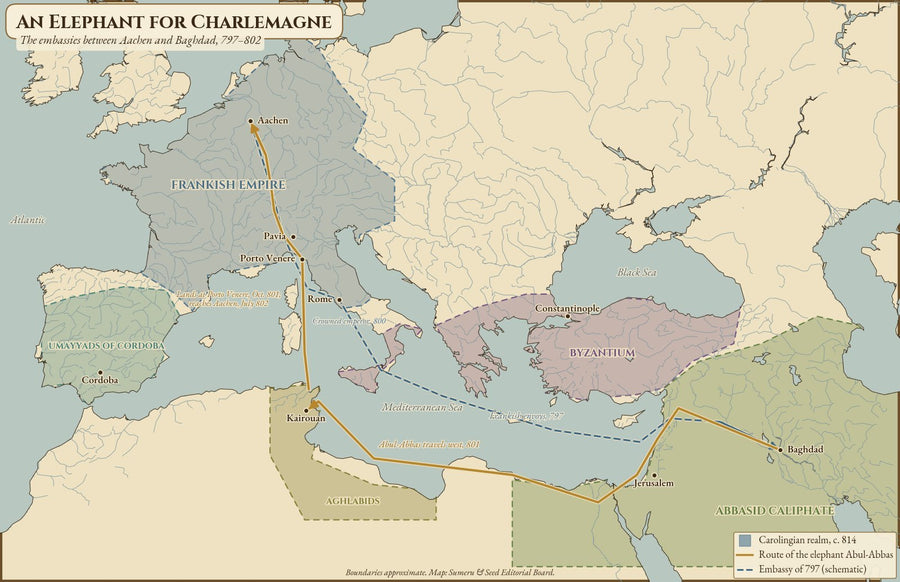
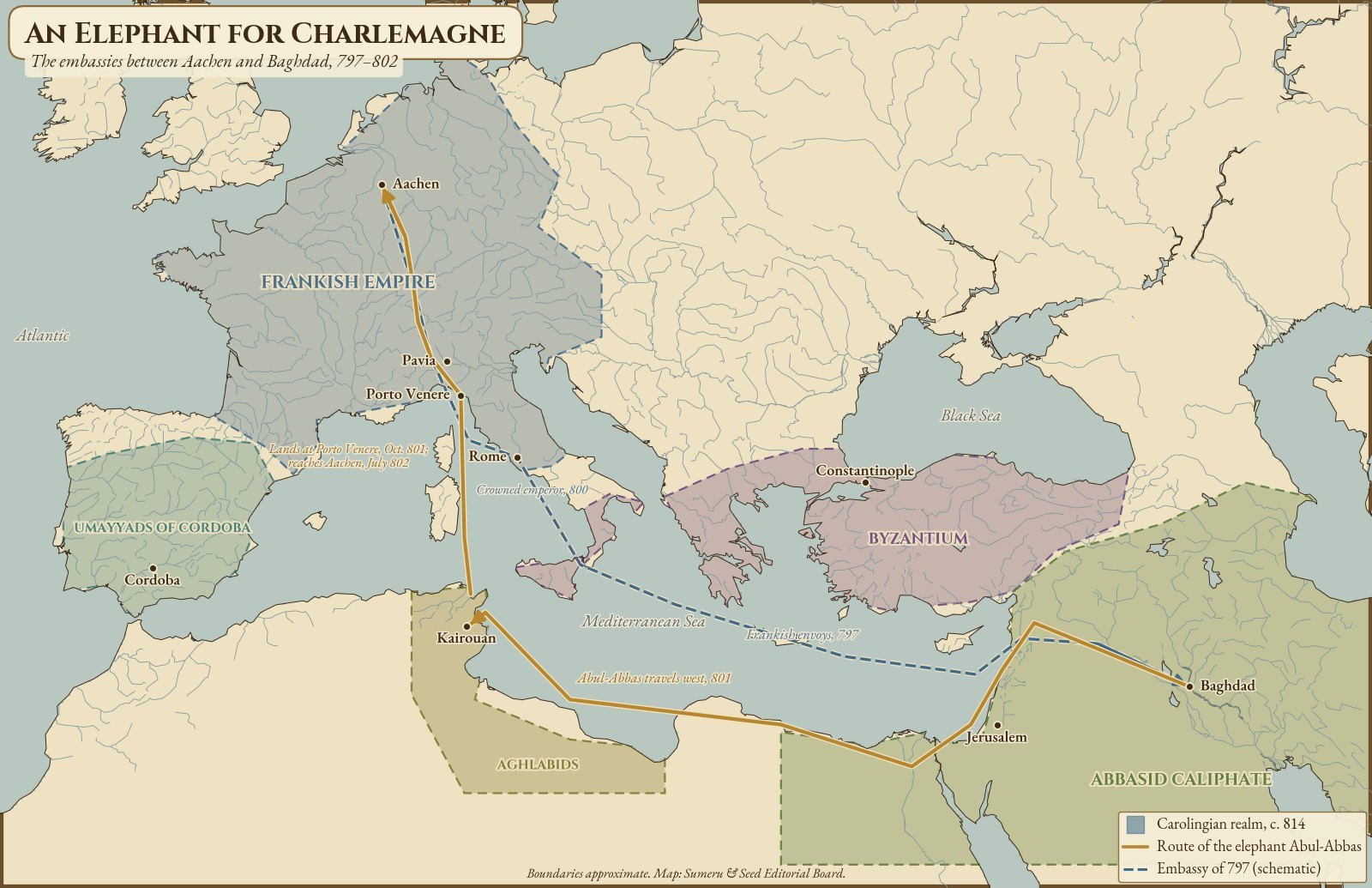
The diplomatic logic was simple. Charlemagne and Harun shared two rivals: the Byzantines and the Umayyads of Spain. In 797 Charlemagne sent three envoys to Baghdad: Lantfrid, Sigimund and a Jewish merchant called Isaac, presumably chosen for his languages and his knowledge of the routes. Four years later, in 801, Charlemagne learned in Italy that envoys from the caliph had landed at Pisa and that Isaac was returning with great gifts, including an elephant. Lantfrid and Sigimund had died on the way.3
The return journey was long. Isaac brought the elephant across North Africa to the Aghlabid lands, and Charlemagne sent a fleet from Liguria to collect him. He landed at Porto Venere, near La Spezia, in October 801, wintered at Vercelli because the Alpine passes were closed, and reached Aachen the following July.4 Einhard, Charlemagne's biographer, adds that Harun sent the elephant because it was the only one he had, and that the caliph also granted Charlemagne rights over the holy places in Jerusalem — a claim that later legend expanded into a Frankish protectorate over the Holy Land.5
What did the elephant mean?
For Charlemagne the gift was a political message. On Christmas Day 800 Pope Leo III had crowned him emperor of the Romans in St Peter's — a title the Byzantines regarded as a usurpation, since in their eyes there was only one Roman emperor, in Constantinople. An exotic gift from the greatest ruler of the East confirmed that Charlemagne was a sovereign of the first rank. Elephants had long been symbols of imperial power; Roman emperors had paraded them in triumphs.
For Harun, the relationship was much less important. No surviving Arabic source mentions Charlemagne or the embassy. Historians have noted this silence; the Franks were a distant people on the edge of the Abbasid horizon, useful perhaps against the Umayyads of Spain but no more.6 The asymmetry is itself instructive: from Aachen, Baghdad was the centre of the world; from Baghdad, Aachen was barely visible.
From the cards of Sumeru Chess, Chapter IV.
Silver, slaves and the Pirenne thesis
The elephant also raises a famous question in economic history. In the 1930s the Belgian historian Henri Pirenne argued that the Arab conquests of the seventh century cut the Mediterranean in two, isolating western Europe and forcing the Carolingians to build an inland, agrarian economy — "without Muhammad, Charlemagne would be inconceivable."7 Later scholars have heavily revised this view. Archaeology has shown that Mediterranean trade had declined long before the Arab conquests, and that by the late eighth century new trade routes were opening up.
Michael McCormick's monumental study of Carolingian communications collected hundreds of journeys by envoys, pilgrims, merchants and slaves between western Europe and the eastern Mediterranean. He argued that the early medieval European economy revived in part because it was selling slaves — many of them Slavs captured on the eastern frontier — to the Islamic world, in exchange for silver and luxury goods.8 The Viking routes through Russia and the Venetian merchants in the Adriatic were part of the same system. One striking piece of evidence is a gold coin of King Offa of Mercia, struck in imitation of an Abbasid dinar of 774, Arabic inscription and all, now in the British Museum.
Byzantium in the middle
Byzantium was the third point in the triangle. Irene briefly considered a marriage alliance with Charlemagne, according to the Byzantine chronicler Theophanes, but she was overthrown in 802. The Byzantines and Franks fought over Venice and Dalmatia until a treaty in 812 in which Constantinople finally recognised Charlemagne as an emperor — though not as emperor of the Romans.9 With the Abbasids, Byzantium fought a constant frontier war in Anatolia; Harun himself led raids across the Taurus and in 806 captured Heraclea.
A connected world
The story of Abul-Abbas shows a Mediterranean world that was divided by religion and rivalry but still bound together by diplomacy and trade. Envoys could travel from the Rhine to the Tigris; a Jewish merchant could act for a Christian emperor at a Muslim court; an Indian elephant could walk through the Alps. It was in this world that the Vikings began to raid, and that the Rus would soon open a new route between the Baltic and Baghdad. The three empires of the year 800 would all be transformed in the next century — but the links between them never entirely broke.
Notes
- Royal Frankish Annals, s.a. 802; trans. Bernhard Walter Scholz, Carolingian Chronicles (Ann Arbor: University of Michigan Press, 1970). The death of the elephant is recorded s.a. 810. ↩
- Royal Frankish Annals, s.a. 782. ↩
- Royal Frankish Annals, s.a. 801. ↩
- Royal Frankish Annals, s.a. 801–802. ↩
- Einhard, Life of Charlemagne 16; trans. Paul Edward Dutton, Charlemagne's Courtier: The Complete Einhard (Peterborough, ON: Broadview Press, 1998). ↩
- Hugh Kennedy, When Baghdad Ruled the Muslim World: The Rise and Fall of Islam's Greatest Dynasty (Cambridge, MA: Da Capo Press, 2005); Richard Hodges and David Whitehouse, Mohammed, Charlemagne and the Origins of Europe (London: Duckworth, 1983). ↩
- Henri Pirenne, Mohammed and Charlemagne, trans. Bernard Miall (London: George Allen & Unwin, 1939). ↩
- Michael McCormick, Origins of the European Economy: Communications and Commerce, AD 300–900 (Cambridge: Cambridge University Press, 2001). ↩
- Theophanes, Chronographia, AM 6293 (800/801); trans. Cyril Mango and Roger Scott, The Chronicle of Theophanes Confessor (Oxford: Clarendon Press, 1997). ↩
Further Reading
- Rosamond McKitterick, Charlemagne: The Formation of a European Identity (Cambridge University Press, 2008).
- Michael McCormick, Origins of the European Economy (Cambridge University Press, 2001).
- Hugh Kennedy, When Baghdad Ruled the Muslim World: The Rise and Fall of Islam's Greatest Dynasty (Da Capo Press, 2005).
- Richard Hodges and David Whitehouse, Mohammed, Charlemagne and the Origins of Europe (Duckworth, 1983).