
The Battle of Thermopylae, 480 BCE: Leonidas at the Hot Gates
Sumeru & Seed Editorial BoardField Report · Chapter II · August–September 480 BCE · Central Greece
Between the mountains and the sea the road was barely wide enough for a cart. For two days some 7,000 Greeks held it against the largest army the world had seen; on the third, betrayed by a mountain path, three hundred Spartans stayed to die.
Part I · The battle
Result A Persian victory — and the most famous last stand in history.
Why it is remembered
- Numbers made useless. In the narrow pass only a few men could fight at once; the Greek hoplites with their long spears and big shields beat back wave after wave.
- The path over the mountain. A local man, Ephialtes, led the Immortals by night along the Anopaea path to the Greek rear.
- The choice to stay. Leonidas sent most of the army away and stayed with his three hundred, the Thespians and the Thebans to cover the retreat.
Xerxes crossed the Hellespont on a bridge of boats in 480 BCE to punish Athens and conquer Greece. The Greek allies chose to stop him where the road from the north squeezed between the mountains and the sea, while their fleet held the straits at Artemisium.1
Leonidas rebuilt an old wall of the Phocians across the narrowest point. Xerxes waited four days, expecting the Greeks to run; they did not.2
The battle, step by step
- Day one. Medes and Kissians attack and are cut down in the narrows; then the Immortals themselves fail. The Spartans feign retreat and turn on their pursuers.3
- Day two. The attacks continue with the same result.
- The night march. Ephialtes guides Hydarnes and the Immortals over the mountain path; the Phocians posted there give way.4
- Day three. Warned at dawn, Leonidas dismisses most of the allies. With the Spartans, 700 Thespians and 400 Thebans he advances into the wider part of the pass to fight in the open.
- The last stand. Leonidas falls; his men fight over his body, then retreat to a hillock behind the wall and die there under arrows from every side.5
“Go tell the Spartans, stranger passing by, that here, obedient to their laws, we lie.” — Simonides' epitaph at Thermopylae6
What followed
Xerxes marched on and burned Athens, whose people had fled to Salamis. A few weeks later the Greek fleet destroyed his at Salamis, and in 479 BCE the Greeks crushed the Persian army at Plataea. Thermopylae became the model of courage against hopeless odds.7
Part II · Play it in Sumeru Chess
Thermopylae on the chessboard
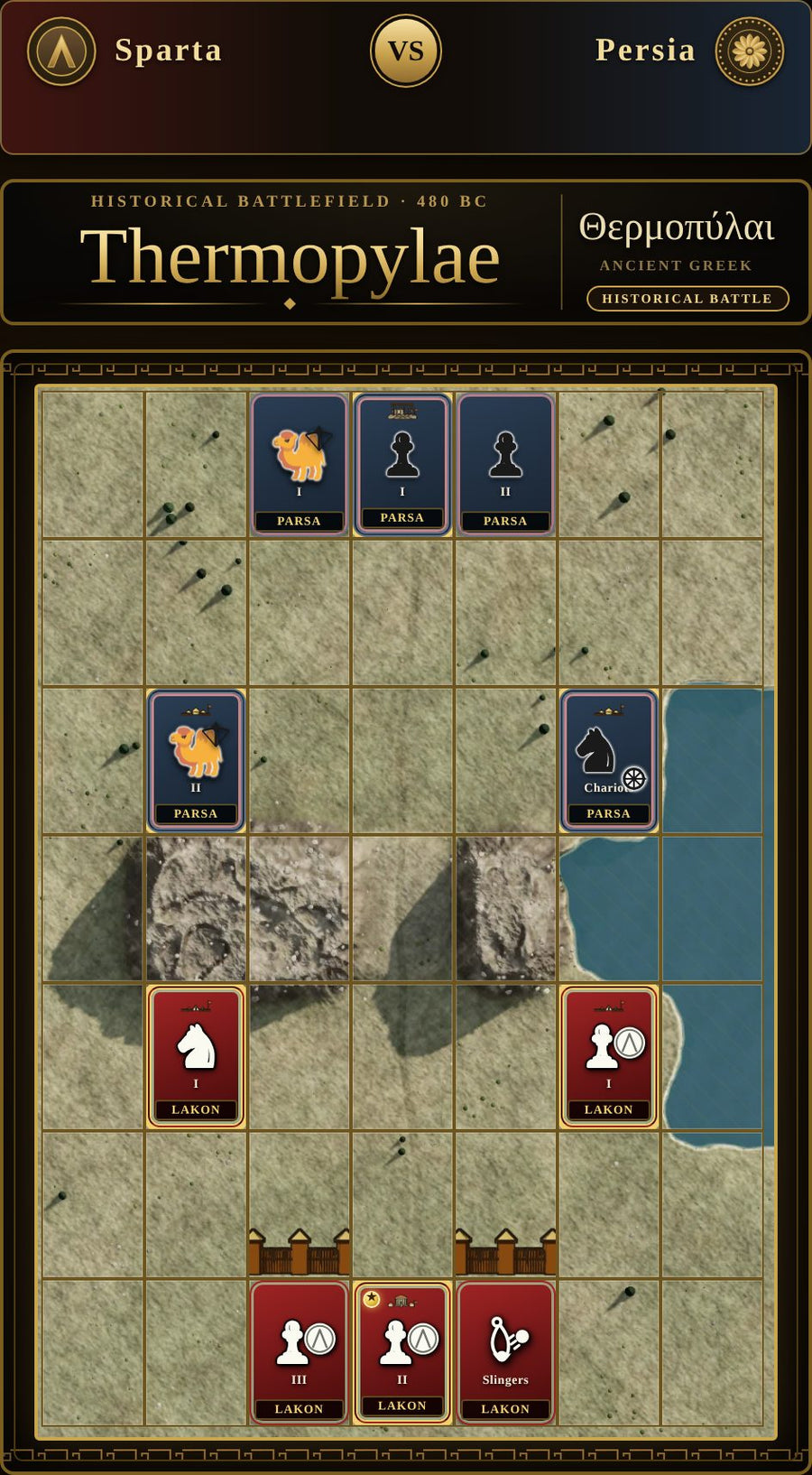
Thermopylae is one of the historical battlefields of Chapter II of Sumeru Chess, the Age of Spears & Arrows. It is a 7 × 7 board drawn from the real ground: the Sparta side deploys from The Hot Gates, the Persia side from Trachis.
- Rocks are impassable.
- The pass is a narrow road between cliffs: armies move through it as on open ground.
- Walls can be held only by your own foot archers, crossbowmen and throwers: +1 ATK, +1 SPD, and only missiles can reach them.
Where to find it
- Conquest Campaign. Lead Sparta against Persia, or Persia against Sparta: Thermopylae is the first of the two historical battles of that war (the other is Plataea), and the war ends at the enemy capital.
Fight it like history
- Hold the narrows. The Thermopylae board is closed by rocks and the wall; few squares are open. Let the enemy come at you where only one army can attack at a time.
- Put missiles on the wall. Only your own foot archers, crossbowmen and throwers can stand on it, at +1 ATK, and only missiles can reach them there.
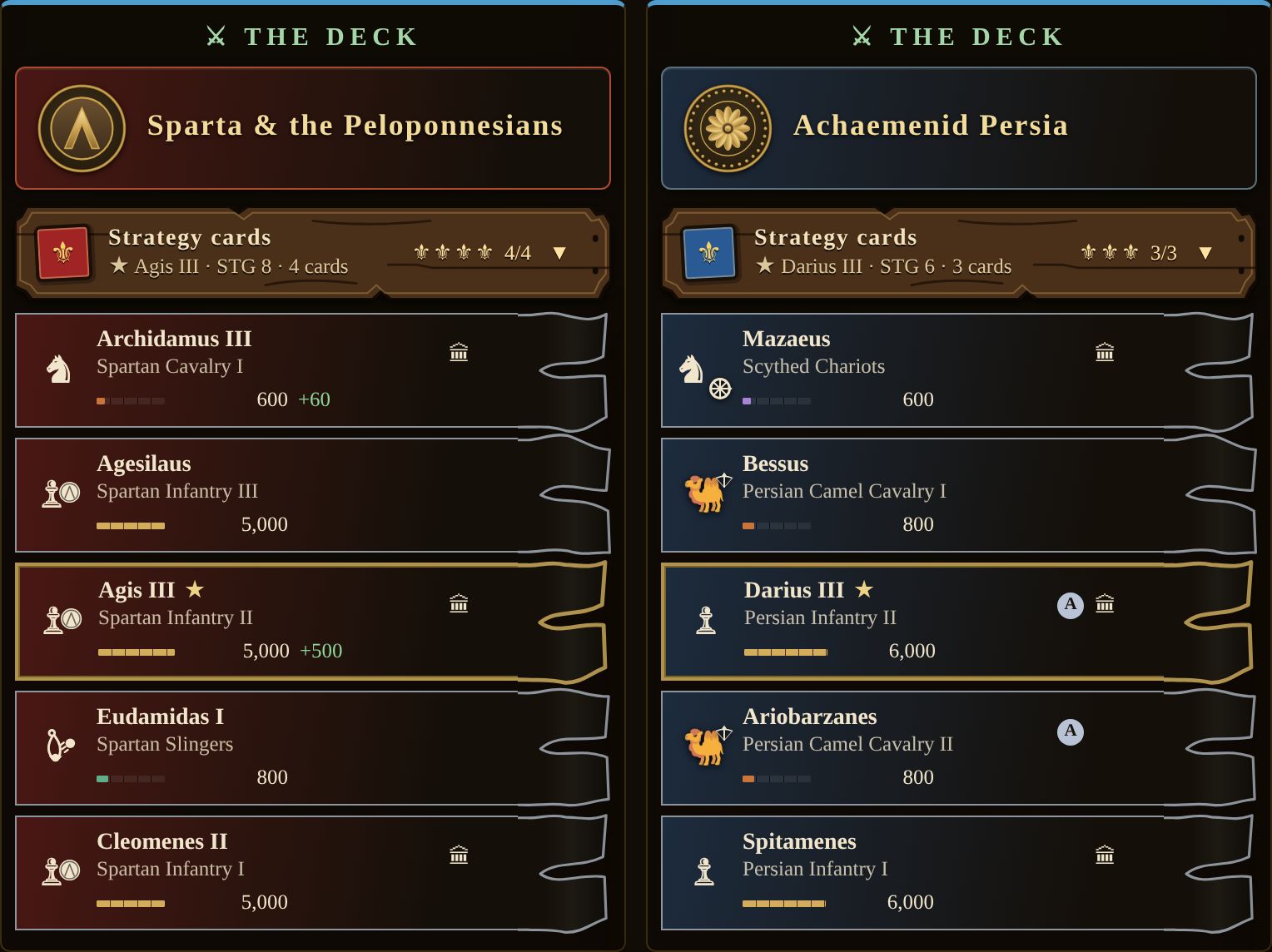
- Kill the commander. If the enemy's ★ Chief Commander is routed, his side plays no more strategy cards and every army loses 2 MOR.
Chapter II is for Sumeru Premium members — one membership opens every chapter of Sumeru Chess and Imperion 1776. Anyone can read its rulebook and browse its cards.
Play Chapter IIOpen the Card CollectionNotes and sources (7)
- Herodotus 7.33–36, 7.175–177. ↩
- Herodotus 7.176, 7.210. ↩
- Herodotus 7.210–212. ↩
- Herodotus 7.213–218. ↩
- Herodotus 7.219–225. ↩
- Herodotus 7.228. ↩
- Herodotus 8.40–96, 9.1–89. ↩
Further reading
- Herodotus, The Histories, trans. Tom Holland (Penguin, 2013), Book 7.
- Paul Cartledge, Thermopylae: The Battle That Changed the World (Overlook, 2006).
- Tom Holland, Persian Fire (Little, Brown, 2005).