
The Battle of Carrhae, 53 BC: Crassus and the Parthian Arrows
Sumeru & Seed Editorial BoardField Report · Chapter III · 53 BC · Upper Mesopotamia
Seven legions marched into the open plain to win Crassus a war. Ten thousand Parthian horsemen, fed by a camel train of arrows, shot them to pieces without ever closing. Rome's eagles hung in Parthian temples for thirty years.
Part I · The battle
Result A crushing Parthian victory and the death of Crassus.
Why it is remembered
- Horse against foot. For the first time a great Roman army met an enemy it could neither catch nor outlast. The Parthians shot, wheeled away and shot again.
- The arrows never ran out. Surena had a thousand camels carrying fresh arrows to the line — the Romans' hope that the archers would empty their quivers was in vain.
- The end of the triumvirate. Crassus' death broke the alliance with Caesar and Pompey; four years later they were at war with each other.
Crassus, the richest man in Rome, had wealth and a triumph over Spartacus but no great foreign conquest to match Caesar and Pompey. As governor of Syria he invaded Parthia, refusing the Armenian king's advice to come through the hills, and marched across the open plain of Mesopotamia.1
Surena met him near Carrhae. He hid his armoured cataphracts under cloaks, then threw them off to the sound of war drums; when the Romans formed a hollow square, the horse archers surrounded it and began to shoot.2
The battle, step by step
- The square. The legions form a great hollow square on the plain; the horse archers ride round it, shooting into the packed ranks.
- The arrows keep coming. The Romans wait for the quivers to empty — then see the camel train bringing more.3
- Publius' charge. Crassus' son leads 1,300 horse, 500 archers and eight cohorts out to drive the enemy off. The Parthians feign flight, draw him away, surround him and destroy his force; his head is carried on a spear past his father's lines.4
- Night retreat. The Romans abandon 4,000 wounded and fall back on Carrhae, then try to slip away.
- The parley. Surena offers terms; at the meeting a scuffle breaks out and Crassus is killed. Of his army, some 10,000 escape.5
What followed
Rome lost seven eagles at Carrhae. Cassius, the future assassin of Caesar, saved what was left and held Syria. Augustus finally recovered the standards by treaty in 20 BC and celebrated it on coins and on the breastplate of the Prima Porta statue.6
Part II · Play it with Imperium Cards
Carrhae with the physical cards
Carrhae is played with Edition II · The Third Servile War, where Crassus is a commander; Parthia gets its own cards in Edition IV · The Eagle Wars, coming later. The card battle below has been with the sets since their first printing.


In 53 BC, Crassus led seven legions into the Mesopotamian desert, where Surena's horse archers encircled them in the scorching heat. Unable to close with an enemy that never stopped moving, the Roman square crumbled under relentless arrow fire — Crassus died in the rout, and Rome lost 20,000 men.
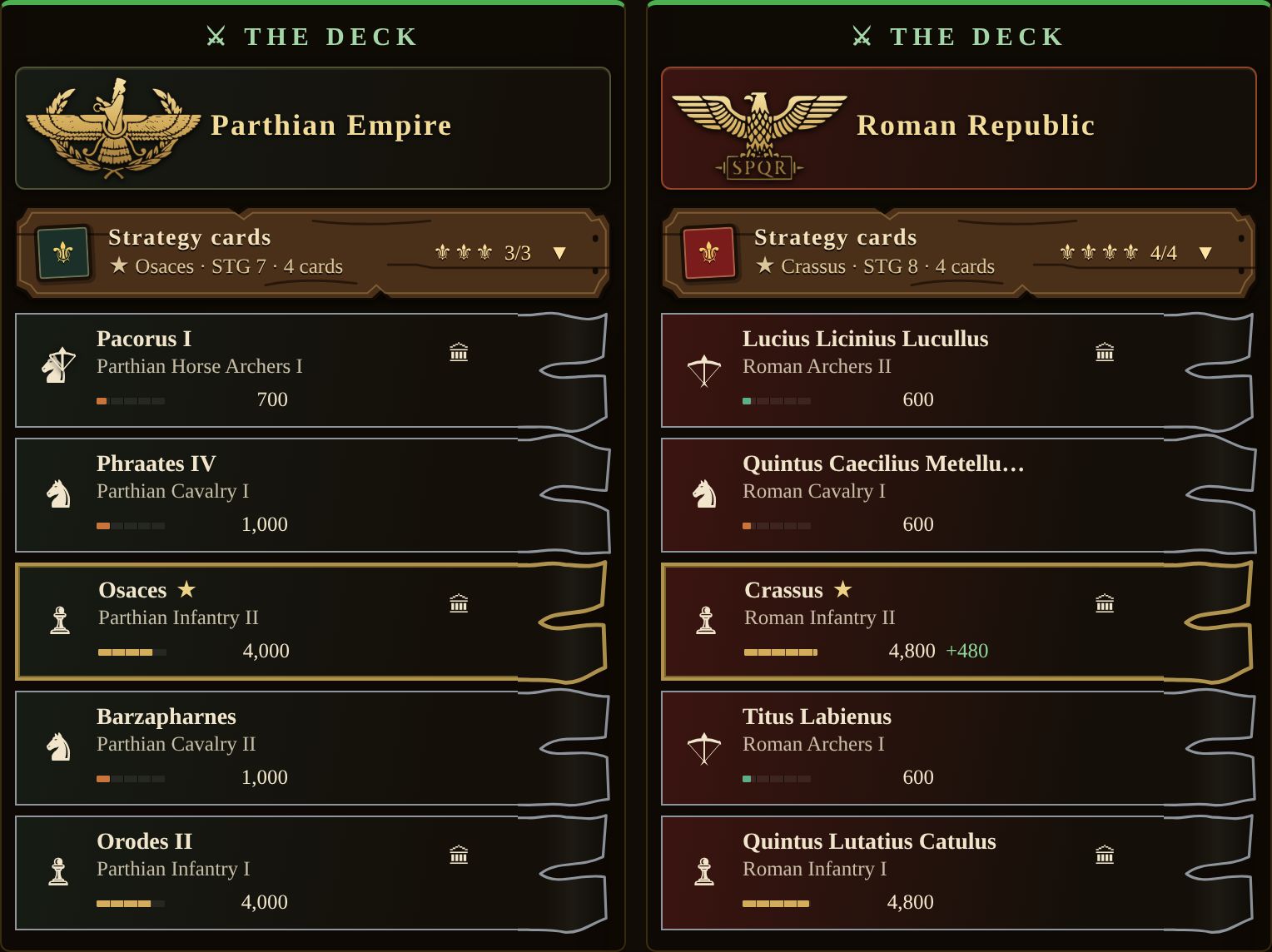
Order of battle
Battle sequence
- Phase IRoman army advances into open desert
- Phase IIParthian horse archers begin continuous encirclement
- Phase IIIPublius Crassus charges and is isolated and destroyed
- Phase IVRoman formation collapses — Crassus killed in rout
A decisive Parthian victory through mounted archery and encirclement — Rome's worst defeat in the East, and the death of the First Triumvirate.
Could you have broken the encirclement?
Find Crassus in Edition II — Edition IV The Eagle Wars coming Late 2026
 Edition II · Third Servile War · Core SetBuy on Amazon ›
 Edition IV · The Eagle Wars · Late 2026Coming soon
Part III · Play it in Sumeru Chess
Carrhae on the chessboard
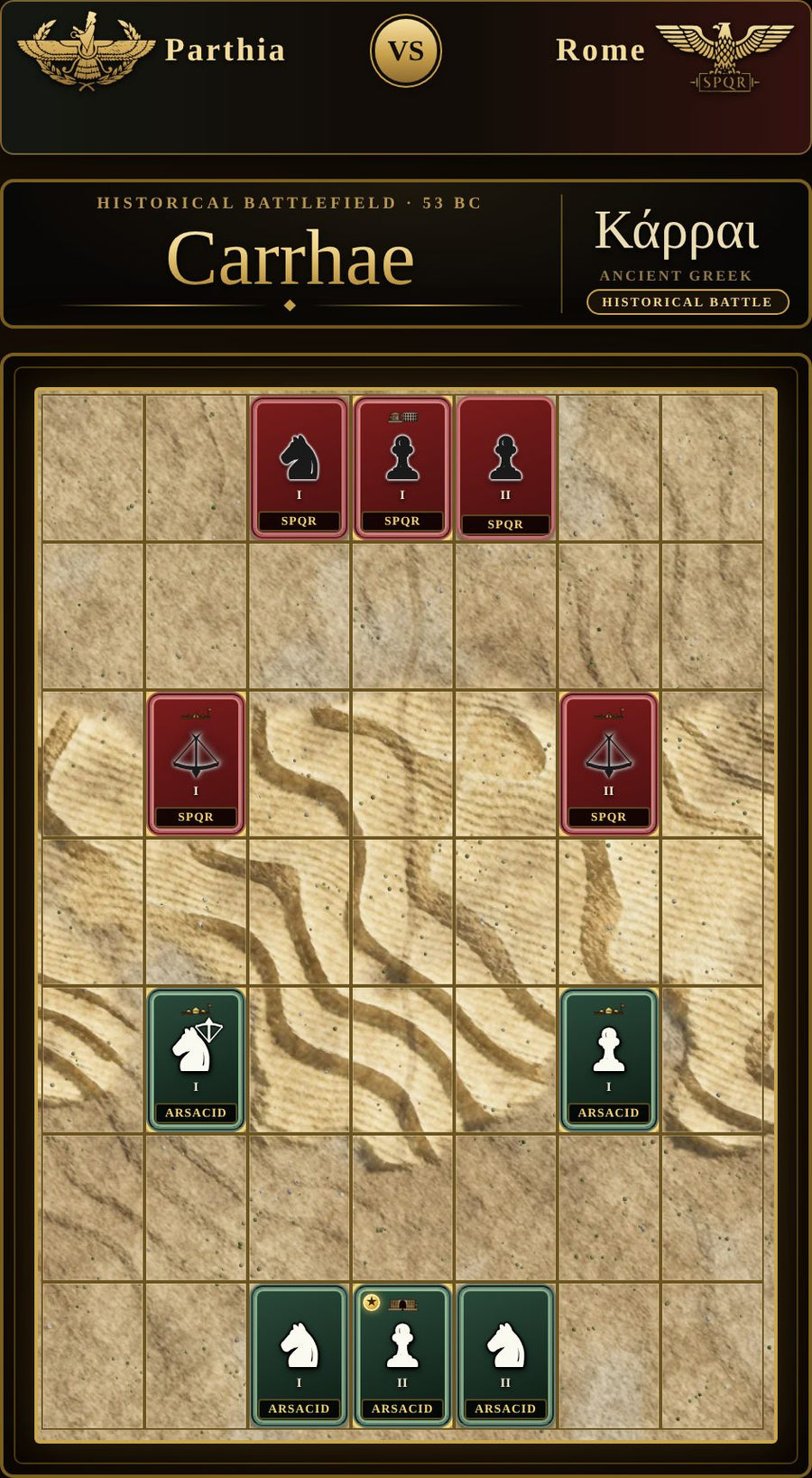
Carrhae is one of the historical battlefields of Chapter III of Sumeru Chess, the Age of Iron & Glory. It is a 7 × 7 board drawn from the real ground: the Parthia side deploys from Ichnae, the Rome side from Carrhae.
- Rocks are impassable.
Where to find it
- Conquest Campaign. Lead Parthia against Rome, or Rome against Parthia: Carrhae is the first of the two historical battles of that war (the other is the Amanus), and the war ends at the enemy capital.
Fight it like history
- Do not stand still under arrows. Missile armies shoot first; close the distance or leave their range.
- Never chase alone. Publius' charge is the classic trap: an army that runs out ahead can be pinned and finished by 2 vs 1.
- The rocks of the Carrhae board are impassable. They narrow the plain — use them to cover a flank.
Chapter III is free to play in your browser, no download: Rome and Carthage are open to everyone; the other powers of the age come with Sumeru Premium.
Play Chapter IIIOpen the Card CollectionNotes and sources (6)
- Plutarch, Crassus 16–22; Cassius Dio 40.12–20. ↩
- Plutarch, Crassus 23–24. ↩
- Plutarch, Crassus 25. ↩
- Plutarch, Crassus 25–26. ↩
- Plutarch, Crassus 27–31; Cassius Dio 40.21–27. ↩
- Augustus, Res Gestae 29; Cassius Dio 54.8. ↩
Further reading
- Plutarch, Life of Crassus (Loeb or Penguin Fall of the Roman Republic).
- Gareth C. Sampson, The Defeat of Rome: Crassus, Carrhae and the Invasion of the East (Pen & Sword, 2008).
- Raoul McLaughlin, Rome and the Distant East (Continuum, 2010).