
Galen and Zhang Zhongjing: Two Physicians in an Age of Plague
Sumeru & Seed Editorial BoardAt the end of the second century CE, as epidemics swept both ends of Eurasia, a Greek doctor in Rome and a Chinese physician in the Han empire wrote the works that would define medicine in their worlds for more than a thousand years.

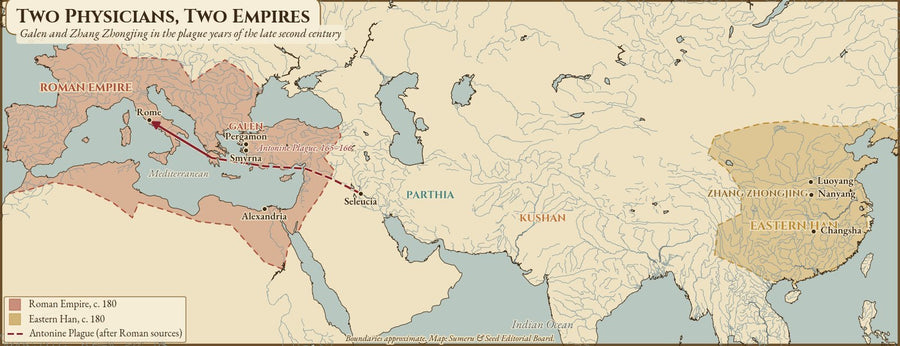
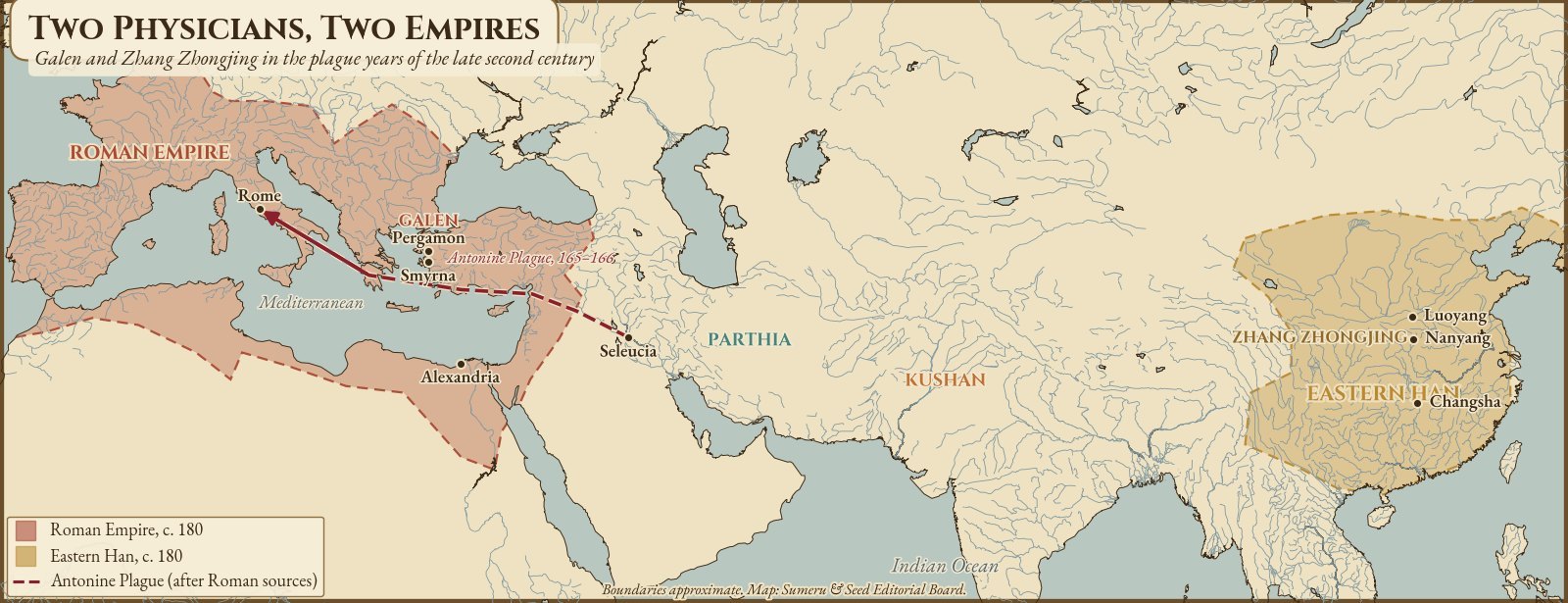
In the year 166 CE a Greek physician of about thirty-seven left Rome in a hurry and went home to Pergamon in Asia Minor. He later said that he had left because of the hostility of jealous rivals; his critics then and since have suspected that he was fleeing the plague that had just reached the city.1 His name was Galen. A few decades later, on the other side of Eurasia, a physician from Nanyang in the Han empire sat down to write a book about the epidemic diseases that, he said, had killed most of his large clan. His name was Zhang Ji, better known as Zhang Zhongjing. The two men never heard of each other. But their lives ran in parallel, and the books they wrote shaped medicine in their worlds for well over a thousand years.
Galen of Pergamon
Galen was born in Pergamon in 129 CE, the son of a wealthy architect who, he said, was told in a dream to make his son a doctor. He studied medicine in Smyrna, Corinth and Alexandria, then returned to Pergamon, where for four years he was physician to the gladiators of the high priest — a job that gave him unrivalled experience of wounds.2 In 162 he went to Rome, where he made his name with public anatomical demonstrations. In one famous demonstration he cut the recurrent laryngeal nerve of a squealing pig, and the animal fell silent: proof that the voice was controlled by the brain, not, as many believed, by the heart.3
Recalled to Rome by the emperor Marcus Aurelius in 168–169, Galen spent the rest of his long life as a court physician and writer. He was astonishingly productive: his surviving works fill more than twenty volumes in the standard modern edition. In them he combined the Hippocratic theory of the four humours — blood, phlegm, yellow bile and black bile — with anatomy learned by dissecting animals, a theory of the pulse, and a systematic pharmacology. He insisted that a good doctor must also be a philosopher, trained in logic.4
The Antonine Plague
The plague that drove Galen from Rome had arrived with soldiers returning from Lucius Verus' war against Parthia in 165–166. Roman tradition said it had emerged when soldiers looted a temple at Seleucia on the Tigris. Galen described its symptoms — fever, diarrhoea, and a dark rash that blistered and scabbed — in enough detail that most historians think it was smallpox.5 It returned in waves for more than twenty years. How many it killed is fiercely debated; estimates range from a few percent of the empire's population to a quarter or more. Kyle Harper has argued that it was a turning point in the history of the Roman Empire.6
In 192 a fire in Rome destroyed the Temple of Peace, where Galen kept many of his books, drugs and instruments. In 2005 a scholar working in a monastery in Thessaloniki found a lost treatise of his, On Avoiding Grief, in which he describes the loss — and how a philosopher should bear it.7 Galen died around 216, probably in his late eighties.
Zhang Zhongjing of Nanyang
Much less is known about Zhang Zhongjing's life. He came from Nanyang, in what is now Henan, and was probably active around 200 CE, in the last turbulent decades of the Eastern Han. A later tradition says he served as governor of Changsha, but this appears only in sources written centuries after his death, and many historians doubt it.8
What we do know comes from the preface to his book, the Treatise on Cold Damage and Miscellaneous Diseases (Shanghan zabing lun). There he wrote that his clan had once numbered more than two hundred people, and that within ten years of the start of the Jian'an era (196 CE) two-thirds had died, seven out of ten of them from "cold damage" (shanghan), a term for acute febrile illness. Grieving the loss, he gathered ancient texts and prescriptions and wrote his book.9 The late Han suffered repeated epidemics; the poet and prince Cao Zhi described one in 217, when households were filled with the sound of weeping.
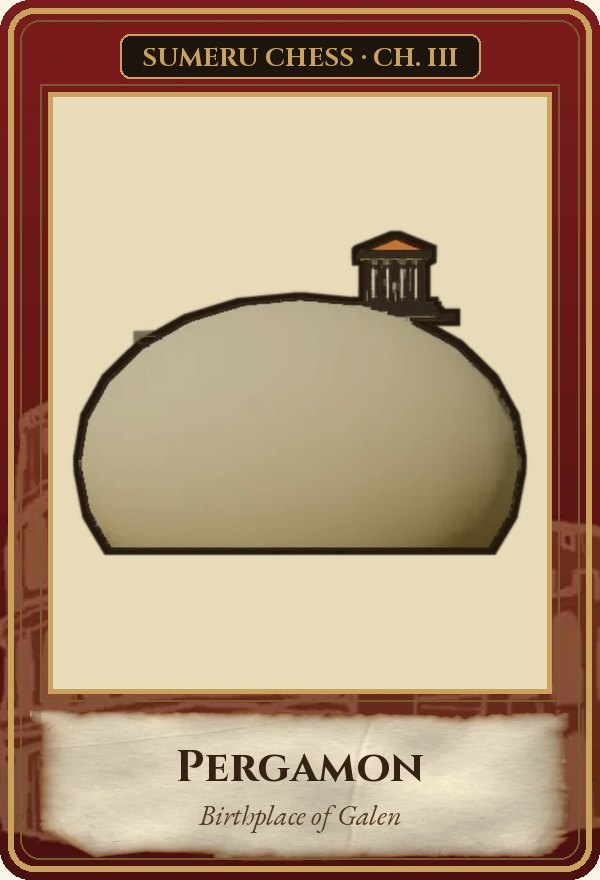
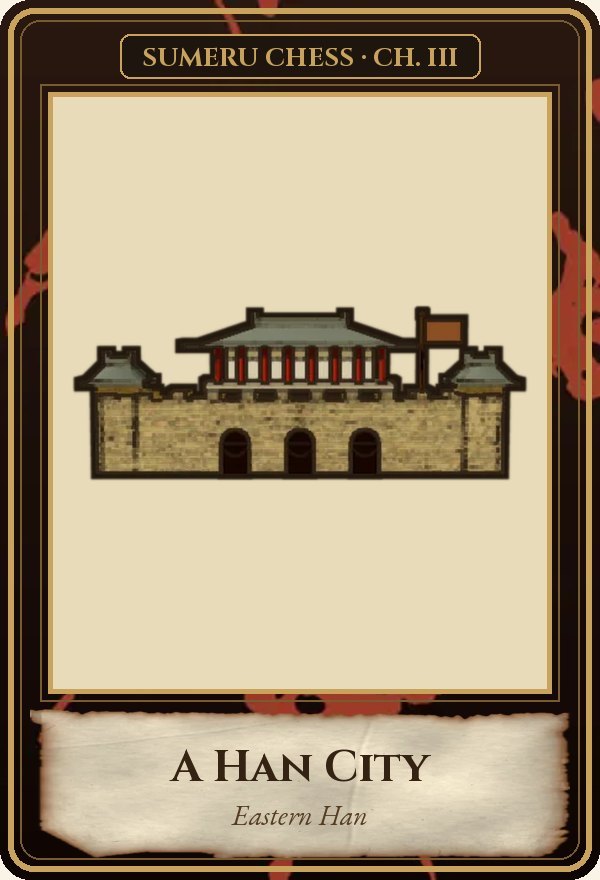
From the cards of Sumeru Chess, Chapter III.
The Treatise on Cold Damage
Zhang Zhongjing's achievement was to turn a mass of remedies into a system. His treatise follows the progress of a febrile disease through six stages or "channels" (liujing) — from the outer taiyang stage, with chills, fever and headache, to the deep jueyin stage — and gives, for each pattern of symptoms, a specific prescription. Many of his formulas, such as the cinnamon-twig decoction (guizhi tang) and the ephedra decoction (mahuang tang), are still prescribed in East Asian medicine today.10
His text did not survive intact. It was reconstructed in the third century by the court physician Wang Shuhe and edited again in 1065 by the imperial Bureau for Revising Medical Texts of the Song dynasty, which divided it into two books, the Shanghan lun and the Jingui yaolüe (Essentials of the Golden Cabinet). From then on, Zhang Zhongjing was revered as the "Sage of Medicine" (yisheng).11
Two systems, two legacies
Paul Unschuld and other historians of medicine have warned against simple comparisons between Greek and Chinese medicine: they rested on different ideas of the body and of nature.12 Galen's medicine was built on anatomy and the balance of humours; Zhang Zhongjing's on the movement of disease through the body's channels and the balance of yin and yang. Galen argued and boasted in the first person; Zhang Zhongjing set out patterns and prescriptions with almost no theory at all.
Yet the parallels are striking. Both men were shaped by epidemics. Both organised the scattered knowledge of their predecessors into systems that could be taught. And both became authorities so great that, for more than a thousand years, later physicians in their worlds wrote largely as their commentators. Galen's works, translated into Arabic in Baghdad and into Latin in Europe, dominated Western and Islamic medicine until the seventeenth century; Zhang Zhongjing's remain part of the training of practitioners of Chinese medicine today.
Notes
- Galen, On My Own Books 1; see Vivian Nutton, Ancient Medicine, 2nd ed. (London: Routledge, 2013). ↩
- Susan P. Mattern, The Prince of Medicine: Galen in the Roman Empire (New York: Oxford University Press, 2013). ↩
- Galen, On Anatomical Procedures; Mattern, Prince of Medicine. ↩
- Galen, That the Best Physician Is Also a Philosopher; trans. in P. N. Singer, Galen: Selected Works (Oxford: Oxford University Press, 1997). ↩
- R. J. Littman and M. L. Littman, "Galen and the Antonine Plague," American Journal of Philology 94, no. 3 (1973): 243–255. ↩
- Kyle Harper, The Fate of Rome: Climate, Disease, and the End of an Empire (Princeton: Princeton University Press, 2017). ↩
- Galen, On Avoiding Grief (De indolentia), ed. Véronique Boudon-Millot and Jacques Jouanna (Paris: Les Belles Lettres, 2010); English trans. by Vivian Nutton in P. N. Singer, ed., Galen: Psychological Writings (Cambridge: Cambridge University Press, 2013). ↩
- On the tradition see Paul U. Unschuld, Medicine in China: A History of Ideas (Berkeley: University of California Press, 1985). ↩
- Zhang Zhongjing, preface to the Shanghan zabing lun; trans. Craig Mitchell, Feng Ye and Nigel Wiseman, Shang Han Lun: On Cold Damage (Brookline, MA: Paradigm Publications, 1999). ↩
- Mitchell, Feng and Wiseman, Shang Han Lun. ↩
- Unschuld, Medicine in China; Asaf Goldschmidt, The Evolution of Chinese Medicine: Song Dynasty, 960–1200 (London: Routledge, 2009). ↩
- Unschuld, Medicine in China; see also Shigehisa Kuriyama, The Expressiveness of the Body and the Divergence of Greek and Chinese Medicine (New York: Zone Books, 1999). ↩
Further Reading
- Vivian Nutton, Ancient Medicine (Routledge, 2nd ed. 2013).
- Susan P. Mattern, The Prince of Medicine: Galen in the Roman Empire (Oxford University Press, 2013).
- Paul U. Unschuld, Medicine in China: A History of Ideas (University of California Press, 1985).
- Shigehisa Kuriyama, The Expressiveness of the Body and the Divergence of Greek and Chinese Medicine (Zone Books, 1999).