
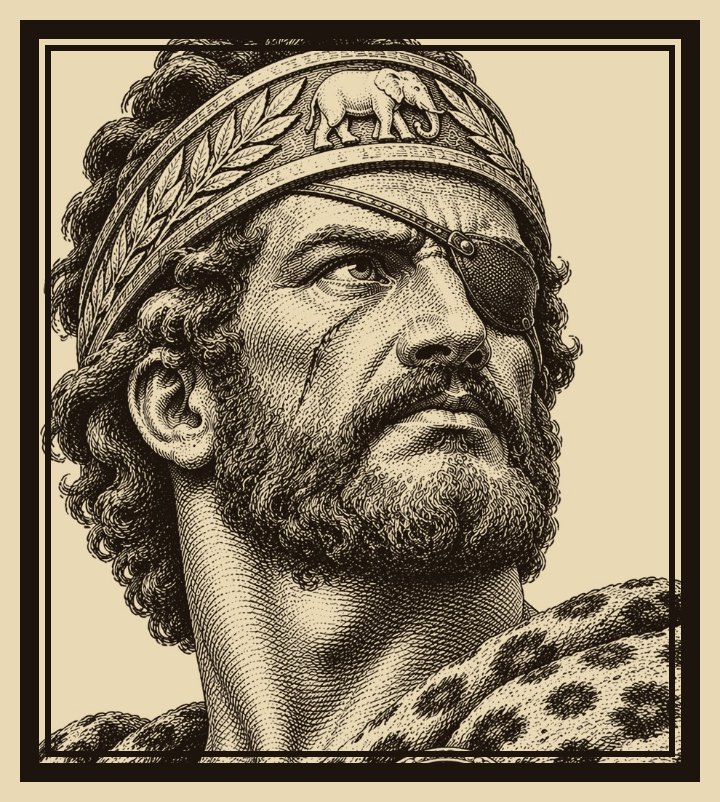
Hannibal Barca: The Life of Rome's Greatest Enemy
Sumeru & Seed Editorial BoardHe crossed the Alps with elephants, destroyed Roman armies for fifteen years in Italy and never took Rome. Hannibal's life is a study in brilliance, endurance and the limits of what a general can do against a state.

Almost everything we know about Hannibal comes from his enemies. The Greek historian Polybius, who wrote about fifty years after the war and knew men who had fought in it, admired him; the Roman Livy, writing under Augustus, both feared and grudgingly respected him. No Carthaginian account survives. Yet even through Roman eyes, Hannibal Barca emerges as one of the most remarkable commanders of the ancient world.1
A family at war
Hannibal was born in 247 BCE, the eldest son of Hamilcar Barca, Carthage's leading general in the First Punic War (264–241 BCE). That war cost Carthage Sicily and, soon afterwards, Sardinia. Hamilcar turned to Spain, where between 237 and his death in 229 he built a new Carthaginian dominion based on the silver mines of the south. His son-in-law Hasdrubal continued the work and founded the city of Carthago Nova (Cartagena).
Polybius tells a story that Hannibal himself told many years later to King Antiochus III: when he was nine, before setting out for Spain with his father, he asked to go along, and Hamilcar made him lay his hand on a sacrificial victim and swear never to be a friend of Rome.2 Whether or not it happened exactly so, Hannibal spent his whole life fulfilling that oath.
Over the Alps
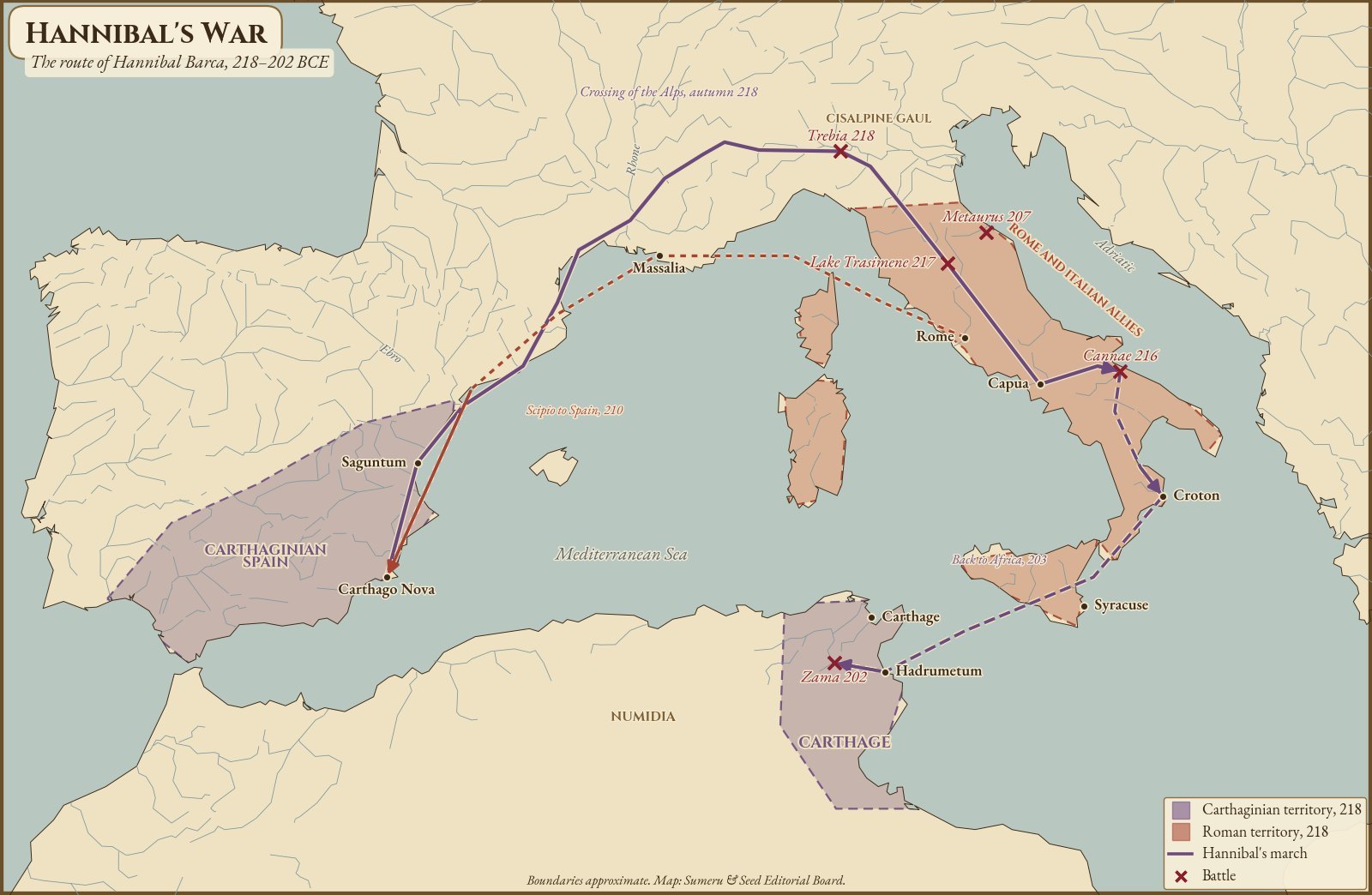
In 221 BCE, aged twenty-five or twenty-six, Hannibal was acclaimed commander in Spain by the army. In 219 he besieged Saguntum, a city allied to Rome, and Rome declared war. Instead of waiting to be attacked, Hannibal took the war to Italy — by land.
In the spring of 218 he set out from Carthago Nova with a large army and some thirty-seven elephants, crossed the Ebro and the Pyrenees, fought his way across the Rhône and in the autumn crossed the Alps. The pass he used is still debated. The crossing, in snow, under attack from mountain tribes and on narrow tracks, cost him a large part of his army. Polybius, who had seen the Alpine route himself, says that Hannibal arrived in Italy with 12,000 African and 8,000 Iberian infantry and no more than 6,000 cavalry.3
Trebia, Trasimene, Cannae
What followed was the most brilliant series of victories in Roman military history — won against Rome. At the Trebia in December 218 Hannibal lured a Roman army across an icy river and ambushed it. At Lake Trasimene in June 217 he hid his army in the hills above a lakeside road and destroyed a consular army in the morning mist; the consul Flaminius was killed.4
At Cannae in Apulia, on 2 August 216, Rome confronted him with the largest army it had ever fielded, perhaps 80,000 men. Hannibal placed his weakest troops, Gauls and Spaniards, in a forward-curving centre and his African veterans on the wings. As the Roman legions pushed into the centre, it bent back; the Africans turned inwards; and Hannibal's cavalry, having driven off the Roman horse, attacked from behind. The Roman army was surrounded and massacred. Livy gives 45,500 infantry and 2,700 cavalry killed; Polybius' figure is higher still.5 Cannae became the model of the battle of annihilation, studied by generals ever since.
From the cards of Sumeru Chess, Chapter III.
Why not Rome?
After Cannae, many of Rome's allies in southern Italy, including the great city of Capua, went over to Hannibal. According to Livy, his cavalry commander Maharbal told him that he knew how to win a victory but not how to use one.6 Hannibal did not march on Rome — and historians have debated his decision ever since. Most now think he was right: he had no siege train, Rome was strongly walled, and his strategy was not to capture the city but to break up its system of alliances and force it to negotiate.
The strategy failed because Rome refused to negotiate and its central Italian allies stayed loyal. Under the policy of Quintus Fabius Maximus, "the Delayer," the Romans avoided open battle, shadowed Hannibal's army and recovered lost cities one by one. Reinforcements from Carthage were rare. In 207 Hannibal's brother Hasdrubal crossed the Alps with a second army but was defeated and killed at the Metaurus; the Romans threw his head into Hannibal's camp.
Meanwhile a young Roman general, Publius Cornelius Scipio, conquered Carthaginian Spain and in 204 invaded Africa. Hannibal was recalled after fifteen years in Italy. At Zama in 202 BCE, facing Scipio and the Numidian cavalry of Masinissa, he was defeated for the first and only time in a major battle.7
Statesman and exile
Hannibal's career did not end at Zama. Elected sufete, one of the chief magistrates of Carthage, in 196, he reformed the city's finances and curbed the power of the ruling oligarchy so effectively that Carthage could pay its war indemnity to Rome early. His enemies denounced him to Rome, and he fled east to the court of the Seleucid king Antiochus III. After Antiochus was defeated by Rome at Magnesia in 190, Hannibal moved on, eventually to Bithynia. When Roman envoys demanded his surrender there, around 183–181 BCE, he took poison.8
Legacy
Rome never forgot him. "Hannibal at the gates" became a proverbial cry of alarm, and the memory of Cannae made Rome determined, fifty years later, to destroy Carthage altogether. For later soldiers, from Napoleon to the German general staff, Hannibal became the model of the commander who wins by manoeuvre against a stronger enemy. Modern historians stress the other side: that Hannibal's genius on the battlefield could not overcome the depth of Roman manpower, the loyalty of Rome's allies and a Senate that refused to admit defeat.9 His life is a reminder that battles are won by generals, but wars are won by states.
Notes
- For the sources see Dexter Hoyos, Hannibal's Dynasty: Power and Politics in the Western Mediterranean, 247–183 BC (London: Routledge, 2003), and Eve MacDonald, Hannibal: A Hellenistic Life (New Haven: Yale University Press, 2015). ↩
- Polybius, Histories 3.11; Livy 21.1.4. ↩
- Polybius 3.56.4. ↩
- Polybius 3.70–74 (Trebia) and 3.82–85 (Trasimene); Livy 21.52–56 and 22.4–7. ↩
- Livy 22.49.15; Polybius 3.117. See Adrian Goldsworthy, Cannae (London: Cassell, 2001). ↩
- Livy 22.51.4. ↩
- Polybius 15.9–16; Livy 30.29–35. ↩
- Livy 33.46–49 (sufeteship and flight); 39.51 (death). ↩
- Adrian Goldsworthy, The Fall of Carthage: The Punic Wars 265–146 BC (London: Cassell, 2000). ↩
Further Reading
- Polybius, The Rise of the Roman Empire, trans. Ian Scott-Kilvert (Penguin, 1979).
- Eve MacDonald, Hannibal: A Hellenistic Life (Yale University Press, 2015).
- Adrian Goldsworthy, The Fall of Carthage: The Punic Wars 265–146 BC (Cassell, 2000).
- Dexter Hoyos, Hannibal's Dynasty (Routledge, 2003).