
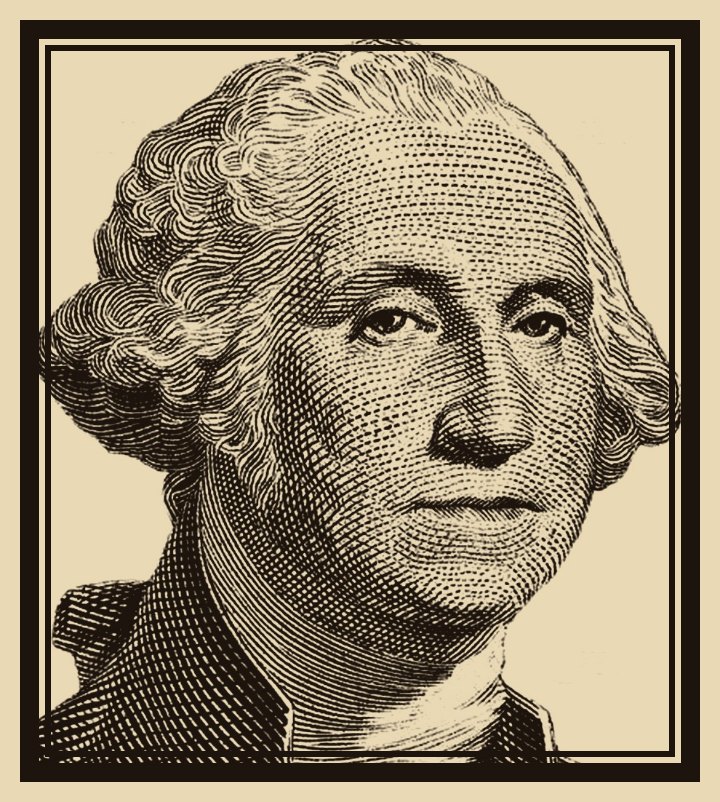
George Washington: The General Who Gave Power Back
Sumeru & Seed Editorial BoardHe lost more battles than he won. His greatness lay elsewhere: in keeping an army alive for eight years, and then — twice — in walking away from power when he could have kept it.
George Washington was born on 22 February 1732 on a tobacco farm in Westmoreland County, Virginia, into the middle rank of the colony's gentry. His father died when he was eleven. There was no money to send him to school in England, as his elder half-brothers had been sent; he learned surveying instead, and at seventeen was measuring land on the frontier for the great Fairfax family. He was tall, strong, a superb horseman, ambitious, and painfully conscious of what he had not been taught.
A hard school
His first war nearly ended his career. Sent in 1754 to warn the French off the Ohio country, he ambushed a French party, was besieged in a badly sited stockade he had named Fort Necessity, and surrendered it — signing, in a French he could not read, a paper admitting the "assassination" of an envoy. The next year he rode with General Braddock's column into the disaster on the Monongahela, had two horses shot under him and four bullet holes in his coat, and helped bring off the survivors.1
He never got the regular British commission he wanted. In 1759 he married a wealthy widow, Martha Dandridge Custis, and settled at Mount Vernon as a planter and member of the Virginia assembly. The years that followed taught him what London's merchants and ministers thought of colonials, and by 1774 he was among the firm opponents of Parliament's taxes.
Commander-in-chief
On 15 June 1775 the Continental Congress chose him to command its army — in part because he was a Virginian and New England needed the South, in part because he was the only delegate who came in uniform. He refused a salary.
He was not a great battlefield tactician. He was driven from Long Island and New York in 1776, beaten at Brandywine and Germantown in 1777, and never won a large open battle against British regulars without help. What he understood, sooner than his critics, was that the army itself was the Revolution: while it existed, Britain had not won. So he learned to refuse battle, to retreat, and to strike only when the odds were his. On Christmas night 1776, with enlistments about to expire and the cause apparently finished, he took 2,400 men across the icy Delaware and captured the Hessian garrison of Trenton; a week later he slipped round Cornwallis and beat his rearguard at Princeton. Those ten days saved the war.2
At Valley Forge in the winter of 1777–78 some two thousand of his men died of disease and exposure; the survivors were drilled by a Prussian volunteer, Baron von Steuben, into soldiers who could meet the redcoats in line. And when the chance came in 1781 — a French fleet off Virginia, Cornwallis with his back to the water — Washington marched four hundred miles in five weeks to close the trap at Yorktown.
Giving it back
His finest moments came after the fighting. In March 1783, at Newburgh, unpaid officers talked of marching on Congress. Washington met them, and before reading a letter fumbled for his spectacles: "Gentlemen, you will permit me to put on my spectacles, for I have not only grown gray but almost blind in the service of my country." Some of them wept, and the mutiny was over. That December, at Annapolis, he handed his commission back to Congress and went home. King George III, told by the painter Benjamin West that Washington meant to retire to his farm, is said to have answered: "If he does that, he will be the greatest man in the world."3
He was called back to preside over the Constitutional Convention in 1787 and was elected the first President, unanimously, in 1789. In office he set the customs of the new government — the cabinet, neutrality in Europe's wars, the title "Mr. President" — and after two terms he declined a third. He died at Mount Vernon on 14 December 1799.
The unfinished part
Washington held people in slavery all his adult life; at his death there were more than three hundred enslaved men, women and children at Mount Vernon. He came to think the institution wrong and said so in private, but did not act in public. His will freed those he owned outright — 123 people — after his wife's death; he was alone among the slaveholding presidents of the founding generation in doing so. The rest belonged by law to the Custis estate and remained enslaved.4
His contemporaries set him beside Cincinnatus, the Roman who left his plough to save the republic and then returned to it. It was the comparison he had worked for. In an age that ended with Napoleon crowning himself, Washington's refusal to do the same was his most original act.
Notes
- Fred Anderson, Crucible of War (2000), chs. 5–9. Washington described the bullet holes in a letter to his brother of 18 July 1755. ↩
- David Hackett Fischer, Washington's Crossing (2004). ↩
- The story comes from the diary of the painter Joseph Farington, who had it from West many years later; the wording varies between tellings. On Newburgh see Ron Chernow, Washington: A Life (2010), ch. 35. ↩
- Figures from the 1799 census of the enslaved community that Washington drew up with his will; see Mary V. Thompson, "The Only Unavoidable Subject of Regret": George Washington, Slavery, and the Enslaved Community at Mount Vernon (2019). ↩
Further Reading
- Ron Chernow, Washington: A Life (2010).
- Joseph J. Ellis, His Excellency: George Washington (2004).
- David Hackett Fischer, Washington's Crossing (2004).
- Edward G. Lengel, General George Washington: A Military Life (2005).