

The Year 751: Talas, the Abbasid Revolution and the Crisis of Tang China
Sumeru & Seed Editorial BoardWithin five years in the middle of the eighth century, a revolution in Khurasan created the Abbasid caliphate, an Arab and a Chinese army met on the Talas River, and a rebellion broke the Tang. Seen together, they mark the moment the map of Asia changed.
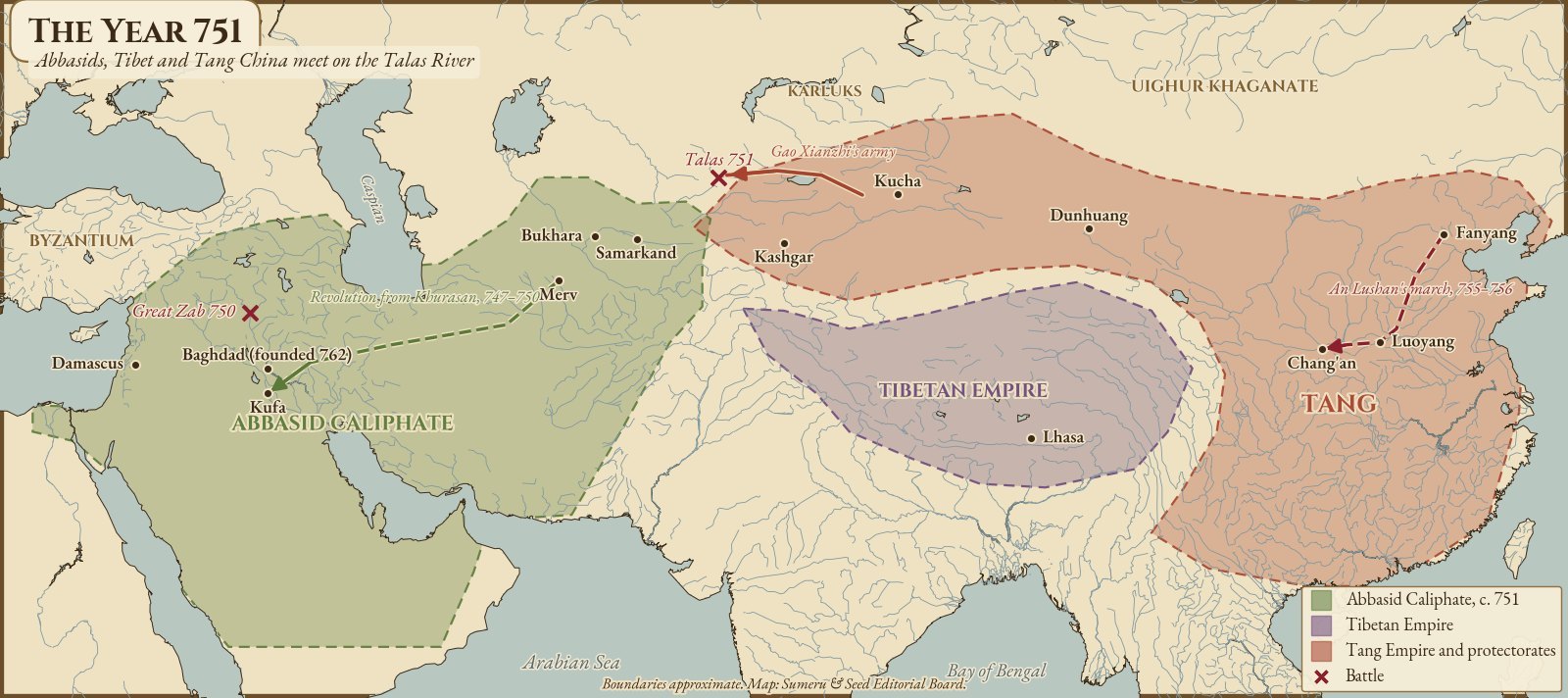
In the summer of 751 an army of the Tang dynasty under the Korean-born general Gao Xianzhi met an army of the new Abbasid caliphate near the Talas River, in what is now Kazakhstan and Kyrgyzstan. After several days of fighting the Tang army's Karluk Turkish allies changed sides, and Gao Xianzhi's force was destroyed. The battle is famous today for two reasons: it is the only major clash between Chinese and Arab armies in history, and it is often said to have brought the secret of paper-making to the Islamic world. Both claims need careful handling. To understand Talas, we need to look at the larger story of which it was a part.1
Three empires in Central Asia
In the first half of the eighth century three powers competed for the oasis cities of Central Asia, the trading hubs that linked China, India and Iran.
The Tang had reached the height of its power. Under Emperor Xuanzong (r. 712–756) it maintained protectorates over the Tarim Basin, with headquarters at Kucha, and claimed suzerainty over the princes of Ferghana and the cities beyond the Pamirs. Its armies in the north-west were professional forces, often commanded by non-Chinese generals such as Gao Xianzhi, who in 747 led an astonishing expedition over the Pamirs to Gilgit to cut the Tibetans off from their Arab allies.2
The Tibetan Empire, built in the seventh century by Songtsen Gampo and his successors, was a formidable military state that fought the Tang for control of the Tarim and the Gansu corridor. Christopher Beckwith has shown how central Tibet was to the politics of Central Asia in this period; it allied in turn with Turks and Arabs against China.3
The Umayyad caliphate had conquered Transoxiana — Bukhara, Samarkand and the Ferghana valley — in the early eighth century. But in 747 a revolution broke out in Khurasan, in eastern Iran. Under black banners, the agent Abu Muslim raised an army in Merv in the name of the Prophet's family; it marched west, and at the battle of the Great Zab in 750 it destroyed the last Umayyad caliph. A new dynasty, descended from the Prophet's uncle al-Abbas, took power.4
The battle
The immediate cause of Talas was a local quarrel. In 750 Gao Xianzhi attacked the city of Tashkent (Chach), executed its ruler and plundered it. The ruler's son appealed to the Abbasid governor of Khurasan, Abu Muslim, who sent an army under Ziyad ibn Salih. Gao Xianzhi marched west to meet it.5
The best Chinese account, in the Comprehensive Mirror for Aid in Government (Zizhi tongjian), says that Gao's army of Chinese and allied troops advanced more than 700 li into Arab territory and met the enemy at the city of Talas. After five days, the Karluks went over to the Arabs and attacked the Tang army from behind; Gao escaped with a few thousand men.6 Arabic sources are brief: Ibn al-Athir, writing four centuries later, gives the Chinese losses as many thousands killed and prisoners taken.7
Talas and paper
Among the captives taken at Talas was a Chinese officer called Du Huan. He spent about ten years in Abbasid lands before returning to China by sea in 762, and he wrote a travel account, the Jingxing ji ("Record of Travels"). Only fragments survive, quoted by his kinsman Du You in the encyclopaedia Tongdian. They are a remarkable source: Du Huan describes the new Abbasid capital at Kufa, the Muslim prayer and fast, and — most famously — Chinese craftsmen working in the Abbasid capital as weavers and painters.8
The story that Chinese prisoners taught paper-making at Samarkand comes from a later Arabic writer, al-Tha'alibi, in the eleventh century. Historians now treat it with caution. Jonathan Bloom has shown that paper was already known in Central Asia before 751, and that its spread through the Islamic world was a gradual process driven by the needs of the Abbasid bureaucracy, not a single transfer of secrets.9 Talas makes a good story; the history of paper is more complicated.



From the cards of Sumeru Chess, Chapter IV.
The real turning point: 755
Talas did not end Chinese power in Central Asia. What ended it was a rebellion at home. In 755 An Lushan, a general of Sogdian and Turkish origin who commanded three frontier armies in the north-east, rebelled. He captured Luoyang and then Chang'an; Emperor Xuanzong fled to Sichuan, and his favourite consort Yang Guifei was killed by his own guards. The rebellion lasted until 763.10
To fight it, the Tang withdrew its best troops from the north-west. The Tibetans moved into the vacuum, seizing the Gansu corridor and, in 763, briefly occupying Chang'an itself. Uighur Turkish cavalry helped the Tang retake its capitals — at a heavy price in tribute. Chinese sources also mention troops from the "Dashi" — the Arabs — among the foreign contingents sent to help the dynasty.11 The registered population of the empire fell from about 53 million in the census of 754 to under 17 million a decade later. Much of the decline reflects the collapse of the registration system rather than deaths, but it shows how deeply the state had been shaken.12
A new map of Asia
By the 790s the Tang had lost the Tarim Basin, and Central Asia west of the Pamirs would never again be under Chinese control. The Abbasids, meanwhile, moved the centre of the caliphate east, to the new round city of Baghdad founded in 762, where Iranian traditions of government, Persian administrators and the trade routes of the East shaped a new Islamic civilisation. Tibet reached its greatest extent, and in 821–822 concluded a peace treaty with the Tang, recorded on a bilingual pillar that still stands in Lhasa.
Seen from the Talas River, then, the 750s were a decade in which three empires redrew the map of Asia. The battle itself was a small part of that story. But it stands at the meeting point of two worlds that, for a few days, collided directly — and it reminds us that the history of China and the history of Islam were never as separate as our textbooks suggest.
Notes
- For the context see Christopher I. Beckwith, The Tibetan Empire in Central Asia: A History of the Struggle for Great Power among Tibetans, Turks, Arabs, and Chinese during the Early Middle Ages (Princeton: Princeton University Press, 1987). ↩
- Jiu Tangshu 104 and Xin Tangshu 135 (biographies of Gao Xianzhi); Aurel Stein, "A Chinese Expedition across the Pamirs and Hindukush, A.D. 747," Geographical Journal 59 (1922): 112–131. ↩
- Beckwith, Tibetan Empire. ↩
- Hugh Kennedy, The Prophet and the Age of the Caliphates, 3rd ed. (London: Routledge, 2016); Moshe Sharon, Black Banners from the East (Jerusalem: Magnes Press, 1983). ↩
- Beckwith, Tibetan Empire; Zizhi tongjian 216. ↩
- Sima Guang, Zizhi tongjian 216, tenth year of Tianbao (751). ↩
- Ibn al-Athir, al-Kamil fi al-ta'rikh, under the year 133 AH. ↩
- Du You, Tongdian 193, quoting Du Huan's Jingxing ji. ↩
- Jonathan M. Bloom, Paper Before Print: The History and Impact of Paper in the Islamic World (New Haven: Yale University Press, 2001). ↩
- Edwin G. Pulleyblank, The Background of the Rebellion of An Lu-shan (London: Oxford University Press, 1955); Mark Edward Lewis, China's Cosmopolitan Empire: The Tang Dynasty (Cambridge, MA: Harvard University Press, 2009). ↩
- Jiu Tangshu 10, under 757, lists Arab troops among the foreign contingents. ↩
- Du You, Tongdian 7. On what the census figures mean see Denis Twitchett, ed., The Cambridge History of China, vol. 3, Sui and T'ang China, 589–906, Part I (Cambridge: Cambridge University Press, 1979). ↩
Further Reading
- Christopher I. Beckwith, The Tibetan Empire in Central Asia (Princeton University Press, 1987).
- Hugh Kennedy, The Prophet and the Age of the Caliphates (Routledge, 3rd ed. 2016).
- Mark Edward Lewis, China's Cosmopolitan Empire: The Tang Dynasty (Harvard University Press, 2009).
- Jonathan M. Bloom, Paper Before Print (Yale University Press, 2001).