
The Mongol War Machine: Decimal Armies, Relay Roads and Siege Engineers
Sumeru & Seed Editorial BoardThe Mongols were not an endless horde. They were a relatively small people who built the most effective military organisation of the pre-modern world — and then used the skills of everyone they conquered.

When Mongol armies appeared in eastern Europe in 1241, Western observers imagined them as countless hordes from Tartarus, the classical hell. The reality was the opposite. In 1206 the entire Mongol nation probably numbered fewer than a million people, and its army perhaps 100,000 men.1 Yet within seventy years the Mongols built the largest contiguous land empire in history. They did it not by numbers but by organisation, discipline and a remarkable ability to absorb the skills of others.
Arrows of a decimal system
At the great assembly (quriltai) of 1206 at which Temüjin was proclaimed Genghis Khan, he reorganised the peoples of the steppe. The Secret History of the Mongols, the dynasty's own account of its origins, lists ninety-five commanders of "thousands" appointed that year, almost all men who had served Genghis Khan personally.2 The army was divided into units of ten (arban), a hundred (jaghun), a thousand (mingghan) and ten thousand (tümen).
This decimal system was not new — the Xiongnu had used something similar — but Genghis Khan used it to break the power of the old tribes. Units were deliberately mixed: a thousand might contain men from several tribes, under a commander loyal to the khan rather than to any clan. Soldiers were forbidden to leave their unit on pain of death. In this way the army became a school of loyalty to the ruling house, and tribal identity faded into a new Mongol identity.3
At the centre stood the keshig, the khan's personal guard, enlarged in 1206 to 10,000 men. Its members, many of them sons of commanders, served in shifts guarding the khan's tent, managing his household and learning to govern. The keshig was at once a bodyguard, a staff college and a hostage system, and it produced many of the empire's generals and governors.4
The horse archer, perfected
Every Mongol man was a horseman and archer from childhood. On campaign each soldier brought several horses, so that he could change mounts and keep moving; armies could cover distances that astonished their enemies. The composite bow, made of horn, wood and sinew, could kill at long range. Light cavalry skirmished and harassed; heavier cavalry, with lamellar armour and lances, delivered the decisive charge.
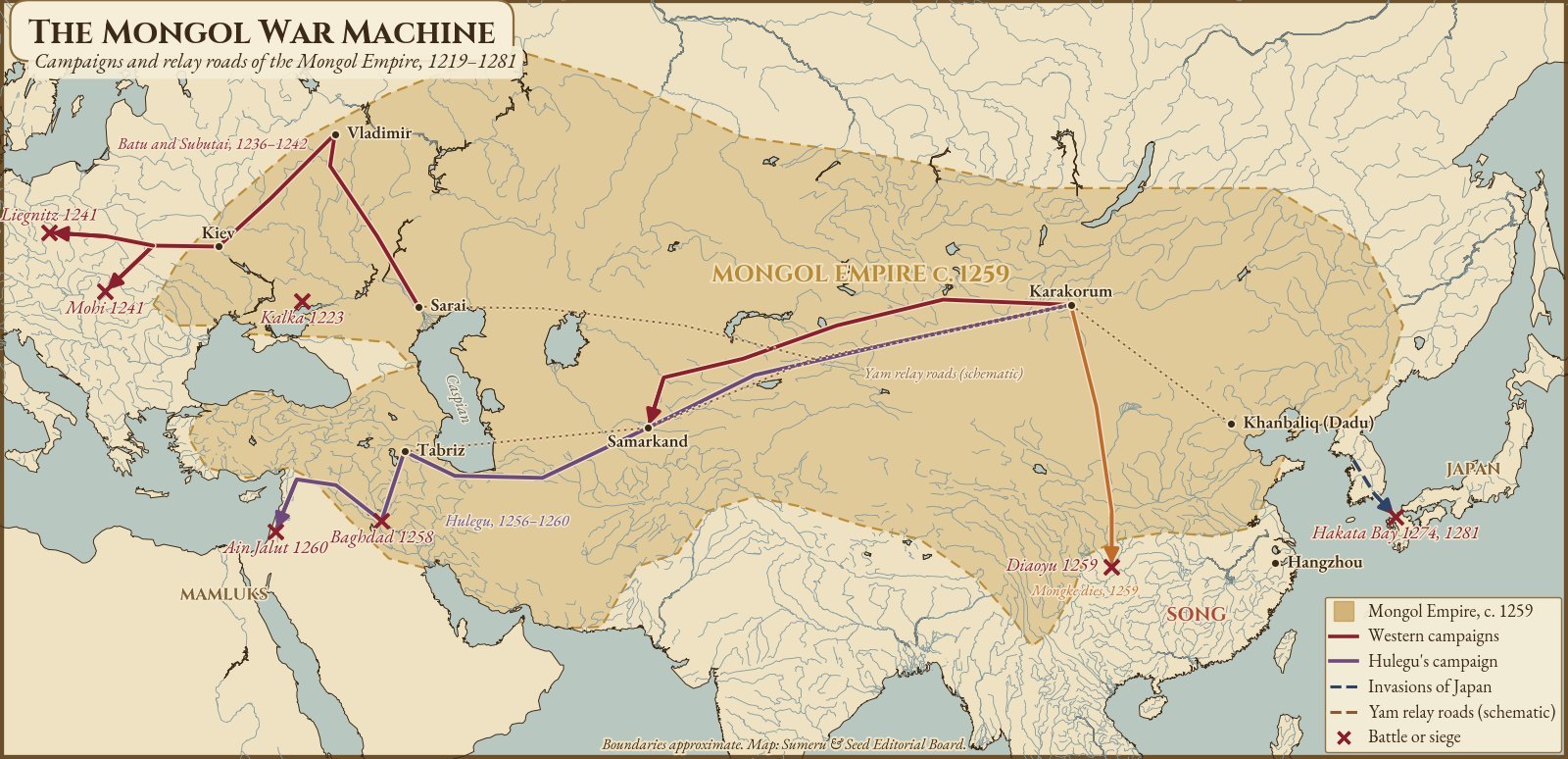
John of Plano Carpini, the papal envoy who travelled to Mongolia in 1245–1247, wrote a detailed report on Mongol warfare so that Europeans could learn to resist it. He described their discipline, their use of feigned retreats to draw enemies into ambushes, their habit of sending captured peoples in front of the army, and their skill at encircling armies on the march.5 At Liegnitz in Poland and at Mohi in Hungary, both in April 1241, European armies were destroyed by exactly these tactics.
The relay roads
An empire stretching from Korea to the borders of Hungary needed communications. The Mongols created the Yam, a system of relay stations at intervals of a day's ride, where officials with a paiza — a tablet of gold, silver or wood bearing the khan's authority — could obtain fresh horses, food and lodging. Ögedei (r. 1229–1241) organised it systematically across the empire.6 Marco Polo later described the Yuan version in admiring detail, claiming that messengers could cover 200 or 250 miles a day by changing horses.7 The Yam carried orders, intelligence, tax revenue, envoys and merchants, and it allowed the Great Khan in Karakorum to know what was happening at the far ends of his realm.
Engineers and experts
The steppe army had one great weakness: it could not take walled cities. In China the Mongols learned fast. They recruited Chinese and Khitan engineers, and by the war against Khwarazm they had siege trains capable of reducing the strongest fortresses. When the Song city of Xiangyang held out for five years (1268–1273), Kublai Khan asked his relative, the Ilkhan of Iran, for help; two Muslim engineers, Ismail and Ala al-Din, came from the west and built counterweight trebuchets that broke the city's walls.8 The Mongols also used gunpowder weapons learned from the Chinese.
Thomas Allsen has shown that this mobilisation of skills went far beyond warfare. The Mongols moved craftsmen, doctors, astronomers, cooks and scholars across the continent, from Iran to China and back.9 Wherever they conquered, they took census of the population and its talents. The war machine was also a machine for collecting people.
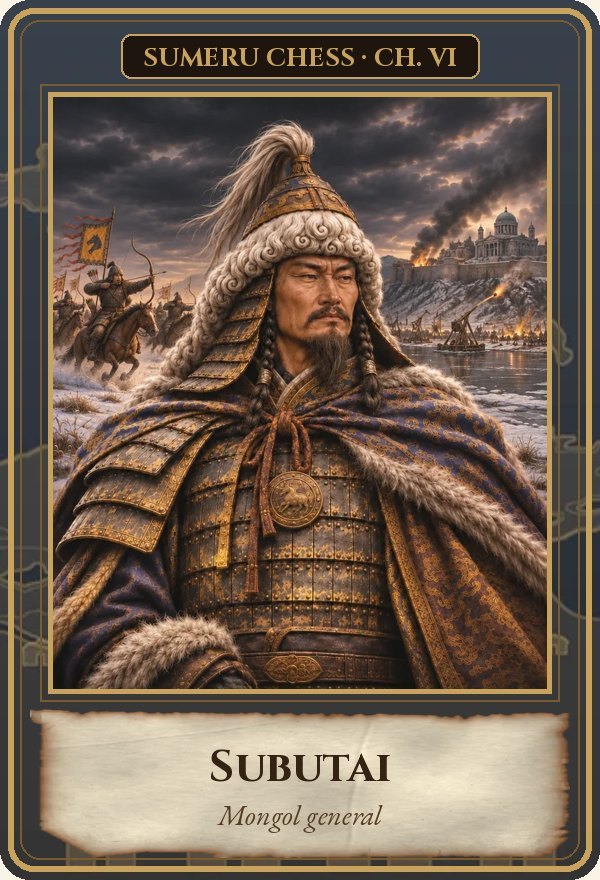
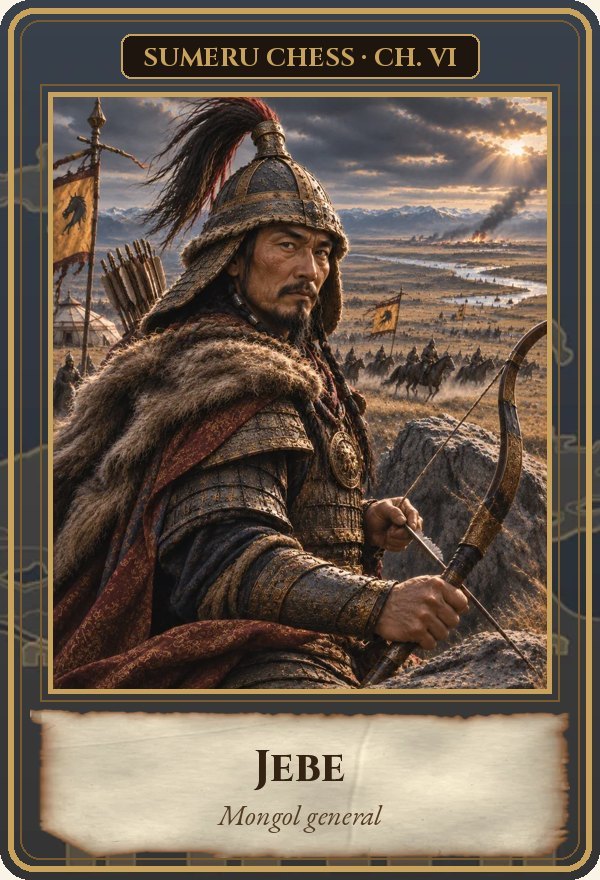
From the cards of Sumeru Chess, Chapter VI.
Generals
The Mongol army was blessed with outstanding commanders, chosen for ability rather than birth. Subutai, of the Uriangkhai people, fought in China, crossed the Caucasus with Jebe in 1220–1223, planned the European campaign of 1236–1242 and died in his seventies. Jebe, whose name means "arrow," had once been an enemy who shot Genghis Khan's horse from under him; spared for his frankness, he became one of the khan's most trusted generals.10 Both appear in the Secret History among the khan's "four hounds," his most fearsome commanders.
Limits
The war machine was not invincible. It struggled in hot, humid lands where horses sickened, such as Vietnam and Java. It was defeated by the Mamluks of Egypt at Ain Jalut in 1260, partly because most of Hülegü's army had withdrawn after the death of the Great Khan Möngke. Its fleets were wrecked by storms off Japan in 1274 and 1281. And, above all, it depended on unity at the top. After the 1260s the empire split into four rival khanates, and Mongol armies began fighting one another.
Yet for half a century the Mongol army was the most effective fighting force in the world. Its secret was not savagery — all medieval armies were savage — but a combination of steppe horsemanship with a ruthlessly rational organisation, open to talent wherever it came from.
Notes
- Population estimates in David Morgan, The Mongols, 2nd ed. (Oxford: Blackwell, 2007), and Timothy May, The Mongol Art of War (Barnsley: Pen & Sword, 2007). ↩
- The Secret History of the Mongols, § 202; trans. Igor de Rachewiltz, The Secret History of the Mongols: A Mongolian Epic Chronicle of the Thirteenth Century, 2 vols. (Leiden: Brill, 2004). ↩
- May, Mongol Art of War. ↩
- Christopher P. Atwood, Encyclopedia of Mongolia and the Mongol Empire (New York: Facts on File, 2004), s.v. "keshig." ↩
- John of Plano Carpini, History of the Mongols, in Christopher Dawson, ed., The Mongol Mission (London: Sheed and Ward, 1955). ↩
- Adam J. Silverstein, Postal Systems in the Pre-Modern Islamic World (Cambridge: Cambridge University Press, 2007). ↩
- Marco Polo, The Description of the World, trans. A. C. Moule and Paul Pelliot (London: Routledge, 1938), in the chapters on the Great Khan's post roads. ↩
- Yuanshi 203 (biographies of Ismail and Ala al-Din); Morris Rossabi, Khubilai Khan: His Life and Times (Berkeley: University of California Press, 1988). ↩
- Thomas T. Allsen, Culture and Conquest in Mongol Eurasia (Cambridge: Cambridge University Press, 2001). ↩
- Secret History §§ 147 (Jebe) and 209; de Rachewiltz, Secret History, commentary. ↩
Further Reading
- Timothy May, The Mongol Art of War (Pen & Sword, 2007).
- Igor de Rachewiltz, trans., The Secret History of the Mongols (Brill, 2004).
- Thomas T. Allsen, Culture and Conquest in Mongol Eurasia (Cambridge University Press, 2001).
- Carl Fredrik Sverdrup, The Mongol Conquests: The Military Operations of Genghis Khan and Sübe'etei (Helion, 2017).