

From the Granicus to the Hyphasis: How Alexander's Army Conquered Persia
Sumeru & Seed Editorial BoardIn eleven years a Macedonian army walked from the Hellespont to the Punjab and destroyed the largest empire the world had yet seen. What kind of army could do that — and why did it finally stop?
In the spring of 334 BCE a king of twenty-one crossed the Hellespont with about 32,000 infantry and 5,000 cavalry.1 Eleven years later he died in Babylon, master of lands from the Adriatic to the Indus. The story of Alexander is often told as the story of a genius, and the ancient writers who shaped it — above all Arrian, writing in the second century CE from the lost memoirs of Ptolemy and Aristobulus — gave Alexander most of the credit.2 But a general is only as good as the instrument in his hands. This essay looks at the instrument: the army that Philip II built and his son used to conquer the Achaemenid Empire.
Philip's army
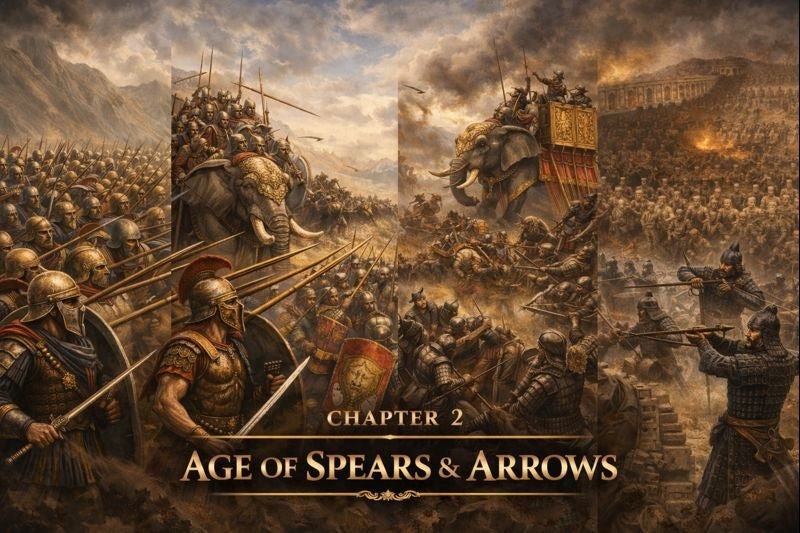
When Philip II came to the throne in 359 BCE, Macedon was a poor kingdom whose infantry had just been cut to pieces by the Illyrians. Within twenty years he had turned it into the strongest military power in the Greek world. The core of his reform was a new kind of heavy infantry, the pezhetairoi or "foot companions." They carried the sarissa, a pike of cornel wood some five to six metres long, held in both hands, with a small shield slung from the shoulder.3 Arranged sixteen ranks deep, the points of the first five ranks projected beyond the front, so that an enemy faced a hedge of iron before he could reach a single Macedonian.
The phalanx was not meant to win battles by itself. Its job was to pin the enemy centre in place. The killing blow came from the cavalry, especially the hetairoi, the Companion cavalry raised from the Macedonian nobility, who charged in wedge formation with the lance. Between these two arms stood the hypaspists, an elite infantry guard able to fight in close order or move quickly over rough ground, and around them a ring of specialists: Agrianian javelin-men, Cretan archers, Thessalian heavy horse and Thracian light cavalry. Modern historians call this the "hammer and anvil": hold with the phalanx, strike with the horse.4
Just as important were things that rarely appear in battle narratives. Philip cut the baggage train to the bone, forbade wagons, and made soldiers carry their own equipment and some of their food. Donald Engels showed in a classic study that this lightness was the secret of Macedonian speed: an army that did not depend on carts could cover ground that would have stopped any Persian force of comparable size.5
Three battles for an empire
Alexander met the Persians three times in open battle, and each time the pattern of Philip's army is visible.
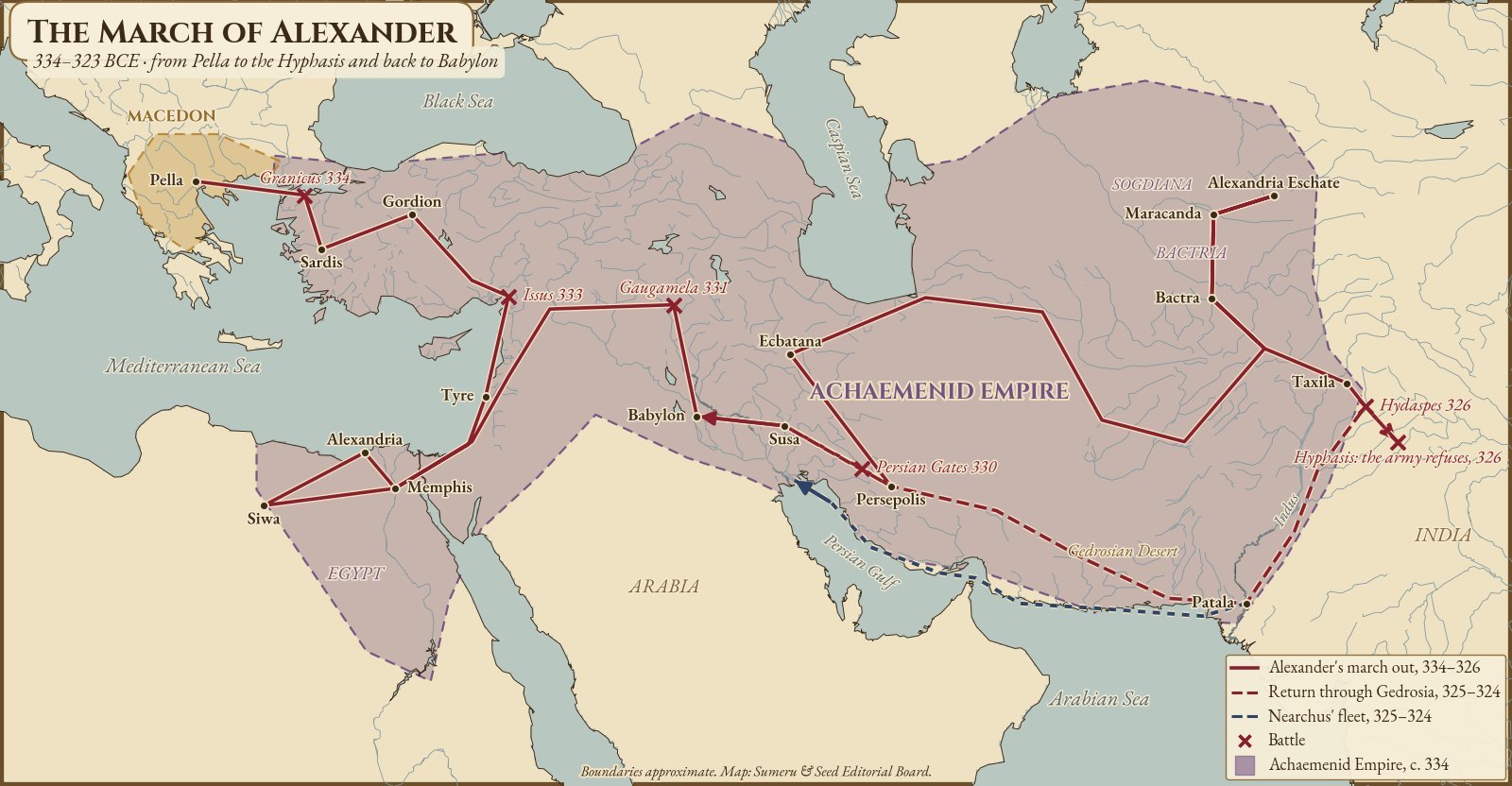
At the Granicus in May 334 the satraps of Asia Minor lined the steep eastern bank of a river with cavalry and placed their Greek mercenary infantry behind. Alexander led the Companions straight across the river and into the Persian horse; in the mêlée he was almost killed and saved by Cleitus the Black.6 Once the cavalry broke, the mercenaries were surrounded and slaughtered. Western Asia Minor fell within months.
At Issus in November 333 Darius III himself took the field and, by marching around Alexander's rear, forced him to fight on a narrow coastal plain where Persian numbers counted for little. Alexander again attacked with his right, the phalanx struggled in the centre against Darius' Greek mercenaries, and the battle was decided when the Great King's chariot turned and fled.7 Darius' mother, wife and daughters were captured in the camp.
At Gaugamela, near Arbela, on 1 October 331, Darius chose his ground with care: a wide, levelled plain suited to his scythed chariots and his much larger cavalry. Arrian credits Alexander with 40,000 infantry and 7,000 horse; the Persian figures in the sources are fantastic, but Darius certainly had the larger army.8 Alexander advanced obliquely to the right, drawing the Persian left wing after him until a gap opened in Darius' line, then turned the Companions into it. Once more Darius left the field. The road to Babylon, Susa and Persepolis lay open.
The harder war
Gaugamela is usually treated as the end of the Persian Empire. In fact the most difficult fighting came afterwards. After Darius was murdered by his own satrap Bessus in 330, Alexander spent three years in Bactria and Sogdiana — modern Afghanistan, Uzbekistan and Tajikistan — fighting a war of sieges, raids and rebellions against local nobles such as Spitamenes. There were no great battles to win. The army had to be split into many columns, garrisons were planted in new cities such as Alexandria Eschate on the Syr Darya, and Alexander married Roxane, daughter of a Sogdian lord, partly to end the fighting.9
This was also the period in which the army began to change. Alexander enrolled Iranian cavalry, adopted elements of Persian court dress and ceremony, and ordered 30,000 young Iranians to be trained in Macedonian fashion. Many Macedonians resented it. The murder of Cleitus at a drinking party in Maracanda in 328 and the execution of the general Parmenion were symptoms of a deep strain between the king and the men who had made his victories possible.10
From the cards of Sumeru Chess, Chapter II.
India and the limit of the march
In 327 the army crossed the Hindu Kush into India. On the Hydaspes (Jhelum) in the monsoon of 326 Alexander fought his last great battle against King Porus, whose army included war elephants. He crossed the river at night upstream of the Indian camp, pinned Porus' cavalry, and then let his infantry deal with the elephants, which turned and trampled their own side when wounded.11 Porus was confirmed as a client king.
A few weeks later, on the Hyphasis (Beas), the army refused to go further. Arrian gives the speech of the officer Coenus, who reminded the king how few of the original Macedonians were left and how long they had been away.12 After three days sulking in his tent, Alexander gave way. The march east was over, not because the army had been defeated, but because it had reached the limit of what men would endure.
The return was a disaster of a different kind. Part of the army sailed down the Indus while Alexander led another column west through the Gedrosian desert (Makran), where the sources describe terrible losses to heat, thirst and flash floods. Meanwhile the admiral Nearchus brought the fleet along the coast to the Persian Gulf. Modern estimates of the losses in Gedrosia vary widely, but no one doubts that it was the costliest march of the whole campaign.13
Why did it work?
Three things explain Alexander's success better than any appeal to destiny. First, Philip's combined-arms army was simply superior in battle to anything the Achaemenids could field, because each arm had a defined task and the whole was led from the front by a king who took the same risks as his men. Second, the army was fast, because it was light. Third, Alexander understood that a conquered empire must be governed: he kept Persian satraps in office, respected local cults, and used the Achaemenid road and tribute system rather than destroying it.14
The limits were also clear. The army could defeat any enemy in the field but could not stay in the field for ever; the Macedonian manpower that had won Gaugamela was spread thin across thirty cities and garrisons. When Alexander died in June 323, at the age of thirty-two, no one could hold his empire together. Within twenty years his generals had divided it into the kingdoms that would define the next two centuries — the world explored in the other essays of this chapter.
Notes
- Diodorus Siculus, Library of History 17.17, gives about 32,000 infantry and 5,100 cavalry for the army that crossed into Asia; the other ancient figures range between 30,000 and 43,000 infantry and 4,000 and 5,500 cavalry. ↩
- Arrian, Anabasis of Alexander, preface 1–3. On the sources see A. B. Bosworth, From Arrian to Alexander: Studies in Historical Interpretation (Oxford: Clarendon Press, 1988). ↩
- On the length and handling of the sarissa see N. G. L. Hammond, The Genius of Alexander the Great (Chapel Hill: University of North Carolina Press, 1997), and Polybius 18.29–30 for the later Macedonian phalanx. ↩
- A. B. Bosworth, Conquest and Empire: The Reign of Alexander the Great (Cambridge: Cambridge University Press, 1988), especially the thematic chapter on the army. ↩
- Donald W. Engels, Alexander the Great and the Logistics of the Macedonian Army (Berkeley: University of California Press, 1978). ↩
- Arrian, Anabasis 1.13–16; Plutarch, Alexander 16. ↩
- Arrian, Anabasis 2.6–11; Curtius Rufus 3.8–11. ↩
- Arrian, Anabasis 3.12.5 for Alexander's numbers; 3.8–15 for the battle. ↩
- Arrian, Anabasis 4.1–4.22; Frank L. Holt, Into the Land of Bones: Alexander the Great in Afghanistan (Berkeley: University of California Press, 2005). ↩
- Arrian, Anabasis 4.8–9 (Cleitus) and 3.26 (Parmenion); 7.6 on the 30,000 epigonoi. ↩
- Arrian, Anabasis 5.8–19. ↩
- Arrian, Anabasis 5.25–29. ↩
- Arrian, Anabasis 6.22–26; Engels, Logistics, reconstructs the Gedrosian march and its supply problems in detail. ↩
- Pierre Briant, From Cyrus to Alexander: A History of the Persian Empire, trans. Peter T. Daniels (Winona Lake, IN: Eisenbrauns, 2002), argues that Alexander was in many ways "the last of the Achaemenids." ↩
Further Reading
- Arrian, Alexander the Great: The Anabasis and the Indica, trans. Martin Hammond (Oxford World's Classics, 2013).
- A. B. Bosworth, Conquest and Empire: The Reign of Alexander the Great (Cambridge University Press, 1988).
- Waldemar Heckel, The Conquests of Alexander the Great (Cambridge University Press, 2008).
- Donald W. Engels, Alexander the Great and the Logistics of the Macedonian Army (University of California Press, 1978).