

Carrhae and the Horse Archer: How Parthia Defeated Rome
Sumeru & Seed Editorial BoardIn June 53 BCE the richest man in Rome led seven legions into the plains of northern Mesopotamia. A few days later most of them were dead or captive. Carrhae was not bad luck — it was a lesson in a different way of war.

Marcus Licinius Crassus had everything a Roman general could want except military glory. He was the richest man in Rome, the conqueror of Spartacus' slave army, and a partner with Pompey and Caesar in the informal alliance that dominated Roman politics in the 50s BCE. In 55 he obtained the province of Syria, and with it the chance to wage a great war in the East like Pompey before him and Caesar in Gaul. The enemy he chose was the Parthian Empire. The result, at Carrhae in June 53 BCE, was one of the worst defeats in Roman history.1
The enemy
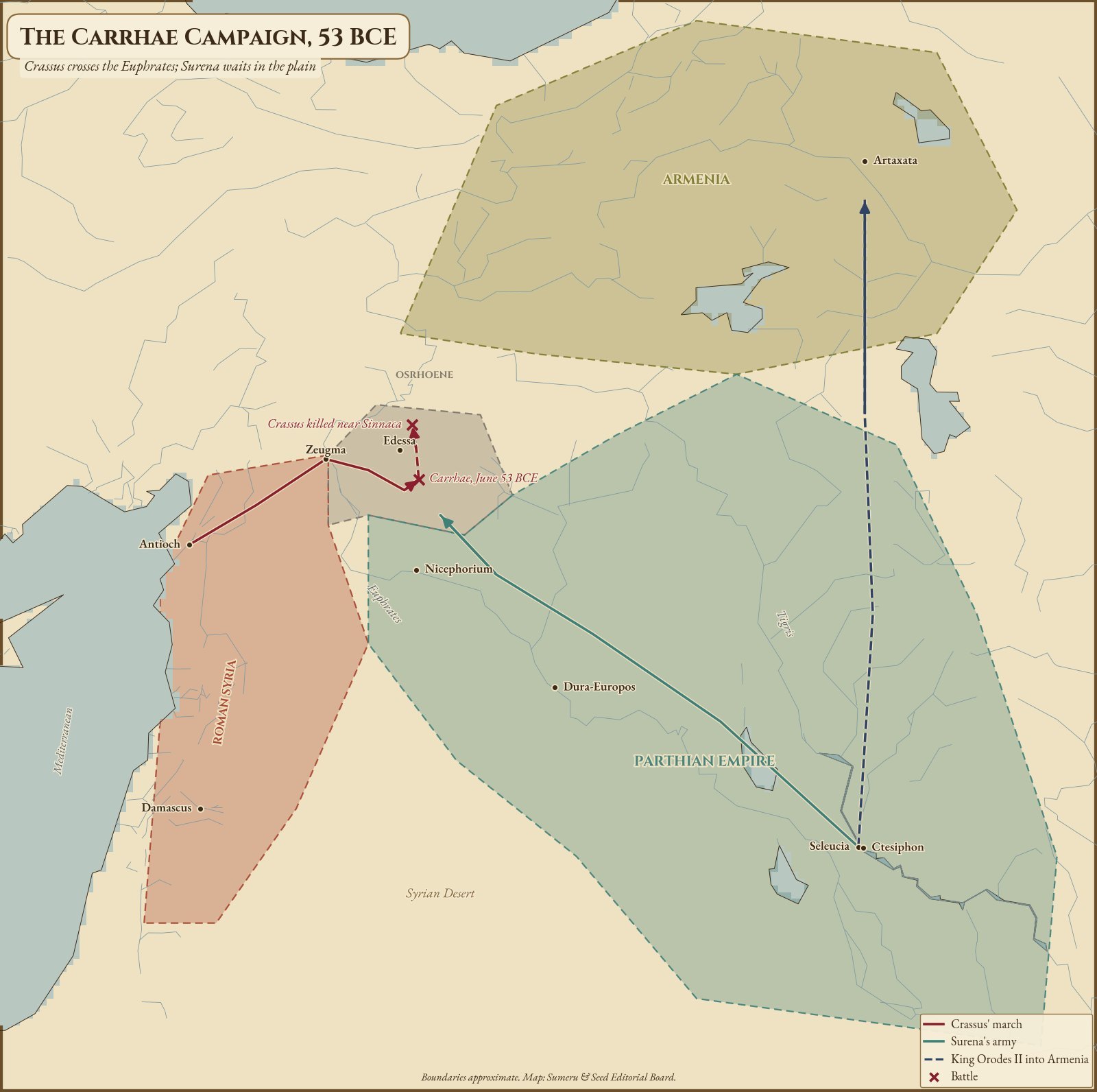
The Parthians, an Iranian people from the steppe east of the Caspian, had taken over most of the old Seleucid kingdom in the second century BCE. Their empire was ruled by the Arsacid dynasty but depended heavily on great noble families, who commanded their own retainers in war. In 53 BCE the Parthian king Orodes II faced two threats at once: the Romans from Syria and their ally Artavasdes of Armenia from the north. Orodes took the main royal army into Armenia himself and left the defence of Mesopotamia to a young nobleman of the house of Suren, known to the Romans simply as Surena.2
Surena's army was small but unlike anything the Romans had met. Plutarch, our main source, says he travelled with 1,000 camels carrying his baggage and an escort of 10,000 horsemen drawn from his own followers and dependants.3 At Carrhae the army probably consisted of about 1,000 cataphracts — heavily armoured lancers whose horses were also armoured — and some 9,000 horse archers. There was no infantry to speak of. Against this Crassus brought seven legions, perhaps 35,000 heavy infantry, with about 4,000 cavalry and light troops, including 1,000 Gallic horsemen led by his son Publius.
The march
Crassus crossed the Euphrates at Zeugma in spring 53. His quaestor Gaius Cassius — the future assassin of Caesar — urged him to follow the river south, where the army could be supplied by water and protected on one flank. Artavasdes advised him to go north through the Armenian hills, where cavalry was less effective. Crassus instead struck out across the open plain towards Carrhae (Harran), guided, according to Plutarch, by an Arab chieftain named Ariamnes who was secretly working for the Parthians.4 The sources are written with hindsight and turn the campaign into a moral tale of greed and folly; but the decision to seek battle quickly on open ground was the one that mattered.
The battle
Near the river Balikh, south of Carrhae, the Romans met Surena's army. Plutarch describes how the Parthians first concealed their armour under cloaks and skins, then threw them off so that the whole army suddenly glittered with steel, while drums with bells set up a terrifying noise.5 Crassus formed his army into a great hollow square, the standard defence against cavalry.
The square was exactly what Surena wanted. His horse archers rode around it, shooting into the dense mass of men. Their composite bows could drive an arrow through a shield and into the arm or foot behind it. The Romans expected the archers to run out of arrows, but Surena had organised a train of camels loaded with fresh supplies, and the shooting never stopped.6 When the legionaries advanced, the archers fell back, shooting over their horses' rumps as they went — the manoeuvre later called the "Parthian shot." When the Romans closed up again, the cataphracts threatened to charge.
In desperation Crassus sent Publius with 1,300 cavalry, 500 archers and eight cohorts to drive the enemy away. The Parthians retreated, drew Publius away from the main army, then surrounded and destroyed his force. Publius' head was carried on a spear past his father's lines.7 By nightfall the Roman army had suffered heavily. Crassus, close to collapse, retreated to Carrhae, abandoning 4,000 wounded.
Over the following days the Romans tried to escape north to the Armenian hills. Surena invited Crassus to a parley; there was a scuffle, and Crassus was killed. Plutarch puts the total losses at 20,000 dead and 10,000 prisoners.8 Cassius Dio adds that the Parthians poured molten gold into the dead man's mouth, an image that became part of the legend of Roman greed. Cassius escaped with some 500 cavalry and organised the defence of Syria.
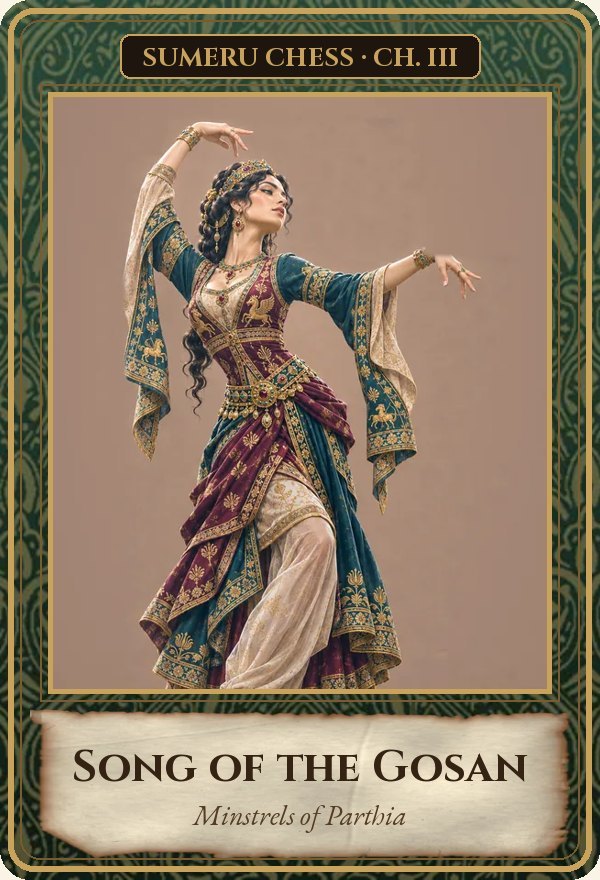
From the cards of Sumeru Chess, Chapter III.
Why did Rome lose?
The ancient writers blamed Crassus' avarice and arrogance. Modern historians stress something more interesting: a mismatch between two complete military systems.9 The legion was designed for close combat. It could defeat any infantry and resist cavalry in a solid formation, but it had few missile troops and little cavalry of its own. On flat, waterless ground, against an enemy who would not close and who could be resupplied with arrows, the legion's strengths became weaknesses: the denser the formation, the easier the target.
Surena's achievement was organisational as much as tactical. The camel train of arrows, the coordination between archers and lancers, and the choice of terrain show a commander who understood how to fight Romans. Orodes rewarded him by having him executed soon afterwards, apparently out of jealousy.10
Consequences
Carrhae fixed the Euphrates as the frontier between Rome and Iran for the next seven centuries. The captured legionary standards became a political wound in Rome; Augustus finally recovered them by diplomacy in 20 BCE and celebrated the event on coins, on the breastplate of the Prima Porta statue and in his own Res Gestae.11 The Roman prisoners were said to have been settled in Margiana, around Merv, far to the east, where Horace imagined them marrying barbarian wives.12 A modern theory that some of them later fought for the Xiongnu and settled in a Chinese town called Liqian is attractive but rests on no solid evidence.
Above all, Carrhae taught Rome that there were limits to what its armies could do. Later emperors — Trajan, Lucius Verus, Septimius Severus — would capture the Parthian capital Ctesiphon, but none could hold Mesopotamia for long. The horse archer and the cataphract remained the masters of the eastern plains.
Notes
- The main ancient narratives are Plutarch, Crassus 16–33, and Cassius Dio, Roman History 40.12–27. ↩
- Plutarch, Crassus 21; on the house of Suren see Josef Wiesehöfer, Ancient Persia from 550 BC to 650 AD (London: I. B. Tauris, 1996). ↩
- Plutarch, Crassus 21.6–7. ↩
- Plutarch, Crassus 20–22; Cassius Dio 40.20–21 calls the guide Abgarus of Osrhoene. ↩
- Plutarch, Crassus 23–24. ↩
- Plutarch, Crassus 24–25. ↩
- Plutarch, Crassus 25–26. ↩
- Plutarch, Crassus 31.7; Cassius Dio 40.27 for the molten gold. ↩
- Rose Mary Sheldon, Rome's Wars in Parthia: Blood in the Sand (London: Vallentine Mitchell, 2010); Gareth C. Sampson, The Defeat of Rome: Crassus, Carrhae and the Invasion of the East (Barnsley: Pen & Sword, 2008). ↩
- Plutarch, Crassus 33. ↩
- Augustus, Res Gestae 29. ↩
- Pliny the Elder, Natural History 6.47; Horace, Odes 3.5.5–12. ↩
Further Reading
- Plutarch, Fall of the Roman Republic, trans. Rex Warner (Penguin, revised ed. 2005), which includes the Life of Crassus.
- Rose Mary Sheldon, Rome's Wars in Parthia: Blood in the Sand (Vallentine Mitchell, 2010).
- Gareth C. Sampson, The Defeat of Rome: Crassus, Carrhae and the Invasion of the East (Pen & Sword, 2008).
- Neilson C. Debevoise, A Political History of Parthia (University of Chicago Press, 1938).