
The Siege of Xiangyang, 1268–1273: The Key to Southern China
Sumeru & Seed Editorial BoardField Report · Chapter VI · 1268–1273 · The Han river, Hubei
Two walled cities faced each other across the Han river, joined by a floating bridge: Xiangyang and Fancheng, the gate to the Yangtze. Kublai Khan's army sat before them for almost six years — until engineers from Persia built trebuchets that could smash their walls.
Part I · The battle
Result A Mongol victory: Xiangyang surrendered, and the Yangtze lay open.
Why it is remembered
- The longest siege of the Mongol wars. Nearly six years of blockade, river battles and failed relief.
- The steppe learned to fight on water. Liu Zheng built Kublai a fleet and trained crews to close the Han river.
- The counterweight trebuchet. Engineers sent from the Ilkhanate built Huihui pao (回回砲) that threw huge stones; Fancheng's walls fell in days.
Xiangyang guarded the Han river route from the north to the middle Yangtze. When the Song general Liu Zheng went over to the Mongols in 1261, he told Kublai that whoever held Xiangyang held the south.1
In 1268 Aju began to ring the twin cities with forts and to blockade the river. The Song sent fleet after fleet to break through.2
The battle, step by step
- The ring of forts. Mongol forts and a new fleet cut Xiangyang and Fancheng off by land and water.
- Relief fails. Song armies and convoys are beaten back again and again; in 1272 Zhang Shun and Zhang Gui force their way in with 3,000 men and supplies, and Zhang Shun is killed.3
- The trebuchets. In 1272–1273 Ismail and Ala al-Din build counterweight trebuchets; Fancheng's walls are breached, the floating bridge is cut and the city falls.4
- The surrender. The stones now strike Xiangyang. In March 1273 Lü Wenhuan surrenders the city.5
What followed
Lü Wenhuan joined the Mongols and led them down the Han. Bayan took the Song capital Lin'an in 1276, and the last Song loyalists died at the sea battle of Yamen in 1279. Kublai Khan, now emperor of the Yuan, ruled all China.6
Part II · Play it in Sumeru Chess
Xiangyang on the chessboard
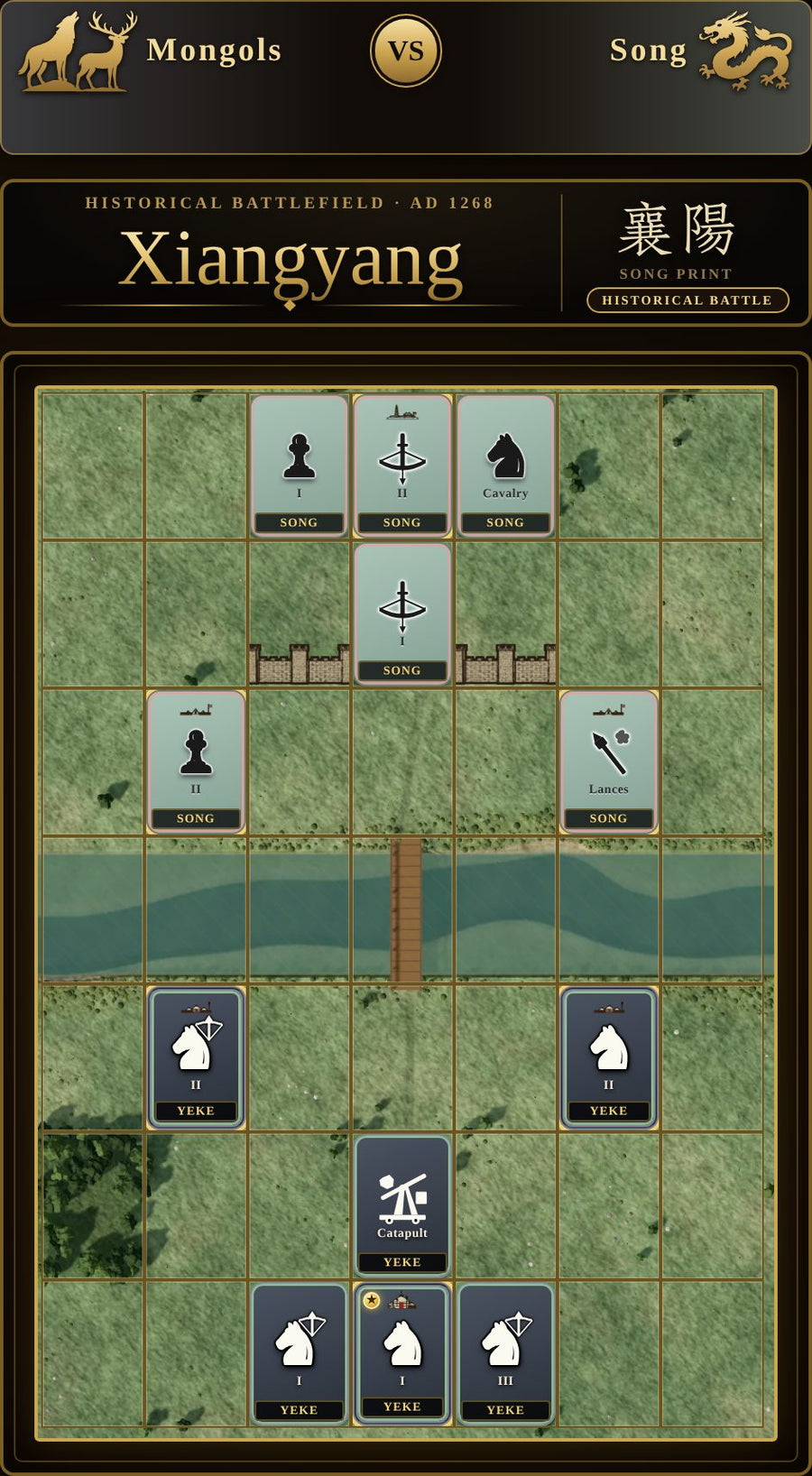
Xiangyang is one of the historical battlefields of Chapter VI of Sumeru Chess, the Age of Storm & Ashes. It is a 7 × 7 board drawn from the real ground: the Song side deploys from Xiangyang, the Mongols side from Mongol Lines.
- Forest stops movement, and an army inside is hidden unless one of yours stands next to it.
- The river stops movement; a defender standing in it fights at -1 DEF (horse) or -2 DEF (foot).
- Fords are the crossing places of the river.
- Walls can be held only by your own foot archers, crossbowmen and throwers: +1 ATK, +1 SPD, and only missiles can reach them.
Where to find it
- Conquest Campaign. Lead Mongols against Song, or Song against Mongols: Xiangyang is the second of the two historical battles of that war (the other is the siege of Diaoyu Castle), and the war ends at the enemy capital.
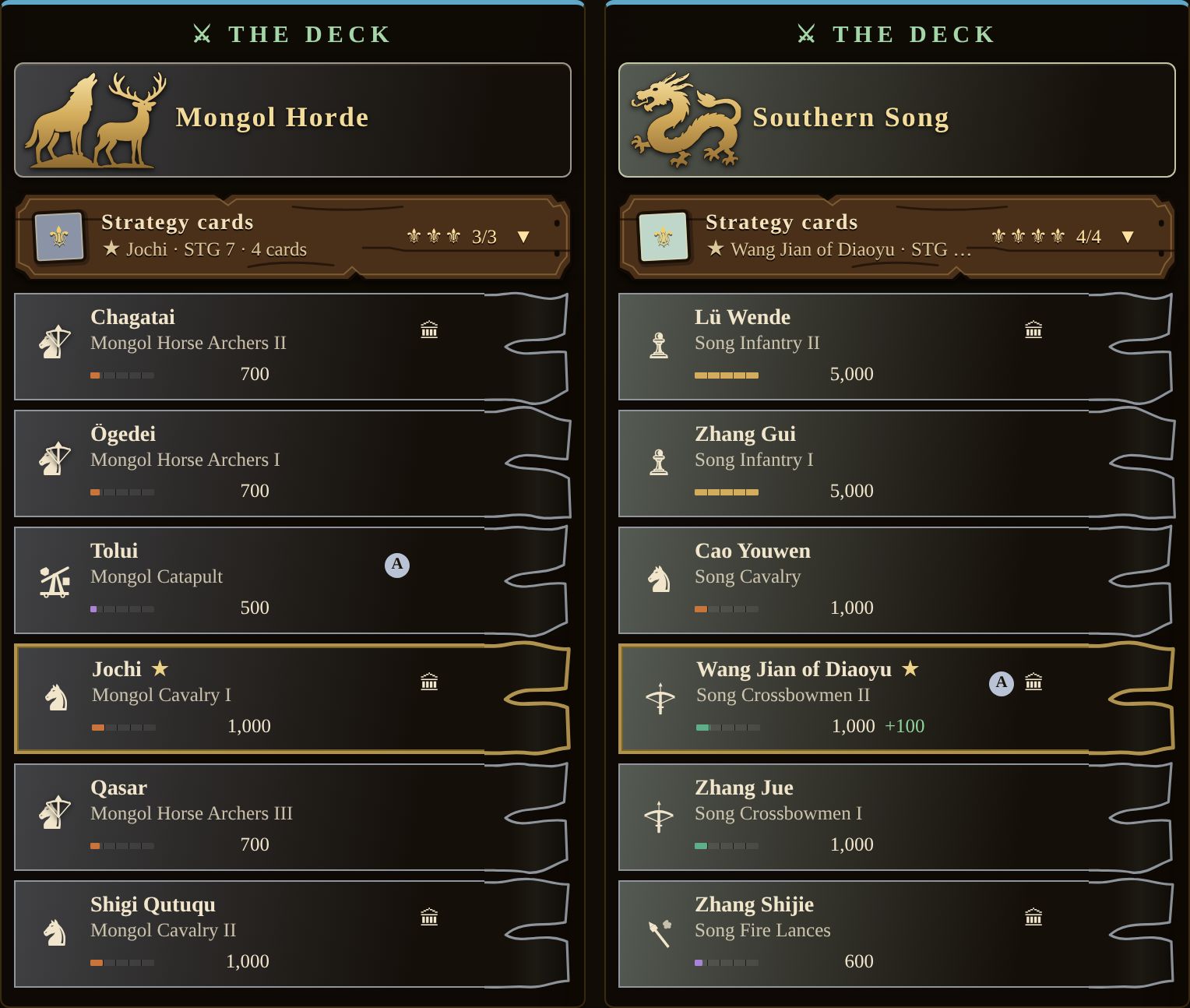
Fight it like history
- Walls are for missiles. Only your own foot archers, crossbowmen and throwers can stand on them: +1 ATK, and only missiles can reach them there.
- The river stops movement. A defender standing in it fights at -1 DEF (horse) or -2 DEF (foot); cross at the ford.
- Use the forest. An army inside is hidden unless one of yours stands next to it.
Chapter VI is free to play in your browser, no download: the Mongols and Khwarazm are open to everyone; the other powers of the age come with Sumeru Premium.
Play Chapter VIOpen the Card CollectionNotes and sources (6)
- Yuanshi 161 (biography of Liu Zheng). ↩
- Yuanshi 128 (Aju); Songshi 46. ↩
- Songshi 450 (Zhang Shun). ↩
- Yuanshi 203 (Ismail and Ala al-Din); Rashid al-Din. ↩
- Yuanshi 8; Songshi 46. ↩
- Yuanshi 9–10; Songshi 47. ↩
Further reading
- Morris Rossabi, Khubilai Khan: His Life and Times (University of California Press, 1988).
- Joseph Needham et al., Science and Civilisation in China vol. 5 part 6 (Cambridge, 1994), on the trebuchets.