
The Siege of Dorostolon, 971: Byzantium against the Rus
Sumeru & Seed Editorial BoardField Report · Chapter IV · April–July 971 · The Danube, Bulgaria
The prince of Kiev wanted to move his capital to the Danube. The emperor came to stop him with his armoured horsemen and his fireships. For three months the Rus held the walls of Dorostolon and sallied out to fight in the open — until a final battle in a dust storm.
Part I · The battle
Result A Byzantine victory: Sviatoslav made peace and left Bulgaria.
Why it is remembered
- An emperor in the field. John Tzimiskes, a soldier who had seized the throne, led his army in person and broke the Rus in open battle.
- Fire on the river. Byzantine ships with Greek fire closed the Danube, so the Rus could neither escape nor be supplied by water.
- A warrior prince. Leo the Deacon's portrait of Sviatoslav — shaven head, one lock of hair, a single earring — is the first description of a Rus ruler.
Invited by Byzantium to attack the Bulgarians, Sviatoslav conquered them instead and declared he would live at Pereyaslavets on the Danube. In 971 Tzimiskes struck: he crossed the Balkan passes at Easter, took the Bulgarian capital Preslav and drove the Rus into Dorostolon.1
The fortress stood on the Danube. Tzimiskes fortified a camp on a hill before it, and his fleet sealed the river.2
The battle, step by step
- Battles before the walls. The Rus come out on foot in a great shield wall; the Byzantine cataphracts charge again and again.
- The siege. Siege engines shoot into the town; Rus sallies burn some of them. The Rus champion Ikmor is killed by the emperor's bodyguard.3
- The last battle. Sviatoslav leads his whole army out. A wind blows dust into the Rus faces; Bardas Skleros rides round behind them, and the Rus are driven back to the town.4
- The peace. Sviatoslav asks for terms: he will leave Bulgaria and never attack the empire again. The two rulers meet on the riverbank.5
What followed
On the way home Sviatoslav was ambushed by the Pechenegs at the Dnieper rapids in 972 and killed; their khan made a drinking cup of his skull. Eastern Bulgaria became a Byzantine province, and a few years later Sviatoslav's son Vladimir took the Christian faith from Constantinople.6
Part II · Play it in Sumeru Chess
Dorostolon on the chessboard
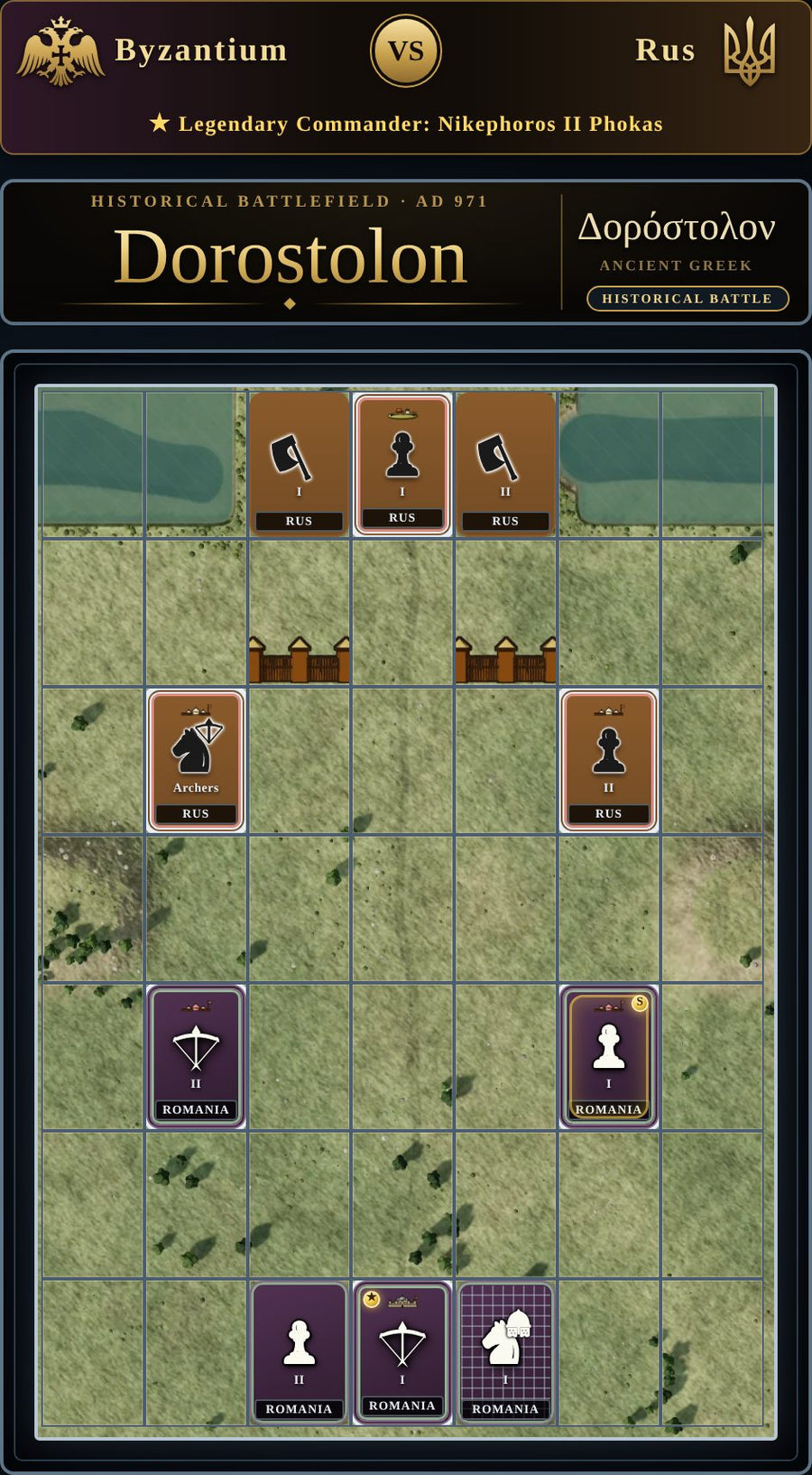
Dorostolon is one of the historical battlefields of Chapter IV of Sumeru Chess, the Age of Raven & Falcon. It is a 7 × 7 board drawn from the real ground: the Rus side deploys from Dorostolon, the Byzantium side from Imperial Camp.
- Hills give a defender +1 DEF, and cavalry cannot climb them.
- Walls can be held only by your own foot archers, crossbowmen and throwers: +1 ATK, +1 SPD, and only missiles can reach them.
Where to find it
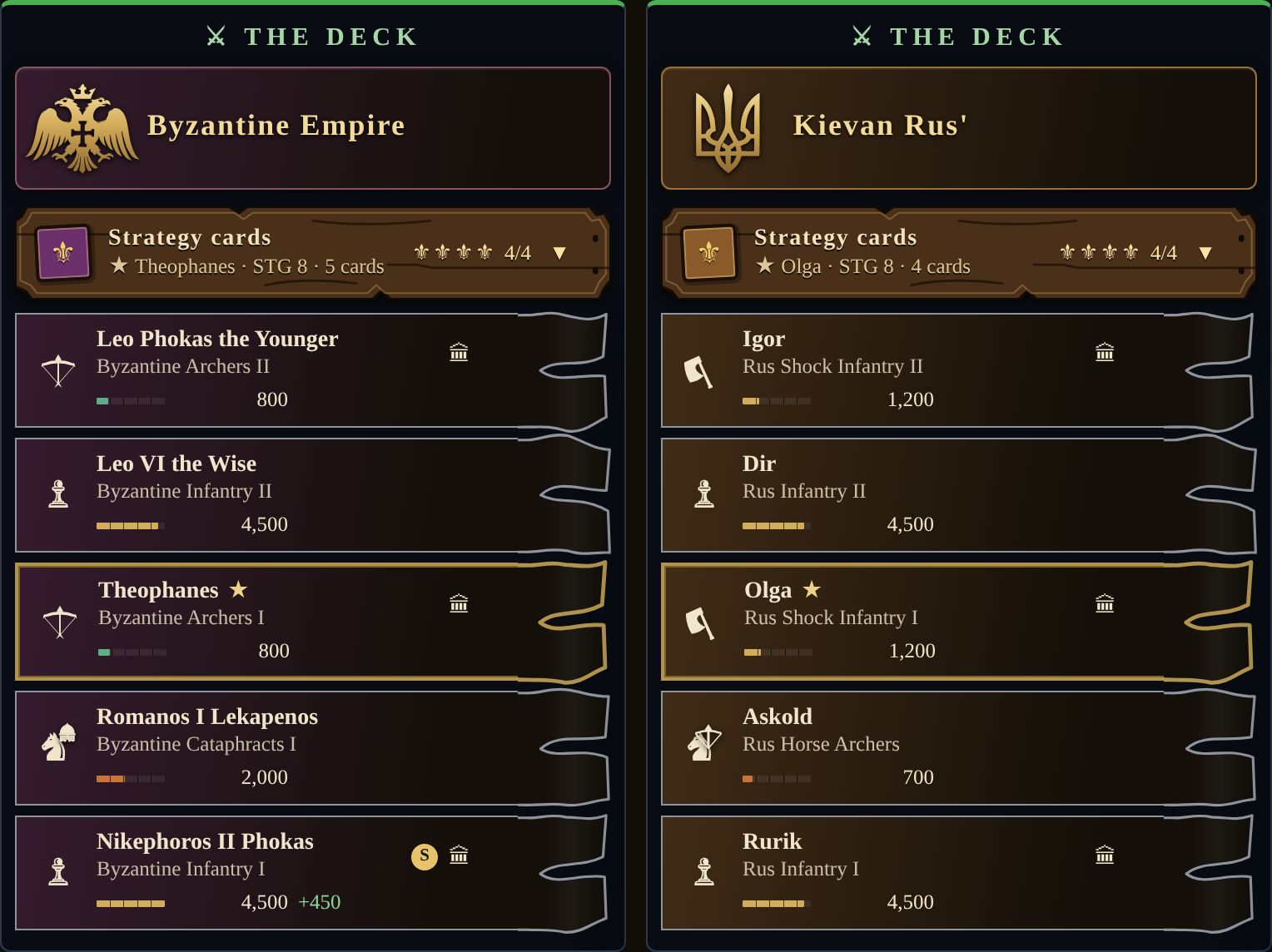
- Conquest Campaign. Lead Byzantium against Rus, or Rus against Byzantium: Dorostolon is the second of the two historical battles of that war (the other is Hieron), and the war ends at the enemy capital.
- Single Battle. Choose Byzantium against Rus and set Battlefield to Random: Dorostolon is one of the four historical fields the game draws for this pair.
Fight it like history
- Put missiles on the walls. Only your own foot archers, crossbowmen and throwers can stand on them: +1 ATK, and only missiles can reach them there.
- Hills favour the defender — +1 DEF, and cavalry cannot climb them. Tzimiskes camped on one.
- Kill the commander. If the enemy's ★ Chief Commander is routed, his side plays no more strategy cards and every army loses 2 MOR.
Chapter IV is for Sumeru Premium members — one membership opens every chapter of Sumeru Chess and Imperion 1776. Anyone can read its rulebook and browse its cards.
Play Chapter IVOpen the Card CollectionNotes and sources (6)
- Leo the Deacon, History 8.1–8; John Skylitzes, Synopsis (Tzimiskes) 13–15. ↩
- Leo the Deacon 8.9–10. ↩
- Leo the Deacon 9.1–6. ↩
- Leo the Deacon 9.8–9; Skylitzes 17. ↩
- Leo the Deacon 9.10–11; Russian Primary Chronicle, s.a. 971. ↩
- Russian Primary Chronicle, s.a. 972. ↩
Further reading
- Alice-Mary Talbot and Denis F. Sullivan (trans.), The History of Leo the Deacon (Dumbarton Oaks, 2005).
- Jonathan Shepard and Simon Franklin, The Emergence of Rus, 750–1200 (Longman, 1996).