
The Battle of the Hydaspes, 326 BCE: Alexander against Porus
Sumeru & Seed Editorial BoardField Report · Chapter II · May 326 BCE · Punjab
A monsoon river in flood, an Indian king on the far bank and two hundred elephants that no Macedonian horse would face. Alexander crossed upstream in a thunderstorm at night — and fought the hardest battle of his life.
Part I · The battle
Result A Macedonian victory; Porus surrendered and was made Alexander’s ally.
Why it is remembered
- The crossing. For weeks Alexander marched troops up and down the bank every night until Porus stopped reacting — then crossed for real, seventeen miles upstream, in a storm.
- Elephants against the phalanx. The Macedonian infantry fought the elephants with javelins, axes and sarissas aimed at drivers and trunks.
- A king treated as a king. Asked how he wished to be treated, the wounded Porus answered: as a king. Alexander gave him back his kingdom and more.
In the spring of 326 BCE Alexander crossed the Indus and was welcomed by the king of Taxila. Taxila's rival Porus refused to submit and waited on the far bank of the Hydaspes, swollen with monsoon rain, with his elephants lined along the shore where any landing would be made.1
Horses would not swim into elephants. Alexander left Craterus in the main camp opposite Porus and led a picked force upstream to a wooded island, crossing in boats and on skins stuffed with straw during a night of thunder and rain.2
The battle, step by step
- The landing. Alexander's force wades ashore, deeper than expected; Porus' son rides up with chariots and horse and is killed.3
- Porus turns. The king leaves a guard against Craterus and draws up his army: elephants in front of the infantry like towers in a wall, cavalry and chariots on the wings.
- The cavalry battle. Alexander attacks the Indian left; Coenus rides round behind the Indian line and takes the Indian horse from the rear.4
- The elephants. The phalanx advances against the elephants; maddened and wounded, they trample friend and foe in the crowded field.
- The ring closes. The Macedonian cavalry surrounds the Indian army; Craterus crosses and joins the pursuit. Porus, wounded, is the last to leave the field.5
“Treat me, Alexander, as a king.” — Porus, in Arrian6
What followed
Alexander founded two cities on the battlefield, one named Bucephala after his horse, which died about this time. Porus kept his throne and grew more powerful as Alexander's ally. A few weeks later, at the Hyphasis, the exhausted army refused to go further east, and Alexander turned back.7
Part II · Play it in Sumeru Chess
The Hydaspes on the chessboard
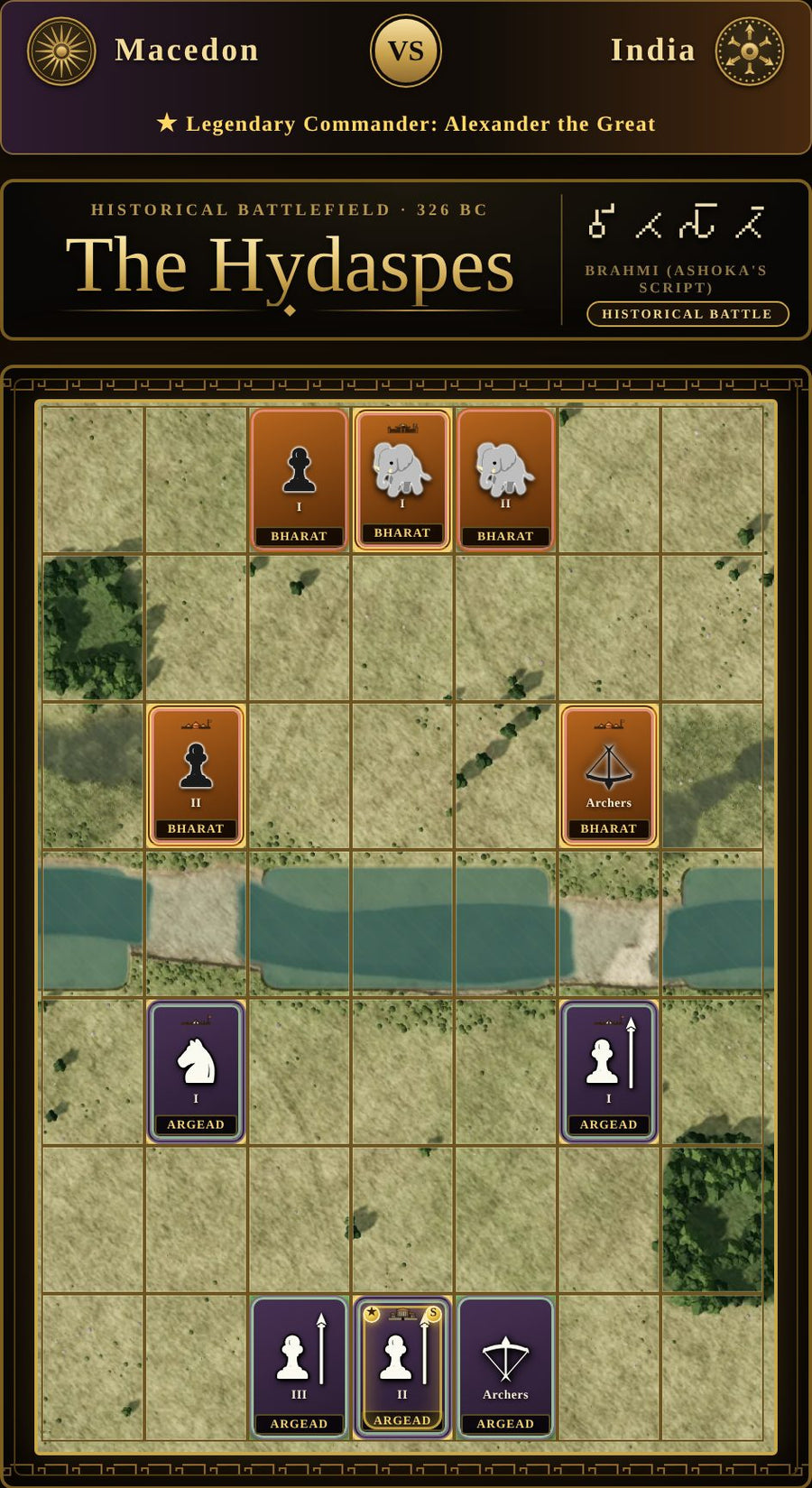
The Hydaspes is one of the historical battlefields of Chapter II of Sumeru Chess, the Age of Spears & Arrows. It is a 7 × 7 board drawn from the real ground: the India side deploys from Paurava, the Macedon side from Jhelum Camp.
- Forest stops movement, and an army inside is hidden unless one of yours stands next to it.
- The river stops movement; a defender standing in it fights at -1 DEF (horse) or -2 DEF (foot).
- Fords are the crossing places of the river.
Where to find it
- Conquest Campaign. Lead Macedon against India, or India against Macedon: the Hydaspes is the first of the two historical battles of that war (the other is the siege of Sangala), and the war ends at the enemy capital.
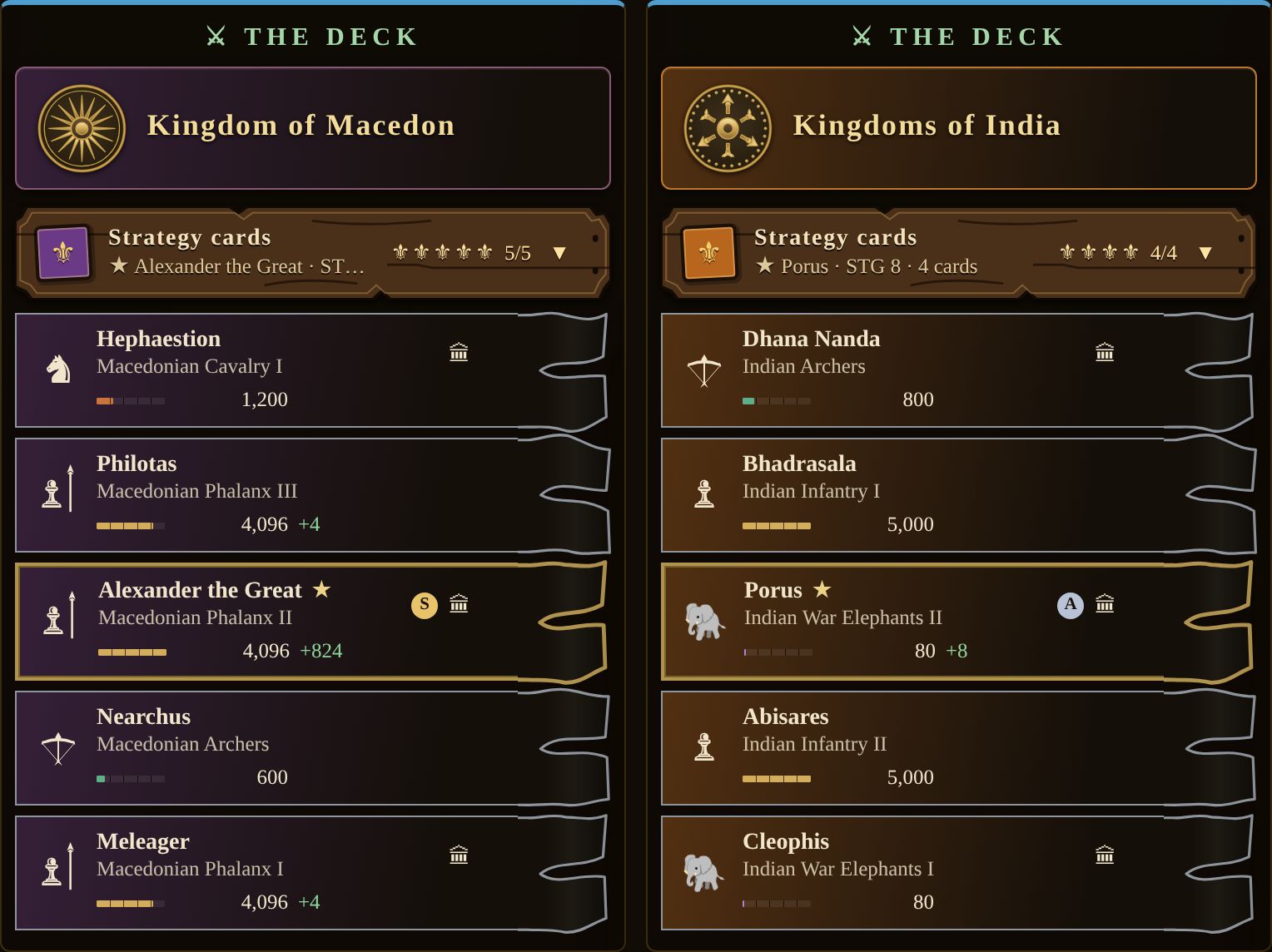
Fight it like history
- The river is a wall. Movement stops on river squares, and a defender standing in the river fights at -1 DEF (horse) or -2 DEF (foot). Cross at the ford and fight on dry ground.
- Hide in the forest. An army in a forest is hidden unless one of yours stands next to it — the island where Alexander gathered his boats.
- Elephants are strong in front. Pin them with one army and finish them with a second (2 vs 1).
Chapter II is for Sumeru Premium members — one membership opens every chapter of Sumeru Chess and Imperion 1776. Anyone can read its rulebook and browse its cards.
Play Chapter IIOpen the Card CollectionNotes and sources (7)
- Arrian, Anabasis 5.8–9; Curtius 8.13. ↩
- Arrian 5.9–12. ↩
- Arrian 5.14–15; Plutarch, Alexander 60. ↩
- Arrian 5.16–17. ↩
- Arrian 5.17–18. ↩
- Arrian 5.19. ↩
- Arrian 5.19–29. ↩
Further reading
- Arrian, The Campaigns of Alexander, trans. Aubrey de Sélincourt (Penguin), Book V.
- A. B. Bosworth, Alexander and the East (Oxford, 1996).
- Frank L. Holt, Into the Land of Bones (University of California Press, 2005).