
The Battle of Gaugamela, 331 BCE: Alexander and Darius on the Plain
Sumeru & Seed Editorial BoardField Report · Chapter II · 1 October 331 BCE · Northern Mesopotamia
On a plain Darius III had levelled for his chariots, Alexander led 47,000 men against the army of the whole Persian Empire, slid his line to the right until a gap opened, and drove the Companion cavalry straight at the Great King. The Achaemenid Empire never fought another great battle.
Part I · The battle
Result A decisive Macedonian victory: Darius fled, and Babylon, Susa and Persepolis fell within months.
Why it is remembered
- A battle on the enemy's chosen ground. Darius had the plain cleared so that his scythed chariots and his far larger cavalry could work. Alexander attacked anyway.
- The slide to the right. Alexander marched his whole line obliquely towards the edge of the levelled ground; the Persian left stretched to follow him — and opened a gap in its centre.
- The charge at the king. Alexander led the Companions in a wedge through that gap towards Darius himself. For the second time in two years, the Great King fled.
After Issus (333 BCE) Alexander took Tyre, Gaza and Egypt while Darius gathered a new army from every corner of the empire, from Bactria to the Indus. In the autumn of 331 the Macedonians crossed the Euphrates and the Tigris and found the Persian host waiting on the plain of Gaugamela, east of Mosul.1
Darius had flattened the ground in front of his line for the chariots. Alexander, outnumbered in cavalry many times over, drew up his army with a second line behind the first, ready to face about if it was surrounded.2
The battle, step by step
- The march to the right. Alexander advances obliquely towards the Persian left; Bessus' cavalry rides out to stop him from leaving the cleared ground.3
- The chariots charge — and fail. Javelin men and archers shoot down drivers and horses; the infantry opens its files and lets the rest through to be caught behind the line.4
- The gap opens. The Persian left has stretched too far; Alexander turns the Companion cavalry and the nearest phalanx battalions into a wedge and drives at the centre, where Darius stands.
- Darius flees. As the wedge nears him, the Great King turns his chariot and escapes; his centre dissolves around him.5
- Parmenion holds. On the left Mazaeus has nearly broken through, and Persian horsemen have reached the Macedonian baggage. Alexander turns back to relieve Parmenion; the pursuit of Darius is called off.
What followed
Darius escaped to Ecbatana and was murdered the next summer by his own satrap Bessus. Alexander entered Babylon and Susa without a fight and burned the palace of Persepolis. Gaugamela made him master of the Persian Empire — and the road to India lay open.6
Part II · Play it in Sumeru Chess
Gaugamela on the chessboard
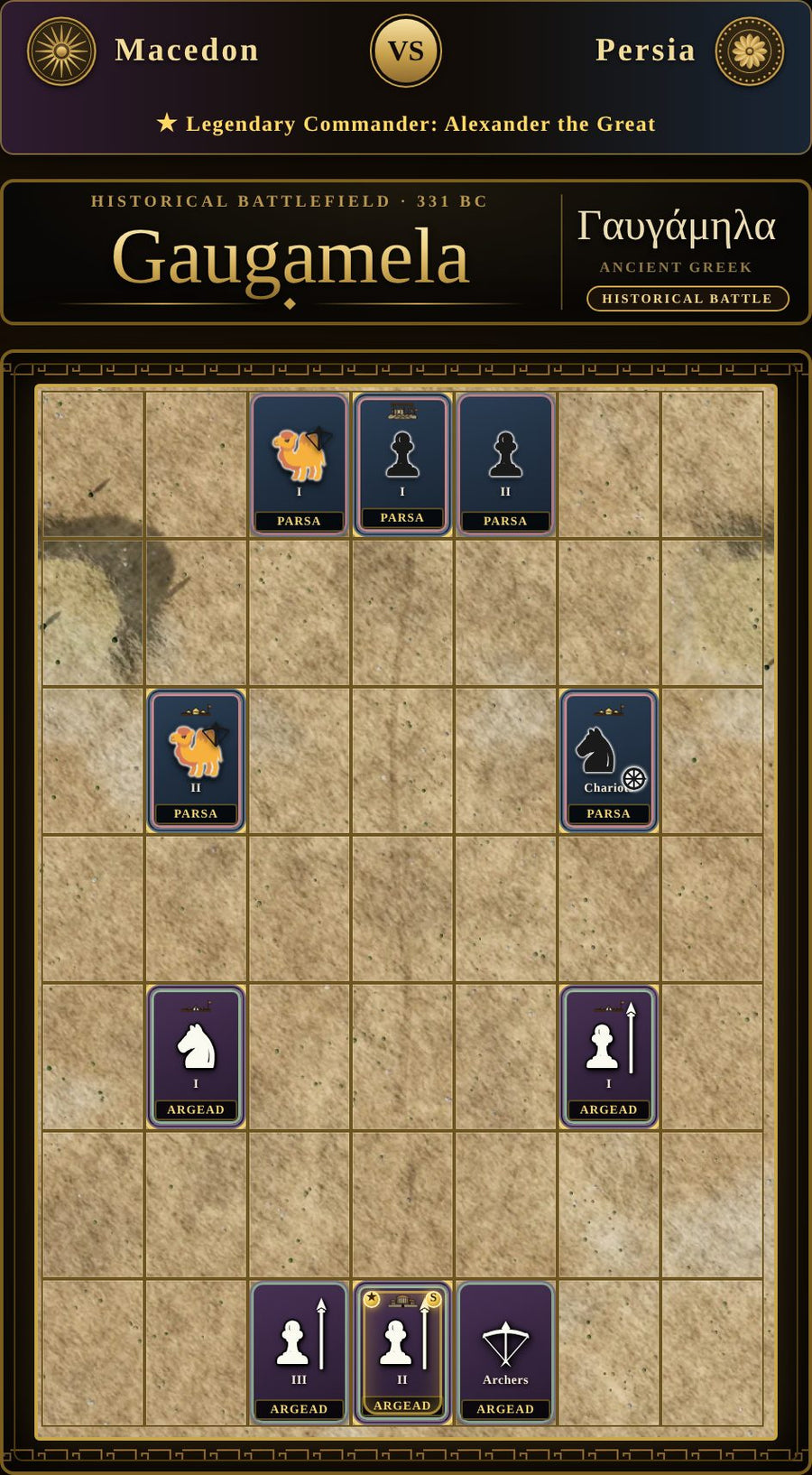
Gaugamela is one of the historical battlefields of Chapter II of Sumeru Chess, the Age of Spears & Arrows. It is a 7 × 7 board drawn from the real ground: the Persia side deploys from Arbela, the Macedon side from Macedonian Camp.
- Hills give a defender +1 DEF, and cavalry and elephants cannot climb them.
Where to find it
- Conquest Campaign. Lead Macedon against Persia, or Persia against Macedon: Gaugamela is the second of the two historical battles of that war (the other is the Granicus), and the war ends at the enemy capital.
Fight it like history
- Use the wedge. Alexander broke Darius with his best cavalry aimed at one point. Find the weak square in the enemy line and strike it with your strongest armies together.
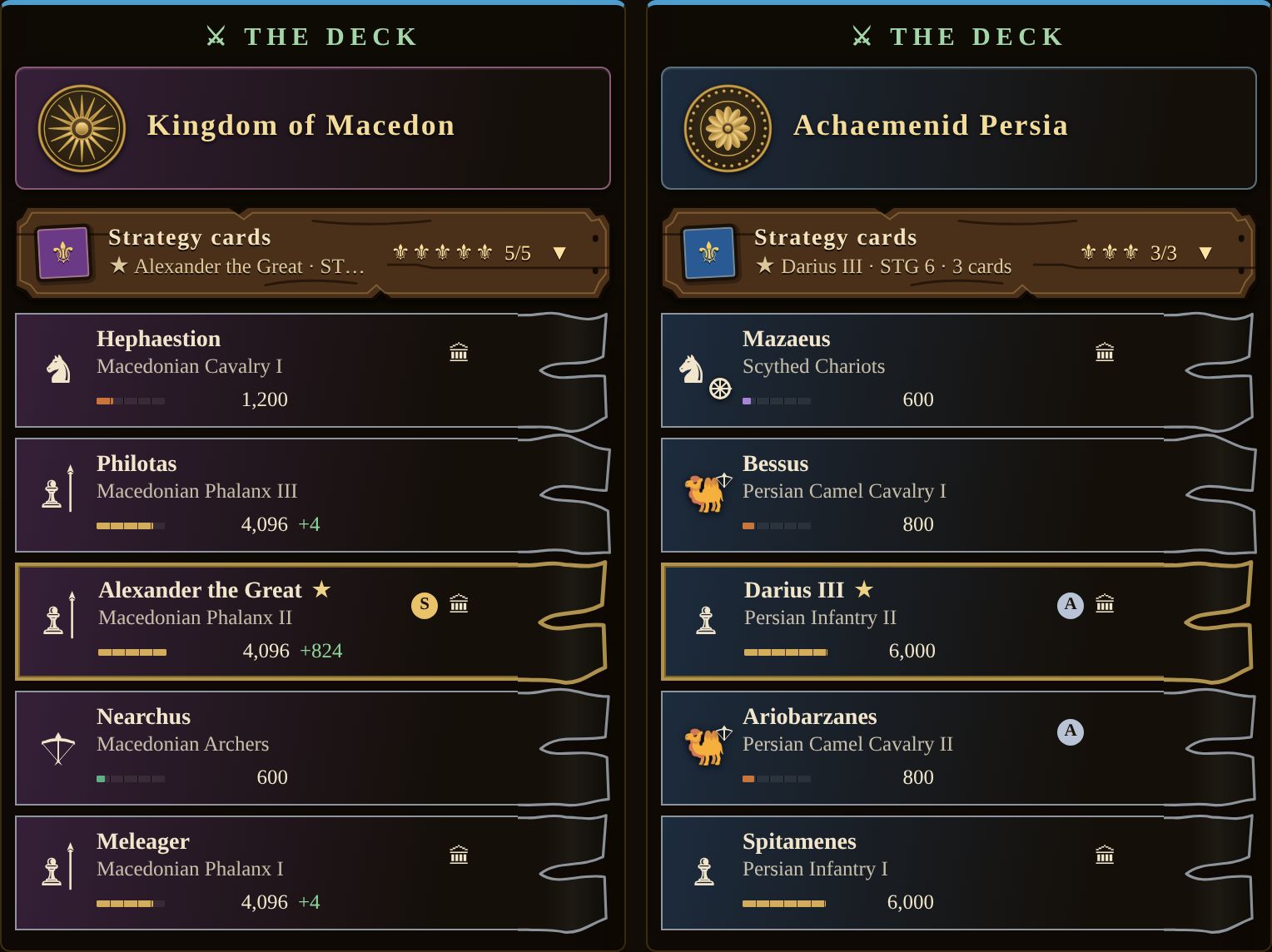
- Kill the commander. Every side has a Chief Commander, marked ★. If his army is routed, his side plays no more strategy cards and every army loses 2 MOR — the flight of Darius, in the rules of the game.
- Mind the scythed chariots. Persia fields them as a fast shock arm. Give them nothing to charge into: screen with missile troops.
- The two hills of the Gaugamela board give a defender +1 DEF, and cavalry and elephants cannot climb them.
Chapter II is for Sumeru Premium members — one membership opens every chapter of Sumeru Chess and Imperion 1776. Anyone can read its rulebook and browse its cards.
Play Chapter IIOpen the Card CollectionNotes and sources (6)
- Arrian, Anabasis 3.7–8; Curtius 4.9–10. ↩
- Arrian 3.12; Curtius 4.13. ↩
- Arrian 3.13. ↩
- Arrian 3.13; Curtius 4.15. ↩
- Arrian 3.14; Diodorus 17.60. The sources differ on the moment Darius fled. ↩
- Arrian 3.15–21. ↩
Further reading
- Arrian, The Campaigns of Alexander, trans. Aubrey de Sélincourt (Penguin), Book III.
- A. B. Bosworth, Conquest and Empire: The Reign of Alexander the Great (Cambridge, 1988).
- Peter Green, Alexander of Macedon, 356–323 B.C. (University of California Press, 1991).