

The Battle of Edington, 878: Alfred the Great Saves Wessex
Sumeru & Seed Editorial BoardField Report · Chapter IV · May 878 · Wiltshire, England
In January the Vikings caught Alfred by surprise and he fled into the marshes of Somerset with a handful of men. Five months later he came out with the levies of three shires, broke Guthrum's army in a shield-wall battle and made the Viking king a Christian.
Part I · The battle
Result A decisive West Saxon victory; Guthrum surrendered and was baptised.
Why it is remembered
- From outlaw to victor. Five months after his kingdom collapsed, Alfred defeated the army that had taken it.
- The shield wall. The Anglo-Saxon Chronicle says Alfred fought “with a close shield-wall” and put the Danes to flight.
- England's map redrawn. The peace that followed divided England between Wessex and the Danish settlers — the beginning of the Danelaw.
On Twelfth Night 878 Guthrum's army fell on Alfred's court at Chippenham. Much of Wessex submitted; Alfred escaped with a small band into the marshes around Athelney in Somerset — where, the later legend says, he burned a peasant woman's cakes.1
In the seventh week after Easter he rode to Egbert's Stone, where the men of Somerset, Wiltshire and Hampshire came to him, “and they were glad of him”. Two days later he found the Danes at Ethandun.2
The battle, step by step
- The muster. The levies of three shires join Alfred at Egbert's Stone.
- The shield wall. At Ethandun the West Saxons fight the Great Army in a close shield-wall and break it.3
- The pursuit. Alfred chases the beaten Danes to their stronghold — probably Chippenham — and blockades it.
- The surrender. After fourteen days, hungry and afraid, the Danes give hostages and swear to leave Wessex.4
What followed
Three weeks later Guthrum and thirty of his chief men were baptised, with Alfred standing as his godfather; he took the name Æthelstan and ruled East Anglia. Alfred built a network of fortified burhs and a navy, and his grandson Æthelstan became the first king of all England.5
Part II · Play it in Sumeru Chess
Edington on the chessboard
Edington is one of the historical battlefields of Chapter IV of Sumeru Chess, the Age of Raven & Falcon. It is a 7 × 7 board drawn from the real ground: the Vikings side deploys from Chippenham, the England side from Athelney.
- Hills give a defender +1 DEF, and cavalry cannot climb them.
- Forest stops movement, and an army inside is hidden unless one of yours stands next to it.
Where to find it
- Conquest Campaign. Lead England against Vikings, or Vikings against England: Edington is the second of the two historical battles of that war (the other is York), and the war ends at the enemy capital.
- Single Battle. Choose England against Vikings and set Battlefield to Random: Edington is one of the four historical fields the game draws for this pair.
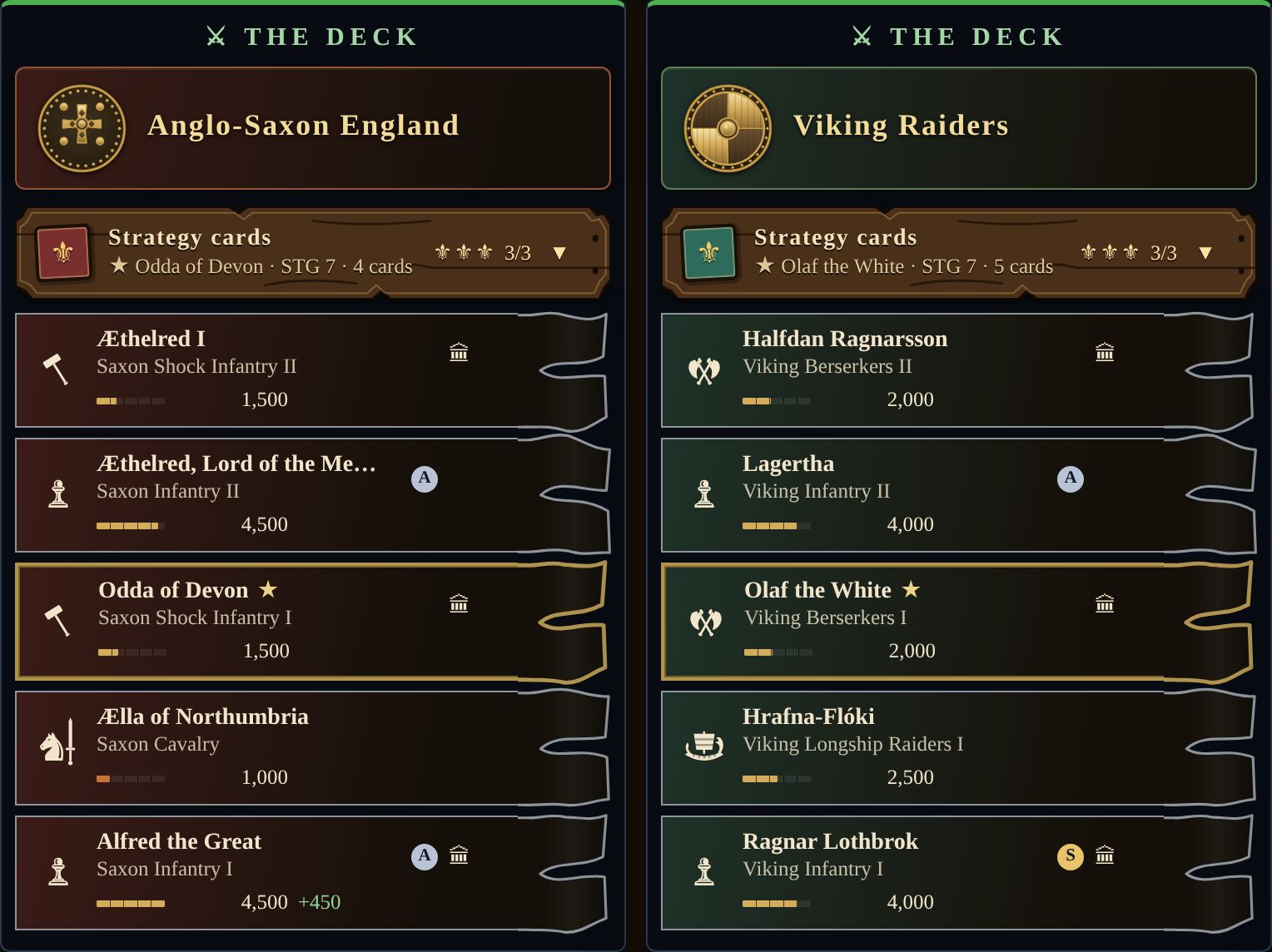
Fight it like history
- Hold the line together. A shield wall is many armies side by side: an enemy that attacks one is open to the next (2 vs 1).
- The forests hide. An army inside is hidden unless one of yours stands next to it — the marshland refuge of Athelney on the Edington board.
- The hill favours the defender. It gives +1 DEF, and cavalry cannot climb it.
Chapter IV is for Sumeru Premium members — one membership opens every chapter of Sumeru Chess and Imperion 1776. Anyone can read its rulebook and browse its cards.
Play Chapter IVOpen the Card CollectionNotes and sources (5)
- Anglo-Saxon Chronicle, s.a. 878; Asser, Life of King Alfred 52–53. ↩
- Anglo-Saxon Chronicle, s.a. 878; Asser 55. ↩
- Anglo-Saxon Chronicle, s.a. 878; Asser 56. ↩
- Asser 56. ↩
- Anglo-Saxon Chronicle, s.a. 878; Asser 56; the treaty of Alfred and Guthrum. ↩
Further reading
- Simon Keynes and Michael Lapidge (trans.), Alfred the Great: Asser's Life of King Alfred and Other Contemporary Sources (Penguin, 1983).
- Justin Pollard, Alfred the Great (John Murray, 2005).