
The Battle of Cannae, 216 BC: Hannibal's Double Envelopment
Sumeru & Seed Editorial BoardField Report · Chapter III · 2 August 216 BC · Apulia, Italy
Outnumbered almost two to one, Hannibal let the largest army Rome had ever raised push into his centre — then closed both wings and his cavalry around it. By evening some 50,000 Romans lay dead on a single field.
Part I · The battle
Result A crushing Carthaginian victory — the worst defeat in Rome's history.
Why it is remembered
- The perfect encirclement. A smaller army surrounded and destroyed a larger one on open ground — the model every staff college still teaches as Cannae.
- The bending crescent. Hannibal's weakest troops stood in the middle and were meant to give way; the Roman advance into the hollow was the trap.
- Cavalry decided it. Hasdrubal's horse broke the Roman cavalry by the river, rode round the whole army and struck the legions in the rear.
Hannibal had crossed the Alps in 218 BC and already destroyed two Roman armies, at the Trebia and at Lake Trasimene. For 216 the Senate raised eight legions with as many allies — the largest army the Republic had ever fielded — and sent both consuls to finish him. Hannibal waited for them on the treeless plain of the Aufidus, where his superior cavalry had room to ride.1
Varro, commanding on 2 August, crossed the river and drew up the infantry deeper and narrower than usual, a battering ram meant to smash the Carthaginian centre by sheer weight. The river guarded one flank of each army; the ground between river and hills was too tight for so many men.2
The battle, step by step
- Skirmishers open the battle in front of both lines.
- By the river, Hasdrubal's Spanish and Gallic horse crush the Roman cavalry in a cramped, dismounted brawl. Paullus, wounded, joins the infantry.3
- The crescent bends. The legions push the Spanish and Gallic centre back until the bulge becomes a hollow — and march into it.
- The jaws close. Hannibal's African veterans, waiting on both ends of the line, turn inward and fall on the Roman flanks.4
- The ride round the rear. Hasdrubal leads his horsemen behind the Roman army, drives off Varro's allied cavalry, then charges the legions from behind. Packed too tight to fight, they are cut down until nightfall.5
“You know how to win a victory, Hannibal; you do not know how to use one.” — Maharbal after the battle, in Livy6
What followed
Paullus died with some eighty senators; Varro escaped with seventy horsemen. Capua and much of southern Italy went over to Hannibal, and Macedon allied with him. Yet Rome refused to make peace, raised new legions and went back to Fabius' war of delay. Fourteen years later Hannibal was beaten at Zama — by a general who had survived Cannae.7
Part II · Play it with Imperium Cards
Cannae with the physical cards
Cannae is one of the battles of Edition I · The Second Punic War of Imperium Cards. Lay out Hannibal's crescent, hide the African infantry on its ends and hold the cavalry on the flanks — or take the Roman side and try to break the centre before the trap closes. The card battle below has been with the set since its first printing.


In 216 BC, Hannibal lured a vastly larger Roman army into the Aufidus plain, then executed history's most perfect encirclement. His center feigned retreat while African veterans pivoted inward on both flanks, trapping 80,000 Romans who were annihilated almost to the last man.
Order of battle
Battle sequence
- Phase IRoman army advances on Carthaginian center
- Phase IICarthaginian center retreats — drawing Romans in
- Phase IIIAfrican infantry pivot inward on both flanks
- Phase IVCavalry completes encirclement — total destruction
The most catastrophic defeat in Roman history — a masterclass in double envelopment still studied in military academies today.
Could you have broken the encirclement?
Recreate history's greatest tactical masterpiece with Edition I


Part III · Play it in Sumeru Chess
Cannae on the chessboard
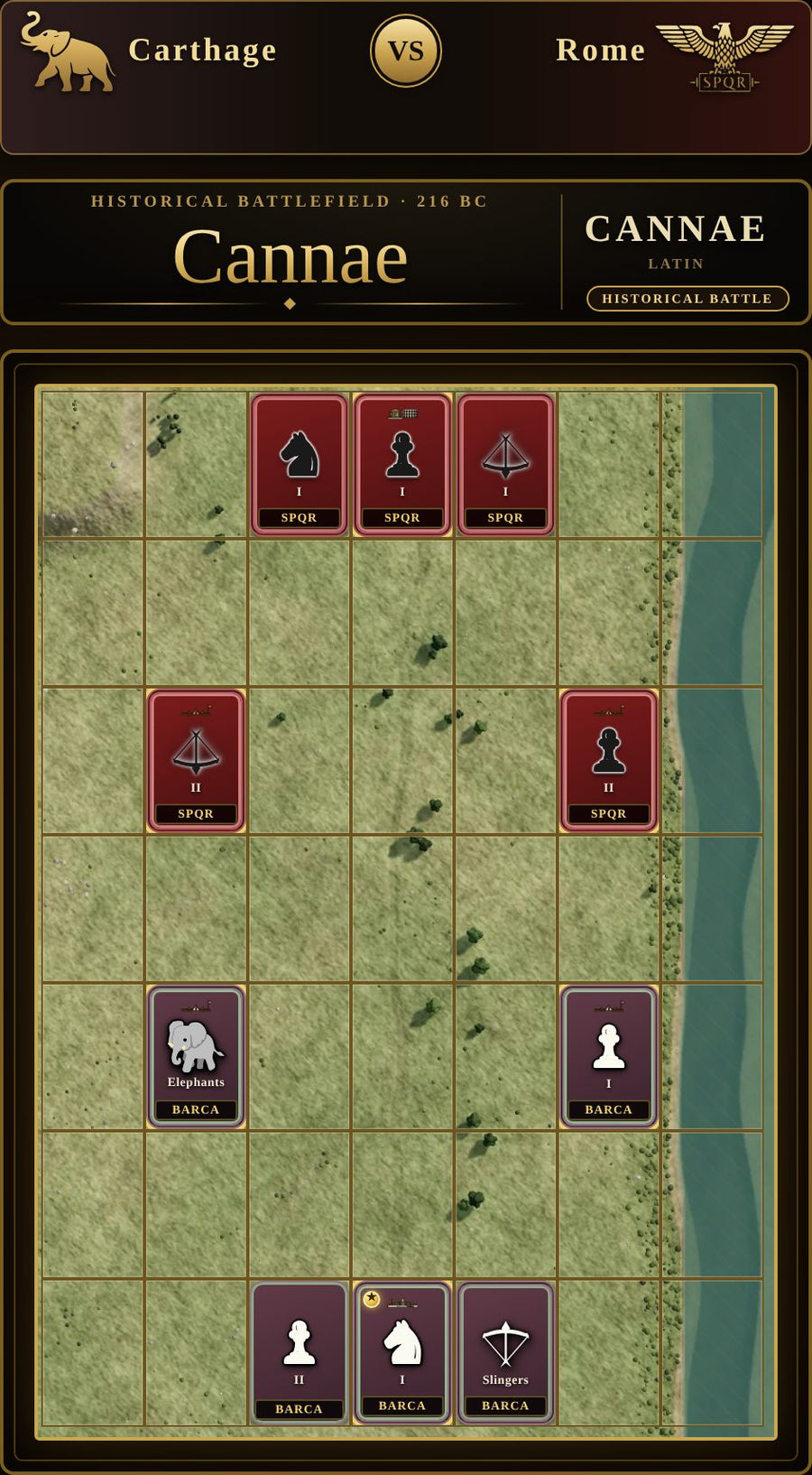
Cannae is one of the historical battlefields of Chapter III of Sumeru Chess, the Age of Iron & Glory. It is a 7 × 7 board drawn from the real ground: the Carthage side deploys from Gerunium, the Rome side from Canusium.
- Hills give a defender +1 DEF, and cavalry and elephants cannot climb them.
Where to find it
- Conquest Campaign. Lead Carthage against Rome, or Rome against Carthage: Cannae is the first of the two historical battles of that war (the other is Zama), and the war ends at the enemy capital.
- Single Battle. Choose Carthage against Rome and set Battlefield to Random: Cannae is one of the four historical fields the game draws for this pair.
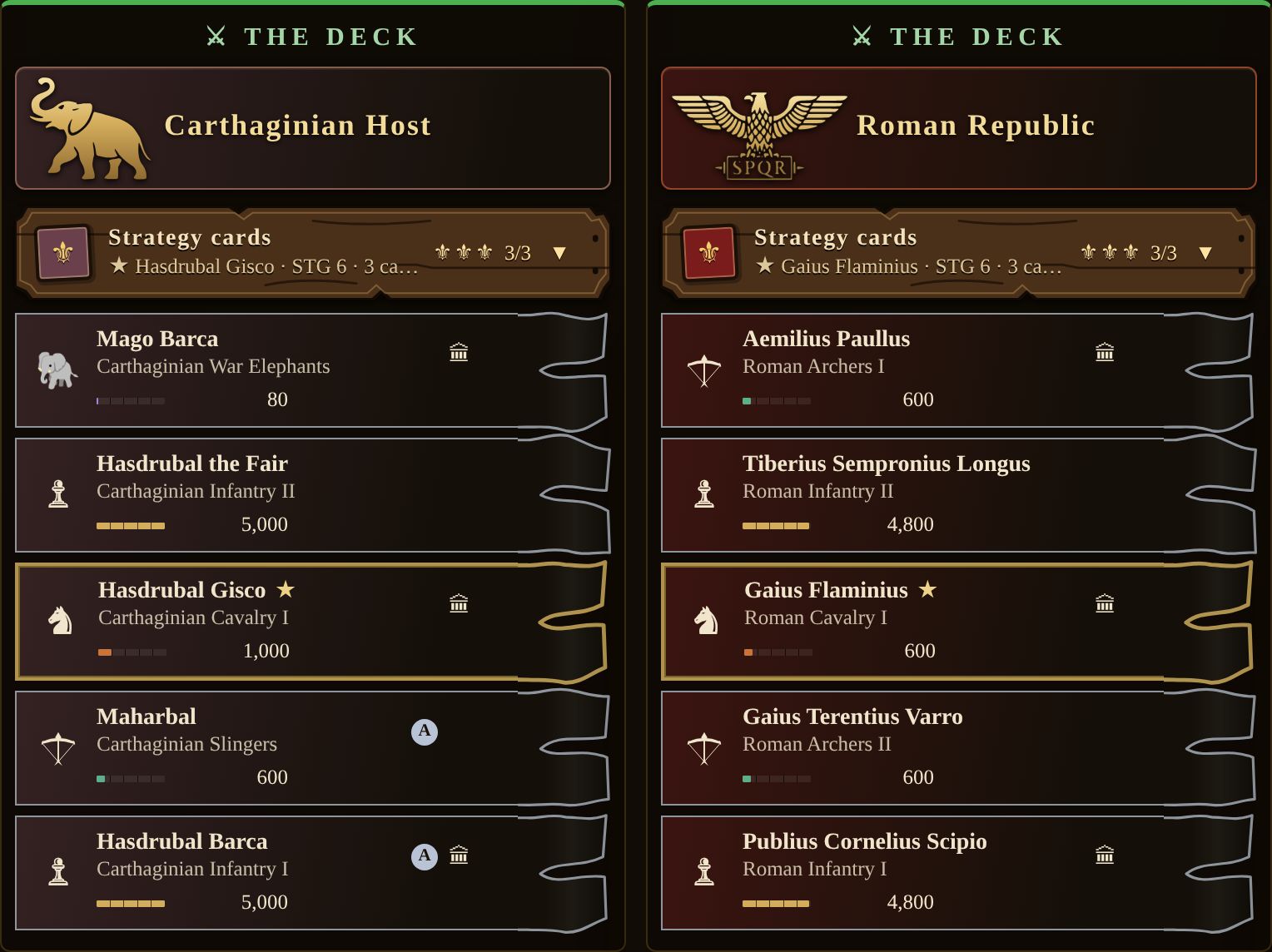
Fight it like history
- Keep the centre alive, not strong. In the game as in history the trap only works if your centre holds long enough: let the Roman armies come forward into the middle of the board.
- Win the flank first. Your cavalry's job is the enemy cavalry. Once it is gone, bring it round behind the Roman line.
- Use 2 vs 1. An enemy army pinned by one of your melee armies can be struck by a second and destroyed outright, no card needed (unless it holds the line) — the encirclement of Cannae in the rules of Sumeru Chess.
- Watch the hills. The two hills of the Cannae board give a defender +1 DEF, and cavalry and elephants cannot climb them.
Chapter III is free to play in your browser, no download: Rome and Carthage are open to everyone; the other powers of the age come with Sumeru Premium.
Play Chapter IIIOpen the Card CollectionNotes and sources (7)
- Polybius 3.107; Livy 22.36–40. On the size of the Roman army see Goldsworthy, Cannae, ch. 4. ↩
- Polybius 3.113. ↩
- Polybius 3.115. ↩
- Polybius 3.115–116. ↩
- Polybius 3.116–117; Livy 22.47–49. ↩
- Livy 22.51. ↩
- Livy 22.49–61; Polybius 3.117–118. Scipio, the victor of Zama, served at Cannae as a military tribune (Livy 22.53). ↩
Further reading
- Polybius, The Rise of the Roman Empire, trans. Ian Scott-Kilvert (Penguin), Book III.
- Adrian Goldsworthy, Cannae: Hannibal's Greatest Victory (Cassell, 2001).
- Gregory Daly, Cannae: The Experience of Battle in the Second Punic War (Routledge, 2002).