
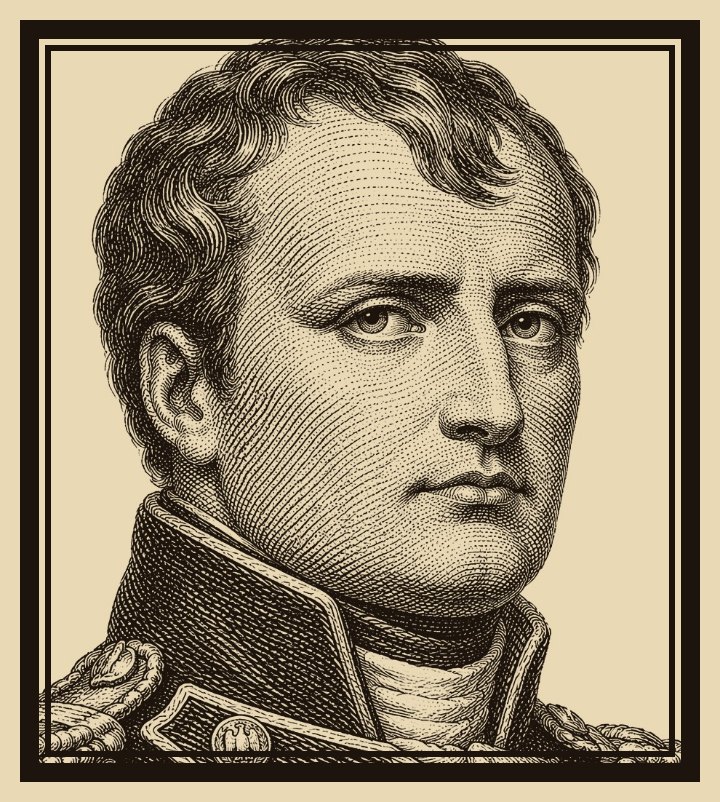
Napoleon Bonaparte: The Artillery Officer Who Remade Europe
Sumeru & Seed Editorial BoardBorn on a poor island a year after it became French, he was a general at twenty-four, master of France at thirty and of Europe at thirty-seven. Eight years later he was a prisoner on a rock in the South Atlantic. What did Napoleon leave behind?
He was born Napoleone Buonaparte at Ajaccio in Corsica on 15 August 1769, the second surviving son of a lawyer of the minor nobility. France had bought the island from Genoa only the year before. He grew up speaking Corsican, learned French at school on a royal scholarship — the other boys at Brienne laughed at his accent — and never lost the outsider's habit of looking at France as something to be mastered.
The gunner
At sixteen he was commissioned a second lieutenant of artillery, the most technical arm of the old army and the one where a poor provincial could rise by mathematics. The Revolution did the rest. In 1793, as a captain, he planned the placing of the batteries that drove the British fleet out of Toulon, and was made brigadier general at twenty-four. In October 1795 he cleared a royalist rising from the streets of Paris with cannon. The government rewarded him with the command of the ragged Army of Italy.
In the spring of 1796 he led it over the mountains and, in a year of marches that are still studied, beat the Piedmontese and four Austrian armies in turn — Lodi, Arcole, Rivoli — and dictated peace himself. An expedition to Egypt in 1798 won the Battle of the Pyramids and lost its fleet to Nelson; its lasting result was scholarly, the survey that founded modern Egyptology and turned up the Rosetta Stone. In 1799 he slipped home, and in November overthrew the Directory. He was thirty.1
The lawgiver
As First Consul he did what ten years of revolution had not: he made its gains permanent and its quarrels stop. He made peace with the Church by the Concordat of 1801, founded the Bank of France, the prefects, the lycées and the Legion of Honour, and sat through many of the sessions that produced the Civil Code of 1804 — equality before the law, secure property, freedom of religion and, less happily, the legal authority of husbands over wives. In 1802 he also sent an army to restore slavery in the French Caribbean; it failed in Haiti, and the failure led him to sell Louisiana to the United States. On St Helena he said that his real glory was not forty battles won, which Waterloo would efface, but the Code, which would live.2 On 2 December 1804, in Notre-Dame, he crowned himself Emperor of the French.
The conqueror
Then came the years that fixed his name: Ulm and Austerlitz in 1805, Jena and Auerstedt in 1806, Friedland in 1807. His method was speed and concentration. The army marched in self-contained corps, lived off the country, and came together on the battlefield faster than its enemies thought possible. At Tilsit, on a raft in the Niemen, he and the Tsar divided the continent.
He could not reach Britain. After Trafalgar he tried to ruin it by closing Europe's ports to its trade, and enforcing that blockade drew him ever further: into Spain in 1808, where a popular war and Wellington's army bled him for six years, and in 1812 into Russia. He crossed the Niemen in June with over half a million men, the largest army Europe had seen. He took Moscow, found it burning, waited five weeks for a peace that did not come, and retreated through the snow. Perhaps one man in six came back.3
The fall
Europe rose behind him. At Leipzig in October 1813 — the "Battle of the Nations," half a million men — the armies of Russia, Prussia, Austria and Sweden beat him in four days. He fought a brilliant, hopeless campaign in France in early 1814, abdicated in April, and was given the island of Elba. Ten months later he landed in Provence with a thousand men and reached Paris in twenty days without firing a shot. The Hundred Days ended at Waterloo on 18 June 1815. The British sent him to St Helena, where he dictated his memoirs, quarrelled with his jailer and died on 5 May 1821, aged fifty-one.
What he left
His wars cost Europe several million lives, and France ended them smaller than he had found her. But the map he tore up was not restored. The Holy Roman Empire was gone; the German and Italian states he had merged and reformed kept his codes and began to think of themselves as nations. Spain's American colonies, cut off from a captive king, went their own way. Armies everywhere adopted his corps, his staff system and his conscription; and his enemy Clausewitz built a theory of war on the study of his campaigns.
He remains hard to judge because both things said of him are true. He was a soldier of the Revolution who carried equality before the law across a continent, and a despot who spent a generation of young men on his own ambition.
Notes
- Andrew Roberts, Napoleon the Great (2014; US title Napoleon: A Life), draws on the new complete edition of his correspondence. For a more critical view see Michael Broers, Napoleon: Soldier of Destiny (2014). ↩
- Reported by Montholon, one of his companions on St Helena; like all the St Helena sayings it was meant for posterity. ↩
- Adam Zamoyski, 1812: Napoleon's Fatal March on Moscow (2004); Dominic Lieven, Russia Against Napoleon (2009), tells the story from the Russian side. ↩
Further Reading
- Andrew Roberts, Napoleon the Great (2014).
- Michael Broers, Napoleon: Soldier of Destiny (2014) and Napoleon: The Spirit of the Age (2018).
- Steven Englund, Napoleon: A Political Life (2004).
- David G. Chandler, The Campaigns of Napoleon (1966).