

The Fall of Khwarazm, 1219–1221: How a Massacre of Merchants Brought the Mongols West
Sumeru & Seed Editorial BoardIn 1218 the Khwarazm-Shah Muhammad ruled the most powerful Muslim state in the East. Three years later his empire was gone, its great cities in ruins. The war that destroyed it began with a caravan, a governor's greed and an insult to Genghis Khan.

In 1218 a caravan of some 450 merchants, almost all of them Muslims, arrived at the frontier town of Otrar on the Syr Darya. They came from Mongolia, sent by Genghis Khan with goods and silver to open trade with the Khwarazmian Empire, the great Muslim power of Central Asia and Iran. The governor of Otrar, Inalchuq, accused them of spying, had them killed and seized their goods — with the consent, our sources say, of his sovereign, the Khwarazm-Shah Ala al-Din Muhammad. When Genghis Khan sent envoys to demand the governor's punishment, the Shah had one of them executed and the beards of the others burned.1 It was the most expensive diplomatic insult in history.
The Khwarazmian Empire
The Khwarazm-Shahs began as governors of Khwarazm, the oasis of the lower Amu Darya south of the Aral Sea, for the Seljuk sultans. As Seljuk power collapsed in the twelfth century, they built their own empire. Ala al-Din Muhammad (r. 1200–1220) conquered Transoxiana from the Qara Khitai, took Afghanistan from the Ghurids, extended his rule over most of Iran and even marched on Baghdad to impose his will on the Abbasid caliph. On paper his empire was immense and his army, recruited largely from Qipchaq and Qangli Turks of the steppe, numerous.2
It had weaknesses. Its conquests were recent. The Shah quarrelled with his own mother, Terken Khatun, whose Qangli kinsmen dominated the army. He had made enemies of the caliph and the Muslim religious establishment. And his strategy, when the Mongols came, was to divide his army among the garrisons of his cities rather than face them in the field.
The invasion
Genghis Khan had just completed the destruction of the last Naiman prince, Küchlüg, and the conquest of the old Qara Khitai lands. In 1219 he marched west with an army that modern historians usually estimate at between 100,000 and 150,000 men, including contingents from his Uighur, Qarluq and other subjects.3
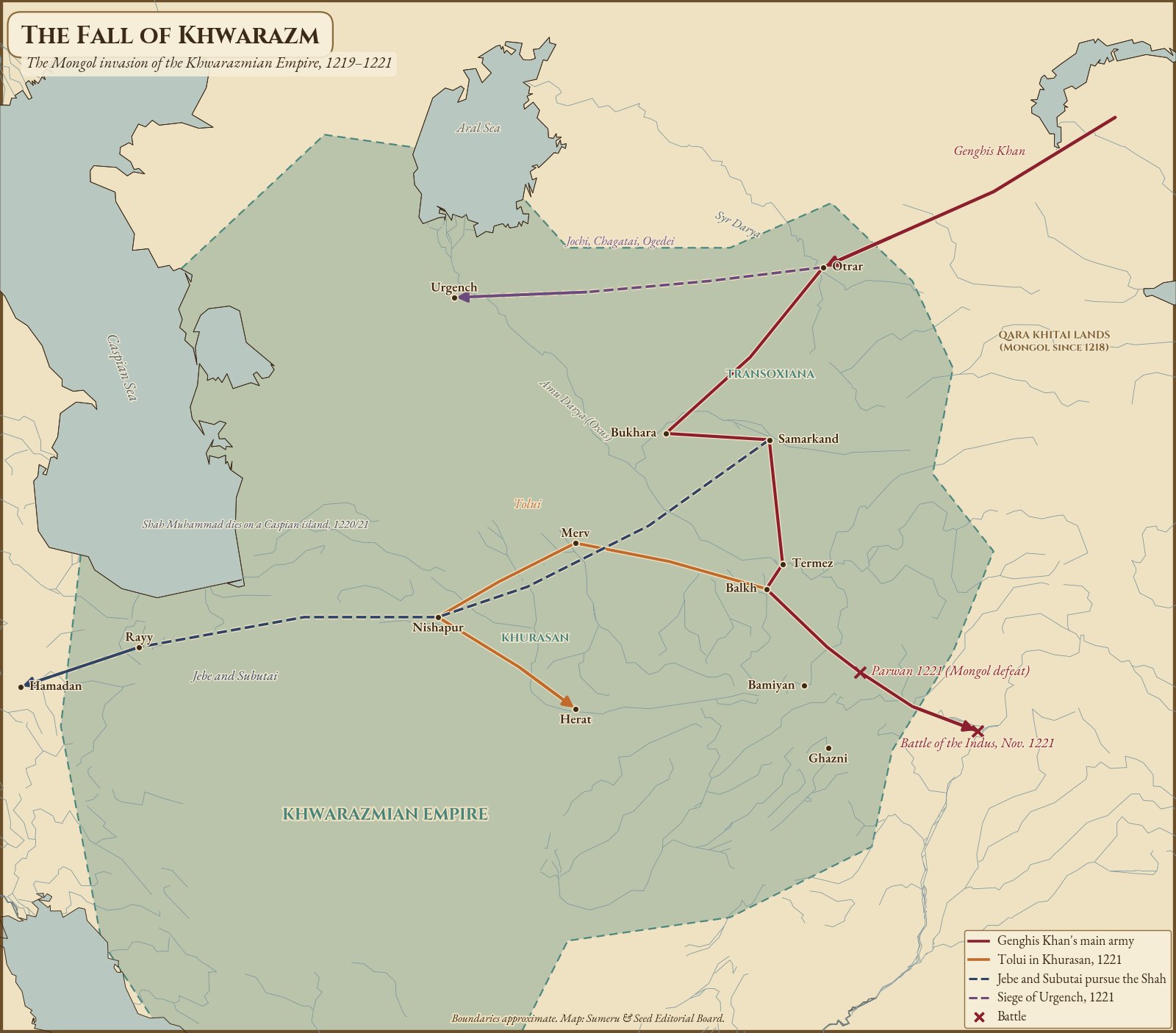
He divided it. His sons Chagatai and Ögedei besieged Otrar, which held out for five months; Inalchuq was taken alive and executed — according to a story repeated by later writers, by having molten silver poured into his eyes and ears. Jochi marched down the Syr Darya. Genghis Khan himself, with his youngest son Tolui, crossed the Kyzyl Kum desert and appeared unexpectedly before Bukhara in February 1220. The city surrendered; the citadel was stormed. Juvaini tells how Genghis Khan rode into the Friday mosque and told the leading citizens that he was the punishment of God for their sins.4 Samarkand, the capital, fell in March after its Turkish garrison surrendered; the soldiers were killed and the craftsmen deported to Mongolia.
The pursuit of the Shah
The Shah fled west. Genghis Khan sent two of his best generals, Jebe and Subutai, with some 20,000–30,000 horsemen to pursue him without rest. They chased him across Khurasan and northern Iran; he died, abandoned and destitute, on an island in the Caspian Sea in the winter of 1220–1221.5 Jebe and Subutai then continued on one of the most remarkable reconnaissance raids in history: through Azerbaijan and Georgia, over the Caucasus, onto the Russian steppe, where in 1223 they defeated an army of Rus princes and Qipchaqs at the Kalka River, before rejoining the main army.
The ruin of Khurasan
In 1221 the war entered its most terrible phase. The great cities of Khurasan — Balkh, Merv, Nishapur and Herat — had surrendered or been occupied and then rebelled, or resisted. Tolui was sent to deal with them. Merv was taken in February 1221; its population, except for a few hundred craftsmen, was put to the sword. Nishapur, where Genghis Khan's son-in-law Toquchar had been killed by an arrow during an earlier attack, was destroyed in April; his widow, it was said, presided over the slaughter.6 Urgench, the old capital of Khwarazm, was besieged by Jochi, Chagatai and Ögedei together and fell after months of street fighting; the Mongols broke the dykes of the Amu Darya and flooded the ruins.
The figures given by the Persian historians — Juvaini speaks of 1,300,000 dead at Merv, and later writers give even larger numbers for other cities — cannot be literally true; no city of the time held such numbers.7 But they record a real trauma. The historian Ibn al-Athir, writing in Mosul, said he hesitated for years before he could bring himself to write about these events, and wished his mother had never borne him.8 Archaeology confirms the destruction: several great cities of Khurasan never recovered their former size.
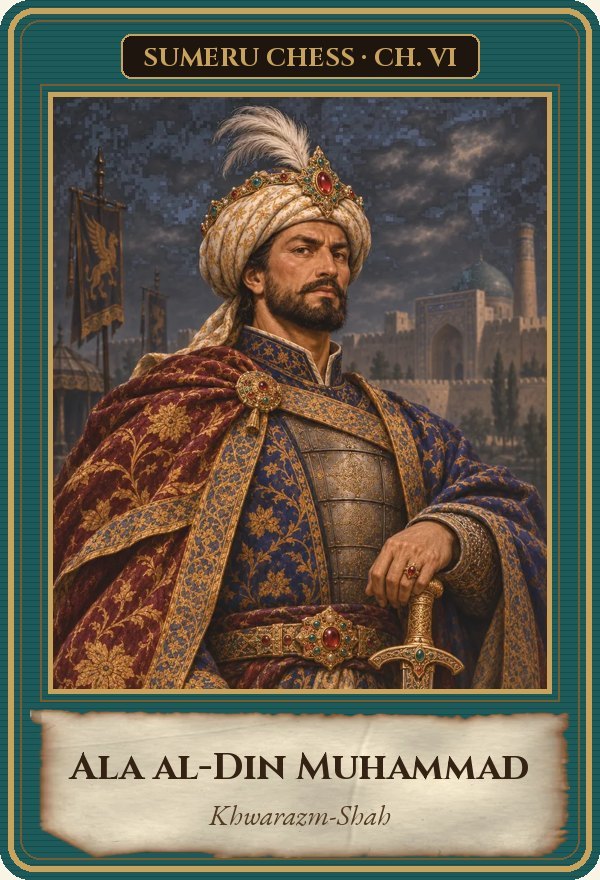
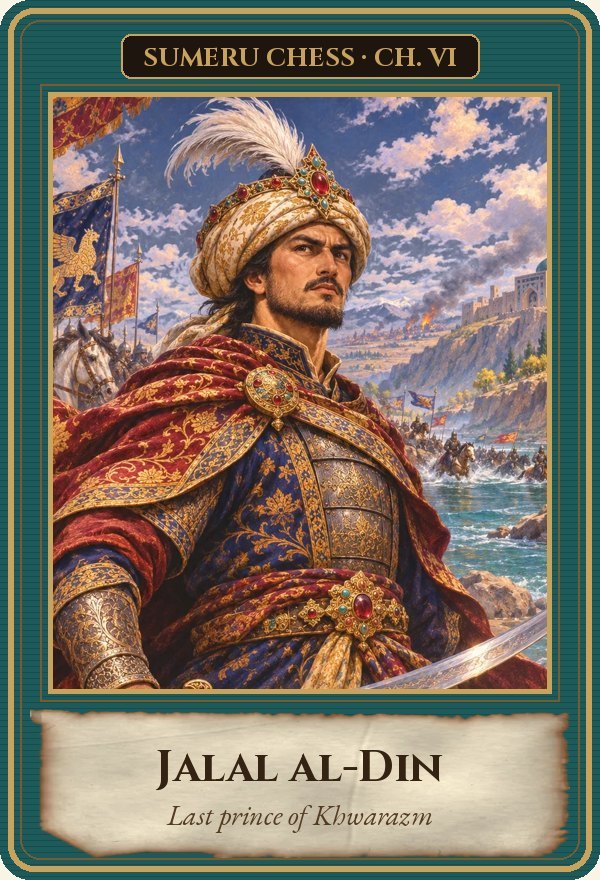
From the cards of Sumeru Chess, Chapter VI.
Jalal al-Din's last stand
Only one Khwarazmian prince fought back effectively. Jalal al-Din Mingburnu, the Shah's eldest son, gathered an army in Afghanistan and in 1221 defeated a Mongol force under Shigi Qutuqu at Parwan, north of Kabul — one of the very few Mongol defeats of the war. Genghis Khan came south in person and caught him on the banks of the Indus in November 1221. After a desperate fight Jalal al-Din spurred his horse off the bank into the river and swam to safety; Genghis Khan, according to the sources, stopped his archers from shooting and pointed him out to his sons as an example of what a son should be.9 Jalal al-Din fought on in India, Iran and the Caucasus for another decade before he was killed in 1231.
Why did Khwarazm fall?
Historians have pointed to several factors. The Khwarazmian state was new and divided; its army was distrusted by its ruler and dispersed in garrisons; the Shah failed to give battle and then lost his nerve. The Mongols, by contrast, combined mobility, intelligence about their enemy (supplied in part by Muslim merchants in their service), discipline and siege engineering learned in their wars in China. Their deliberate use of terror — sparing cities that surrendered, destroying those that resisted — encouraged others to give in.10
The fall of Khwarazm opened the road west. Within forty years Mongol armies would reach Poland, Hungary and Syria, and Genghis Khan's grandson Hülegü would found a Mongol state in Iran. The war that began with a massacre of merchants at Otrar changed the history of the Islamic world for ever.
Notes
- Ata-Malik Juvaini, Genghis Khan: The History of the World Conqueror, trans. J. A. Boyle (Manchester: Manchester University Press, 1958; repr. 1997); Rashid al-Din, Jami' al-tawarikh, trans. W. M. Thackston, Rashiduddin Fazlullah's Jami'u't-tawarikh: Compendium of Chronicles (Cambridge, MA: Harvard University, Department of Near Eastern Languages and Civilizations, 1998–1999). The sources differ on the number of envoys and on the details of the insult. ↩
- W. Barthold, Turkestan down to the Mongol Invasion, 2nd ed. (London: Luzac, Gibb Memorial Series, 1928). ↩
- Timothy May, The Mongol Art of War (Barnsley: Pen & Sword, 2007); estimates vary widely. ↩
- Juvaini, History of the World Conqueror. ↩
- Barthold, Turkestan; Ibn al-Athir, The Chronicle of Ibn al-Athir for the Crusading Period, Part 3, trans. D. S. Richards (Aldershot: Ashgate, 2008). ↩
- Juvaini, History of the World Conqueror. ↩
- Juvaini, History of the World Conqueror, on Merv. On how to read these numbers see David Morgan, The Mongols, 2nd ed. (Oxford: Blackwell, 2007). ↩
- Ibn al-Athir, Chronicle, Part 3, under the year 617 AH. ↩
- Juvaini, History of the World Conqueror; Paul Ratchnevsky, Genghis Khan: His Life and Legacy, trans. Thomas Nivison Haining (Oxford: Blackwell, 1991). ↩
- May, Mongol Art of War; Timothy May, The Mongol Empire (Edinburgh: Edinburgh University Press, 2018). ↩
Further Reading
- Ata-Malik Juvaini, Genghis Khan: The History of the World Conqueror, trans. J. A. Boyle (Manchester University Press, 1958; repr. 1997).
- W. Barthold, Turkestan down to the Mongol Invasion (Gibb Memorial Series, 2nd ed. 1928).
- David Morgan, The Mongols (Blackwell, 2nd ed. 2007).
- Timothy May, The Mongol Empire (Edinburgh University Press, 2018).