
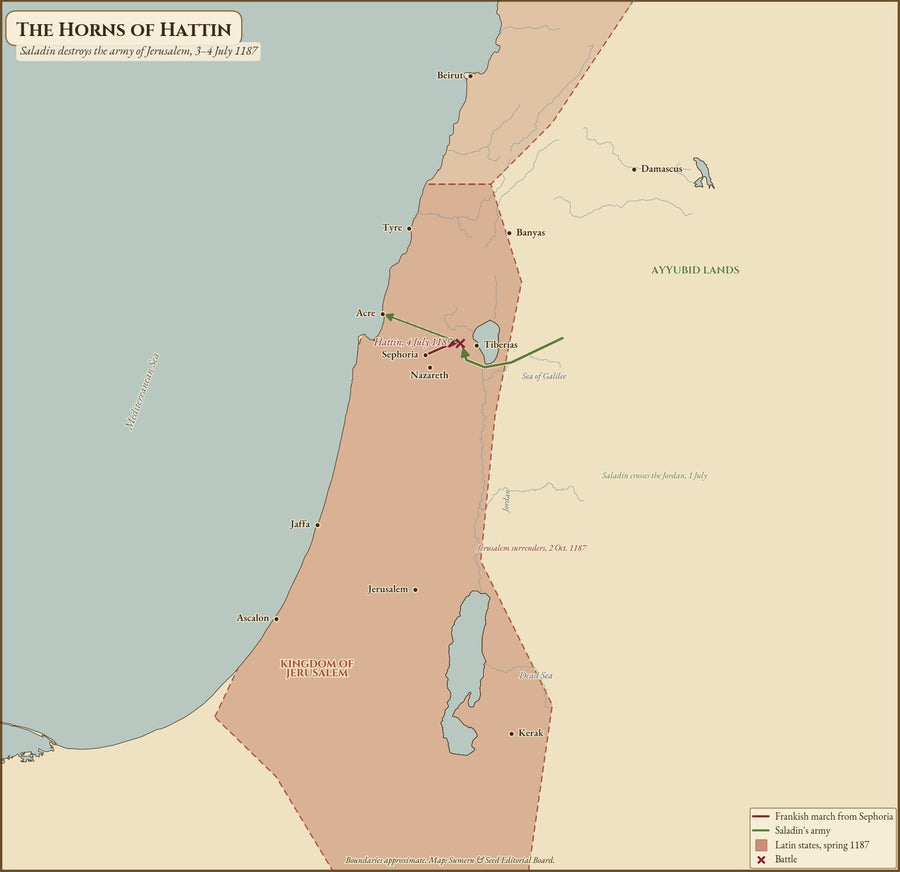
Saladin and the Horns of Hattin, 1187
Sumeru & Seed Editorial BoardOn 4 July 1187, on a hill above the Sea of Galilee, Saladin destroyed the largest army the Kingdom of Jerusalem ever raised. Three months later he entered Jerusalem. How did a summer march to relieve a besieged castle end in catastrophe?

In the summer of 1187 the Latin Kingdom of Jerusalem, founded by the First Crusade eighty-eight years earlier, faced the greatest threat in its history. For the first time since the crusaders arrived, the Muslim lands around it — Egypt, Damascus, Aleppo and Mosul — answered to a single ruler: Salah al-Din Yusuf ibn Ayyub, known in the West as Saladin. The battle he fought at Hattin, near the Sea of Galilee, decided the fate of the kingdom.1
Saladin
Saladin was a Kurd, born in Tikrit around 1137 into a family of soldiers in the service of the Turkish rulers of Syria. He rose under Nur al-Din, the ruler of Aleppo and Damascus, who had made the holy war against the Franks the central theme of his politics. Sent to Egypt with his uncle Shirkuh in the 1160s, Saladin became vizier of the Fatimid caliph, and in 1171 he quietly ended the Shi'ite Fatimid caliphate, restoring the Friday prayer in the name of the Abbasid caliph of Baghdad. After Nur al-Din's death in 1174 he spent twelve years bringing Damascus, Aleppo and the cities of upper Mesopotamia under his control.2
His contemporaries disagreed about him. His secretary Imad al-Din and his judge Baha al-Din ibn Shaddad, who both wrote biographies, presented him as a pious hero of the jihad. Rivals in Mosul and Aleppo saw an ambitious usurper who used holy war to justify fighting other Muslims. Modern historians such as Malcolm Lyons and D. E. P. Jackson have shown that he was both: a skilled politician who built an empire, and a man who genuinely believed in the recovery of Jerusalem.3
A divided kingdom
The Kingdom of Jerusalem in 1187 was deeply divided. King Baldwin IV, a leper, had died in 1185, and his young nephew Baldwin V died the following year. The throne passed to Baldwin IV's sister Sibylla and her husband, Guy of Lusignan, a newcomer from Poitou whom many barons distrusted. The most powerful of them, Raymond III, count of Tripoli and lord of Tiberias through his wife, had been regent and refused to accept Guy. For a time he even made a separate truce with Saladin.
The truce between Saladin and the kingdom was broken by Reynald of Châtillon, lord of Kerak and Oultrejordain, who attacked a Muslim caravan travelling between Cairo and Damascus. Reynald had already sent ships down the Red Sea in 1182–1183 to threaten the coasts of the Hijaz; Saladin had sworn to kill him with his own hand.4
The campaign
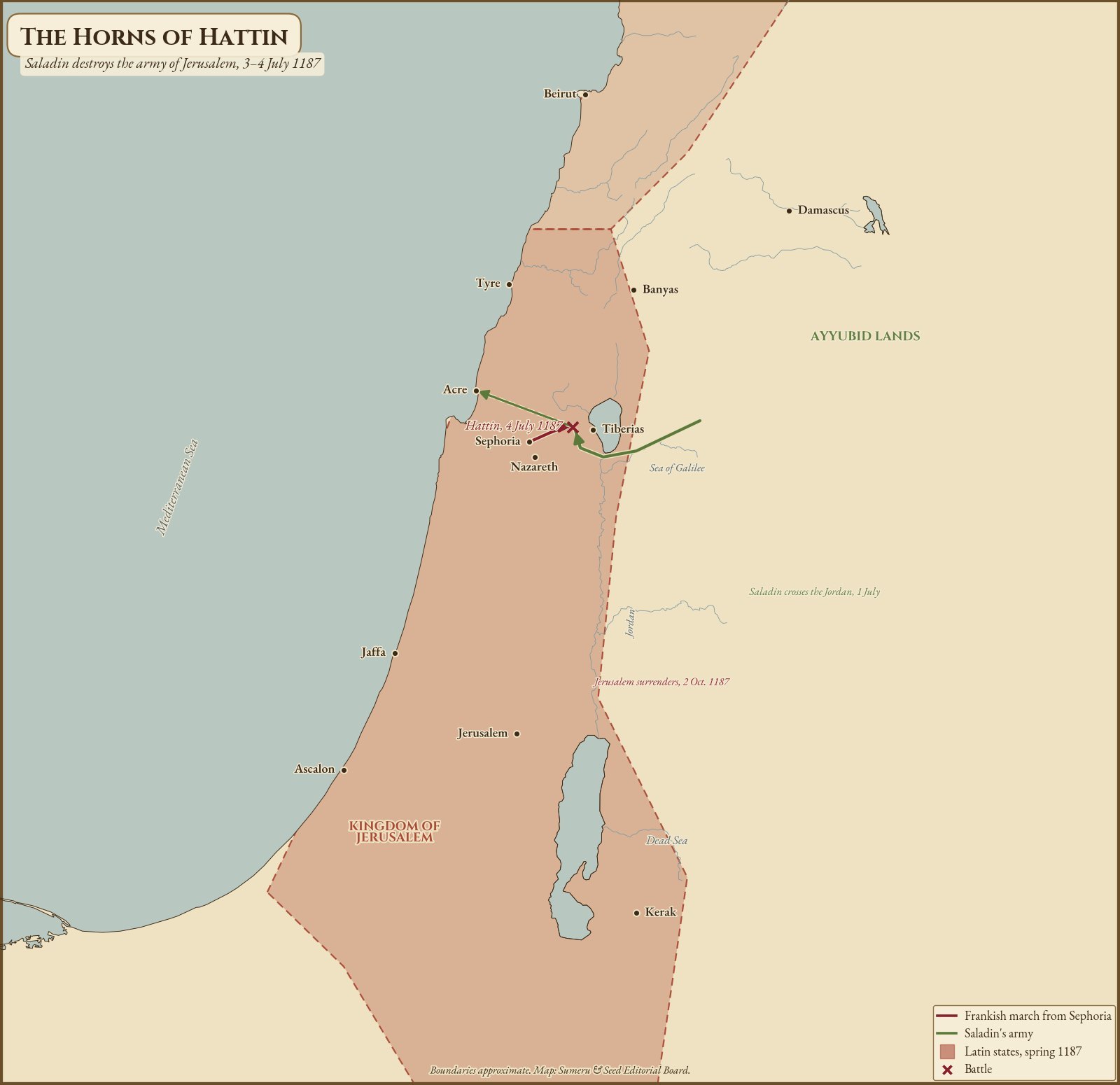
On 1 July 1187 Saladin crossed the Jordan south of the Sea of Galilee with the largest army he had ever assembled, perhaps 30,000 men, including some 12,000 regular cavalry.5 On 2 July he attacked Tiberias. The town fell at once; Raymond's wife, Eschiva, held out in the citadel.
Guy had gathered the whole fighting strength of the kingdom at the springs of Sephoria (Saffuriya), about 25 kilometres west: some 1,200 knights, several thousand light cavalry, and perhaps 15,000 infantry, together with the relic of the True Cross.6 At Sephoria they had water and a strong position. At the council of war that night, according to the most widely followed account, Raymond himself urged the king not to march: Tiberias was his town and his wife was in it, but it was better to lose them than to lead the army across a waterless plateau in midsummer. The Master of the Templars, Gerard of Ridefort, persuaded Guy otherwise; to stay put would be cowardice.7
The Horns of Hattin
On 3 July the Frankish army set out east. Saladin's light cavalry harassed it all day, shooting arrows into the column and attacking the rearguard. The Franks failed to reach water and camped on the plateau near the village of Lubiya. During the night the Muslims set fire to the dry grass upwind, so that smoke blew into the thirsty camp.
On the morning of 4 July the Franks tried to break through towards the springs of Hattin or the lake. The infantry, desperate with thirst, broke away and fled up the slopes of the Horns of Hattin, an extinct volcano with two peaks. Raymond of Tripoli and his knights charged; the Muslim ranks opened to let them through and closed behind them, and Raymond escaped. The remaining knights gathered around the king's red tent on the Horns and charged again and again, but their horses were being killed by arrows and they were surrounded. Ibn al-Athir, who heard the story from Saladin's son al-Afdal himself, describes the young prince watching the last charges and crying out in joy each time they failed, until his father told him to be quiet: the battle was not won until the king's tent fell. When the tent finally fell, it was.8


From the cards of Sumeru Chess, Chapter V.
After the battle
Guy and his nobles were brought to Saladin's tent. Saladin offered Guy a cup of iced water — a sign that his life was safe. When Guy passed the cup to Reynald of Châtillon, Saladin pointed out that he had not given Reynald drink, and so was not bound to spare him. He then killed Reynald, as he had sworn. The captured Templars and Hospitallers, some two hundred men, were executed; the other prisoners were enslaved or ransomed. The True Cross was taken to Damascus.9
With the field army destroyed, the cities of the kingdom had almost no defenders. Acre surrendered within a week; Jaffa, Sidon, Beirut and Ascalon followed. Jerusalem, defended by Balian of Ibelin with a garrison of a few knights and townsmen, surrendered on 2 October 1187 — the anniversary, it was noted, of the Prophet's night journey to Jerusalem. Unlike the crusaders in 1099, Saladin did not massacre the population; most inhabitants were allowed to ransom themselves.10 Only Tyre, defended by Conrad of Montferrat, held out.
Consequences
Hattin provoked the Third Crusade (1189–1192), led by Richard I of England, Philip II of France and the emperor Frederick Barbarossa. Richard recovered Acre and much of the coast and defeated Saladin at Arsuf, but he never retook Jerusalem. A truce in 1192 left the Franks a coastal strip and allowed Christian pilgrims to visit the holy places. Saladin died in Damascus in March 1193.
The battle is remembered as a lesson in the danger of abandoning a strong position for a political reason. John France has stressed that the decision to march was not obviously foolish — a king who allowed a town of his kingdom to fall without a fight risked his authority — but on the plateau of Lubiya the Frankish army met an enemy who controlled the water, the ground and the timing.11 In the long contest between the Latin East and its neighbours, Hattin marked the moment when the balance turned for good.
Notes
- B. Z. Kedar, ed., The Horns of Hattin (Jerusalem: Yad Izhak Ben-Zvi; London: Variorum, 1992), collects the main studies of the campaign. ↩
- Malcolm Cameron Lyons and D. E. P. Jackson, Saladin: The Politics of the Holy War (Cambridge: Cambridge University Press, 1982). ↩
- Baha al-Din ibn Shaddad, The Rare and Excellent History of Saladin, trans. D. S. Richards (Aldershot: Ashgate, 2001); Lyons and Jackson, Saladin. ↩
- Bernard Hamilton, The Leper King and His Heirs: Baldwin IV and the Crusader Kingdom of Jerusalem (Cambridge: Cambridge University Press, 2000). ↩
- Lyons and Jackson, Saladin, on the size of the army; the sources' figures vary. ↩
- John France, Hattin (Oxford: Oxford University Press, 2015). ↩
- The council is described in the Old French continuation of William of Tyre; see Peter W. Edbury, trans., The Conquest of Jerusalem and the Third Crusade: Sources in Translation (Aldershot: Scolar Press, 1996). ↩
- Ibn al-Athir, The Chronicle of Ibn al-Athir for the Crusading Period, Part 2, trans. D. S. Richards (Aldershot: Ashgate, 2007). ↩
- Ibn Shaddad, Rare and Excellent History; Imad al-Din al-Isfahani, al-Fath al-qussi fi'l-fath al-qudsi, partly translated in Francesco Gabrieli, Arab Historians of the Crusades (Berkeley: University of California Press, 1969). ↩
- Lyons and Jackson, Saladin; Edbury, Conquest of Jerusalem. ↩
- France, Hattin. ↩
Further Reading
- John France, Hattin (Oxford University Press, 2015).
- Malcolm Cameron Lyons and D. E. P. Jackson, Saladin: The Politics of the Holy War (Cambridge University Press, 1982).
- Baha al-Din ibn Shaddad, The Rare and Excellent History of Saladin, trans. D. S. Richards (Ashgate, 2001).
- Jonathan Phillips, The Life and Legend of the Sultan Saladin (Yale University Press, 2019).