
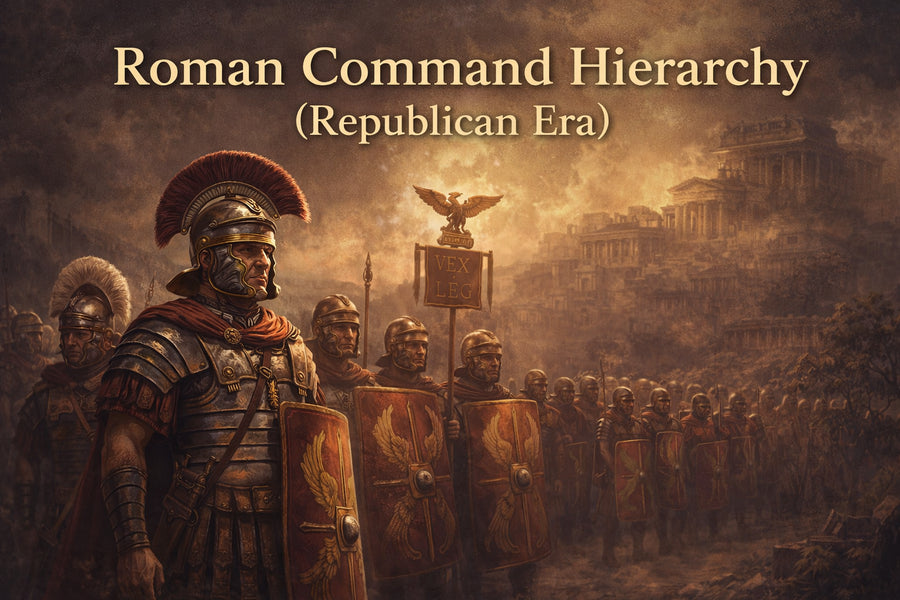
Command Hierarchy of the Roman Republic
Sumeru & Seed Editorial Board
A structured overview of leadership within the Roman military system
Overview
The Roman Republic developed a highly disciplined and effective command structure. Authority flowed clearly from top magistrates to frontline soldiers, enabling coordination, flexibility, and battlefield efficiency.
This system combined political authority with military command through the concept of imperium.


Dictator Perpetuo Dictator Legate
Special Emergency Authority: Dictator
In times of crisis, Rome could appoint a dictator with supreme authority above all officials, including consuls. This role stood outside the normal chain of command and was usually limited to six months.
Its evolution reflects broader political change. Cincinnatus embodied the ideal by relinquishing power after the crisis. Fabius Maximus used the office strategically, avoiding direct battle with Hannibal through delay and attrition. In the late Republic, Sulla expanded the role for political reform and proscriptions. This culminated in Julius Caesar, whose title of dictator perpetuo broke the temporary tradition and signaled the transition toward imperial rule.
The dictator was assisted by the magister equitum (Master of Horse), who supported command, particularly over cavalry.
Chain of Command (Descending Order of Authority)
1. Consul / Proconsul (Consul / Pro Consule)
Supreme authority with full imperium; commands multiple legions or provinces.
2. Praetor / Propraetor (Praetor / Pro Praetore)
Senior magistrate with imperium; acts as secondary commander or provincial governor.
3. Legate (Legatus)
Senior deputy appointed by a consul; may command one or more legions.
4. Military Tribune (Tribunus Militum)
Six per legion; junior officers gaining experience, sometimes rotating command.
5. Camp Prefect (Praefectus Castrorum)
Veteran officer overseeing logistics, engineering, and camp discipline.
6. Centurion (Centurio)
Core leadership; commands ~80 men and enforces discipline in combat.
7. Optio (Optio)
Deputy to the centurion; maintains order within the ranks.
8. Signifer / Aquilifer (Standard Bearers)
Carries unit standards; key for morale and coordination.
9. Tesserarius (Tesserarius)
Manages watchwords, guard duty, and camp security.
10. Legionary Soldier (Miles / Legionarius)
Disciplined heavy infantry forming the backbone of Roman power.
Why This System Mattered
Clear hierarchy and defined roles allowed Rome to coordinate large forces efficiently. Discipline and command cohesion were central to its military success.
Relevance to Strategic Simulation
This structure shows how leadership and organization shape outcomes. In strategic simulations and card systems, layered command often matters more than individual strength.