

Raven Banners: The Vikings from Lindisfarne to Constantinople
Sumeru & Seed Editorial BoardFor two centuries Scandinavian ships carried raiders, traders and settlers from Greenland to the Caspian. The same men who burned monasteries in England sold furs in Baghdad's markets and guarded the emperor in Constantinople.
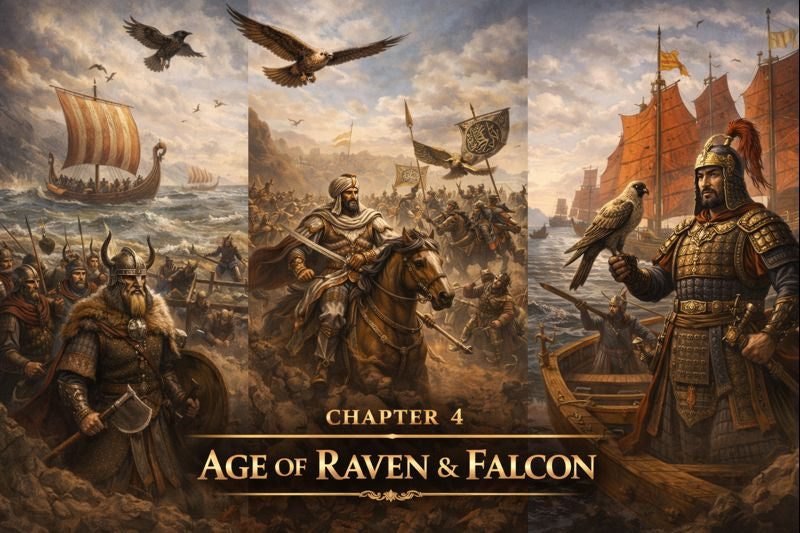
The title of this chapter of the Sumeru Library borrows two images from the Viking age. The raven was the bird of Odin, who was said to send two ravens, Thought and Memory, out over the world each day; Viking war banners bore its image. The falcon is often seen in the trident-like sign of the Rurikid princes of the Rus, the dynasty of Scandinavian origin that ruled Kiev. Together they stand for the two directions in which the peoples of Scandinavia moved between the late eighth and the eleventh centuries: west across the sea to Britain, Francia and the Atlantic, and east along the rivers to Byzantium and the Islamic world.1
Lindisfarne, 793
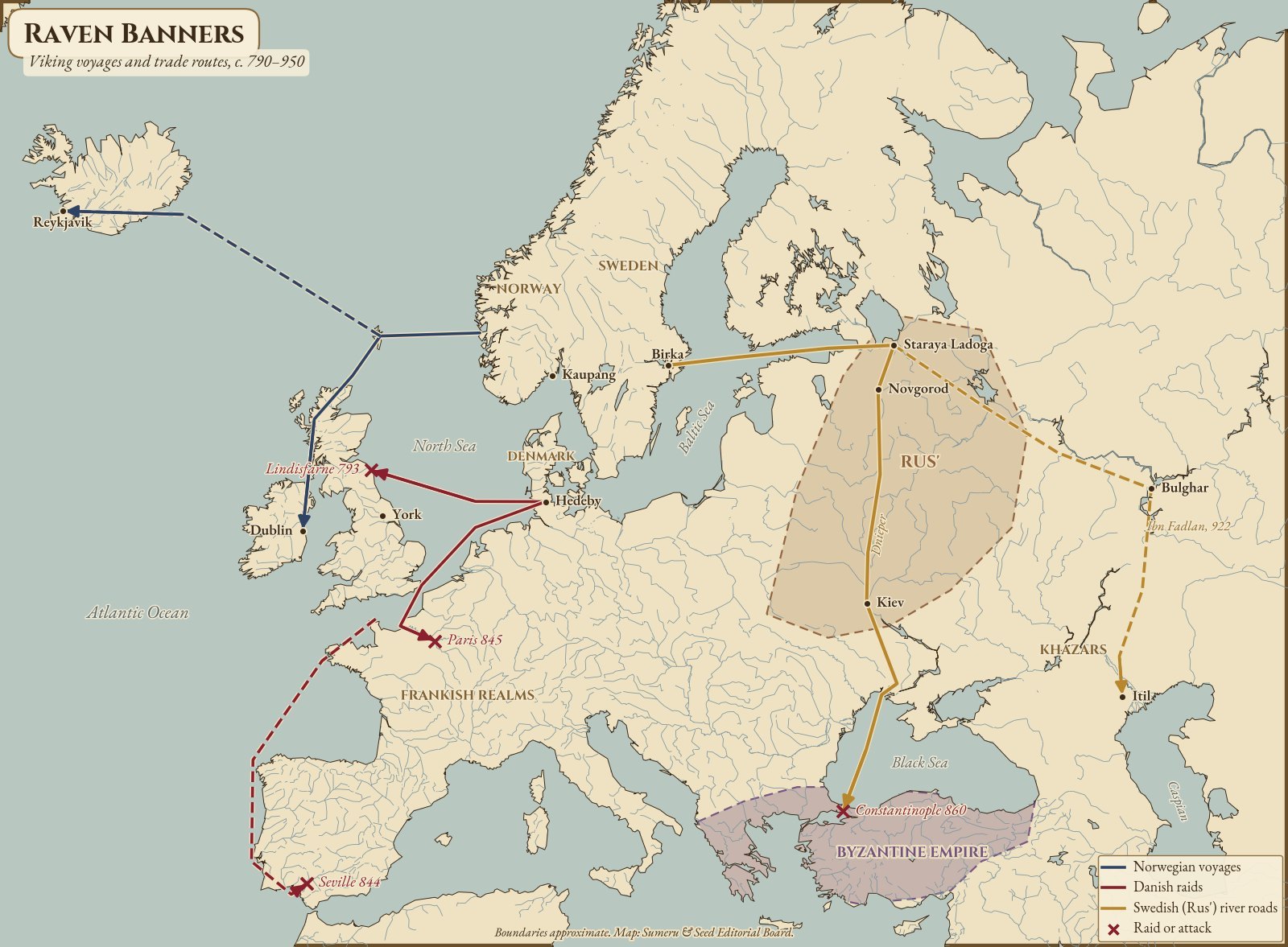
The Viking age in western Europe conventionally begins with an attack on the monastery of Lindisfarne, off the coast of Northumbria, on 8 June 793. The Anglo-Saxon Chronicle records portents in the sky over Northumbria — whirlwinds, lightning and fiery dragons — followed by famine and then the destruction of God's church on Lindisfarne by heathen men.2 The scholar Alcuin, then at Charlemagne's court, wrote to the Northumbrian king that never before had such terror appeared in Britain, and asked what sins had brought this punishment.3
Lindisfarne was not the first contact; a few years earlier men from Norway had killed a royal official in Dorset. But it was a shock because the raiders struck a holy place, unprotected and rich in treasure. Over the following decades the raids grew larger. By the 840s Viking fleets were wintering in Ireland and on the Seine; in 845 a fleet sailed up the Seine and was paid 7,000 pounds of silver to leave Paris, and in 844 another sacked Seville in Muslim Spain.4
From raids to kingdoms
In 865 a much larger force, which the English called the "Great Army," landed in East Anglia. Within a few years it had destroyed the kingdoms of Northumbria, East Anglia and most of Mercia and settled its men on the land. Only Wessex survived, under King Alfred (r. 871–899). Alfred's victory at Edington in 878 and the network of fortified towns, or burhs, that he built across his kingdom stopped the conquest and laid the foundations of a united England.5 The Chronicle records that in the same year the English captured a Viking banner in Devon "which they called Raven."6
Scandinavian settlement left a deep mark. The area of eastern England under Danish law, the Danelaw, is still full of place names ending in -by and -thorpe; York (Jorvik) became a Scandinavian trading city. In Ireland, Viking camps grew into the first towns — Dublin, Waterford, Wexford, Limerick. In the North Atlantic, Norse settlers reached the Faroes, Iceland (from about 870) and Greenland, and around 1000 they landed briefly in North America at L'Anse aux Meadows in Newfoundland.7
The eastern road
Swedish Vikings looked east. From the trading town of Birka they crossed the Baltic to Staraya Ladoga and Novgorod, then used the rivers of Russia — the Dnieper to the Black Sea and Constantinople, the Volga to the Caspian and the Islamic world. Along these routes they traded furs, wax, honey and slaves for silver. More than a hundred thousand Islamic silver coins (dirhams) have been found in Scandinavian hoards; the Spillings hoard on Gotland alone contains more than 14,000 coins, most of them minted in the Abbasid caliphate.8
The Greeks and Arabs called these people Rhos or Rus. The Russian Primary Chronicle, compiled in Kiev in the early twelfth century, tells how in 862 the quarrelling Slavic and Finnic peoples of the north invited three Varangian brothers, led by Rurik, to come and rule them.9 Whatever its truth, the story reflects the Scandinavian origin of the ruling dynasty of Kievan Rus. In 860 a Rus fleet attacked Constantinople itself, terrifying the city; the patriarch Photius preached sermons describing the attack as divine punishment.10 Later Rus princes made treaties with Byzantium that regulated the trade of their merchants in the city.
An Arab eyewitness
The most famous description of the Rus comes from Ahmad ibn Fadlan, a member of an embassy sent by the Abbasid caliph al-Muqtadir to the king of the Volga Bulghars in 921–922. Ibn Fadlan met Rus traders on the Volga. He admired their physique — tall as palm trees, he wrote — and was disgusted by their hygiene. Most famously, he described the funeral of a Rus chieftain, burned in his ship with his goods, animals and a slave woman who was killed to accompany him.11 It is the only eyewitness account of a Viking ship cremation, and archaeologists still argue about how far it can be trusted.
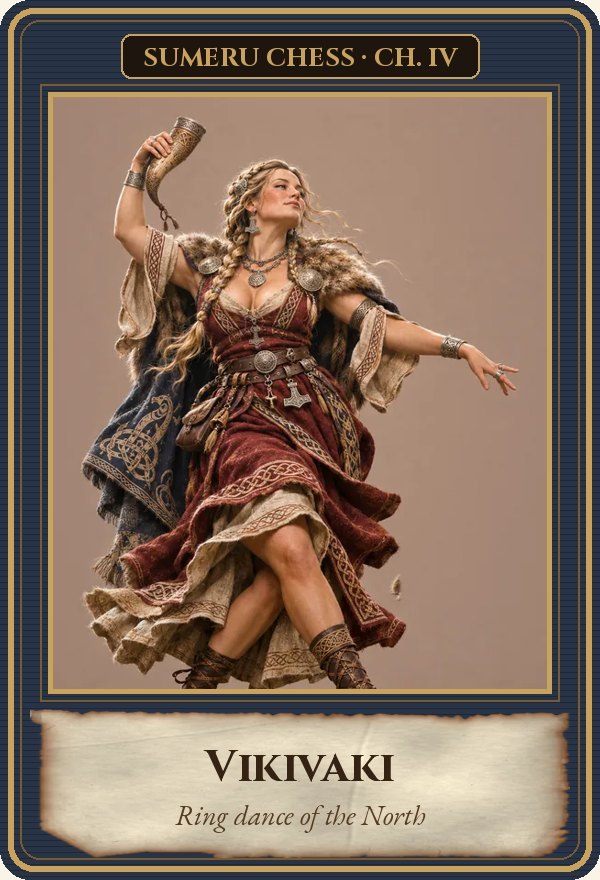
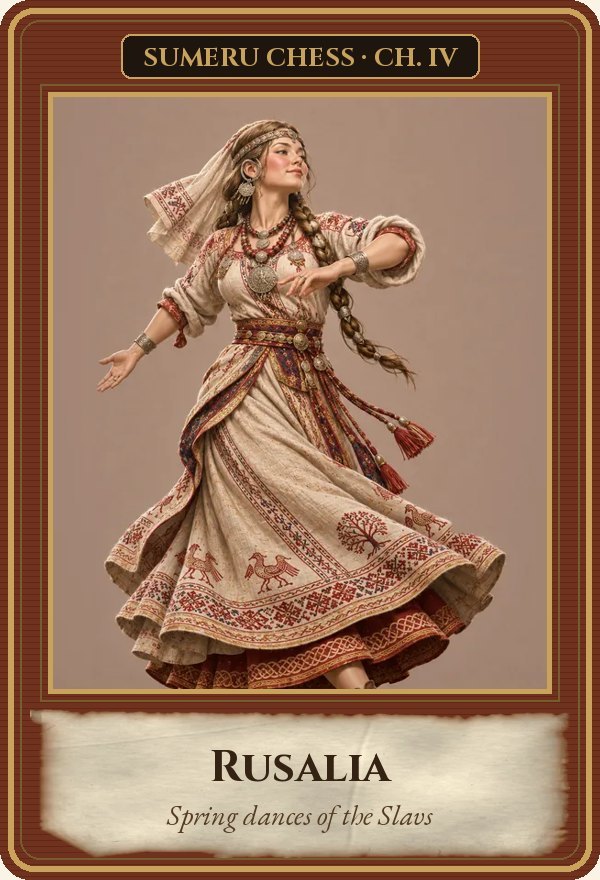
From the cards of Sumeru Chess, Chapter IV.
The Varangian Guard
In 988 the Byzantine emperor Basil II, facing rebellion, asked Prince Vladimir of Kiev for help. Vladimir sent six thousand warriors and, as part of the agreement, accepted baptism and married the emperor's sister Anna. The Scandinavian and Rus warriors who stayed became the core of the Varangian Guard, the emperor's personal bodyguard, famous for their axes and their loyalty.12 Runestones in Sweden commemorate men who died "in Greece," and runic graffiti carved by a bored guardsman can still be seen on a balustrade in Hagia Sophia. The most famous Varangian, Harald Hardrada, served in the guard before becoming king of Norway; he died invading England at Stamford Bridge in 1066, the date that is often used to mark the end of the Viking age.
Raiders, traders, settlers
The Vikings were not a nation and had no single purpose. The same society produced pirates, merchants, colonists, mercenaries and kings. What united them was the ship: fast, shallow-draughted, able to cross open sea and to row up rivers. With it, the peoples of a poor and peripheral region of Europe connected the Atlantic with the Caspian and Baghdad, and left their mark on the history of England, Ireland, Normandy, Russia and Byzantium. Recent scholarship, especially Neil Price's, insists that we take seriously their own view of the world — a world of gods, ravens and the fate that awaited every warrior.13
Notes
- On the Rurikid sign and its interpretation see Simon Franklin and Jonathan Shepard, The Emergence of Rus, 750–1200 (London: Longman, 1996). The raven banner is discussed in Neil Price, Children of Ash and Elm: A History of the Vikings (New York: Basic Books, 2020). ↩
- Anglo-Saxon Chronicle, MS D and E, s.a. 793; trans. Michael Swanton, The Anglo-Saxon Chronicles (London: Phoenix, 2000). ↩
- Alcuin, letter to King Æthelred of Northumbria (793), in Stephen Allott, Alcuin of York: His Life and Letters (York: William Sessions, 1974). ↩
- Annals of St-Bertin, s.a. 845, trans. Janet L. Nelson (Manchester: Manchester University Press, 1991); on Seville, Ann Christys, Vikings in the South: Voyages to Iberia and the Mediterranean (London: Bloomsbury, 2015). ↩
- Asser, Life of King Alfred, in Simon Keynes and Michael Lapidge, trans., Alfred the Great (Harmondsworth: Penguin, 1983). ↩
- Anglo-Saxon Chronicle, s.a. 878. ↩
- Birgitta Wallace, "L'Anse aux Meadows, Leif Eriksson's Home in Vinland," Journal of the North Atlantic, Special Volume 2 (2009). ↩
- Price, Children of Ash and Elm; on the hoards, James Graham-Campbell, The Viking World, 4th ed. (London: Frances Lincoln, 2013). ↩
- The Russian Primary Chronicle: Laurentian Text, trans. Samuel Hazzard Cross and Olgerd P. Sherbowitz-Wetzor (Cambridge, MA: Mediaeval Academy of America, 1953), s.a. 6370 (862). ↩
- Cyril Mango, trans., The Homilies of Photius, Patriarch of Constantinople (Cambridge, MA: Harvard University Press, 1958), Homilies 3–4. ↩
- Ibn Fadlan, Risala; trans. Paul Lunde and Caroline Stone, Ibn Fadlan and the Land of Darkness: Arab Travellers in the Far North (London: Penguin, 2012). ↩
- Sigfús Blöndal, The Varangians of Byzantium, trans. and revised by Benedikt S. Benedikz (Cambridge: Cambridge University Press, 1978). ↩
- Price, Children of Ash and Elm. ↩
Further Reading
- Neil Price, Children of Ash and Elm: A History of the Vikings (Basic Books, 2020).
- Simon Franklin and Jonathan Shepard, The Emergence of Rus, 750–1200 (Longman, 1996).
- Paul Lunde and Caroline Stone, trans., Ibn Fadlan and the Land of Darkness (Penguin, 2012).
- Peter Sawyer, ed., The Oxford Illustrated History of the Vikings (Oxford University Press, 1997).