

The Punic Wars (264–146 BC): Rome against Carthage
Sumeru & Seed Editorial BoardThree wars in a little over a century decided who would rule the Mediterranean. Rome began them as an Italian land power without a fleet and ended them as the only great power in the West.
Short answer: The Punic Wars were three wars fought between the Roman Republic and Carthage from 264 to 146 BC. The first was fought for Sicily, the second was Hannibal's invasion of Italy, and the third ended with the destruction of the city of Carthage. The name comes from Poeni, the Roman word for the Carthaginians, who were Phoenicians by origin.
Who were Rome and Carthage in 264 BC?
Carthage, founded by Phoenicians from Tyre on the coast of what is now Tunisia, was the great sea power of the West, with a trading empire in North Africa, Sardinia, western Sicily and Spain. Its armies were largely hired: Libyans, Numidians, Iberians and Gauls under Carthaginian officers. Rome had just united Italy south of the Po. Its strength was a citizen militia and a network of allies that could replace lost armies year after year. See Carthage and Rome in the Civilization Index.
The First Punic War, 264–241 BC
The war began over Messana, the town that commands the strait between Italy and Sicily, and grew into a struggle for the whole island. To win it Rome, which had no navy, built one. Polybius says that the Romans copied a Carthaginian warship that had run aground, and fitted their ships with a boarding bridge, the corvus, to turn sea battles into infantry fights.1 They won at Mylae (260 BC) and Ecnomus (256 BC), failed in an invasion of Africa under Regulus (255 BC), lost fleets to storms, and finally won the war at the Aegates Islands in 241 BC. Carthage gave up Sicily and paid 3,200 talents.2 Sicily became Rome's first overseas province.
Between the wars
Carthage could not pay its hired soldiers, who rose against it in a savage revolt (241–237 BC). Rome used the moment to take Sardinia and Corsica. Hamilcar Barca then turned to Spain, where he and his successors built a new base of silver, men and horses. From it his son Hannibal began the next war.
The Second Punic War, 218–201 BC
Hannibal crossed the Alps, won at the Trebia, Lake Trasimene and Cannae, and stayed in Italy for fifteen years. Rome endured, conquered Spain under Scipio, invaded Africa and won at Zama in 202 BC. Carthage lost Spain and its fleet and became a dependent of Rome. The full story is in The Second Punic War and in the life of Hannibal Barca.
The Third Punic War, 149–146 BC
Half a century later Carthage was rich again but disarmed. The Numidian king Masinissa, Rome's ally, took its land piece by piece, and the treaty forbade Carthage to fight back. In Rome the elder Cato ended his speeches, whatever their subject, with the opinion that Carthage must be destroyed.3 When Carthage finally took up arms against Masinissa, Rome declared war. The city held out for three years. In 146 BC Scipio Aemilianus stormed it, street by street. The survivors, about 50,000 according to Appian, were sold as slaves, the city was burned, and its territory became the Roman province of Africa.4
Why do the Punic Wars matter?
They made Rome a naval power, gave it its first provinces, and removed the only state in the West that could match it. Within a generation of Zama Roman armies were in Greece and Asia. The wars also changed Rome itself: long service overseas, a flood of slaves and wealth, and great commands for single men were the conditions of the crisis that later ended the Republic.
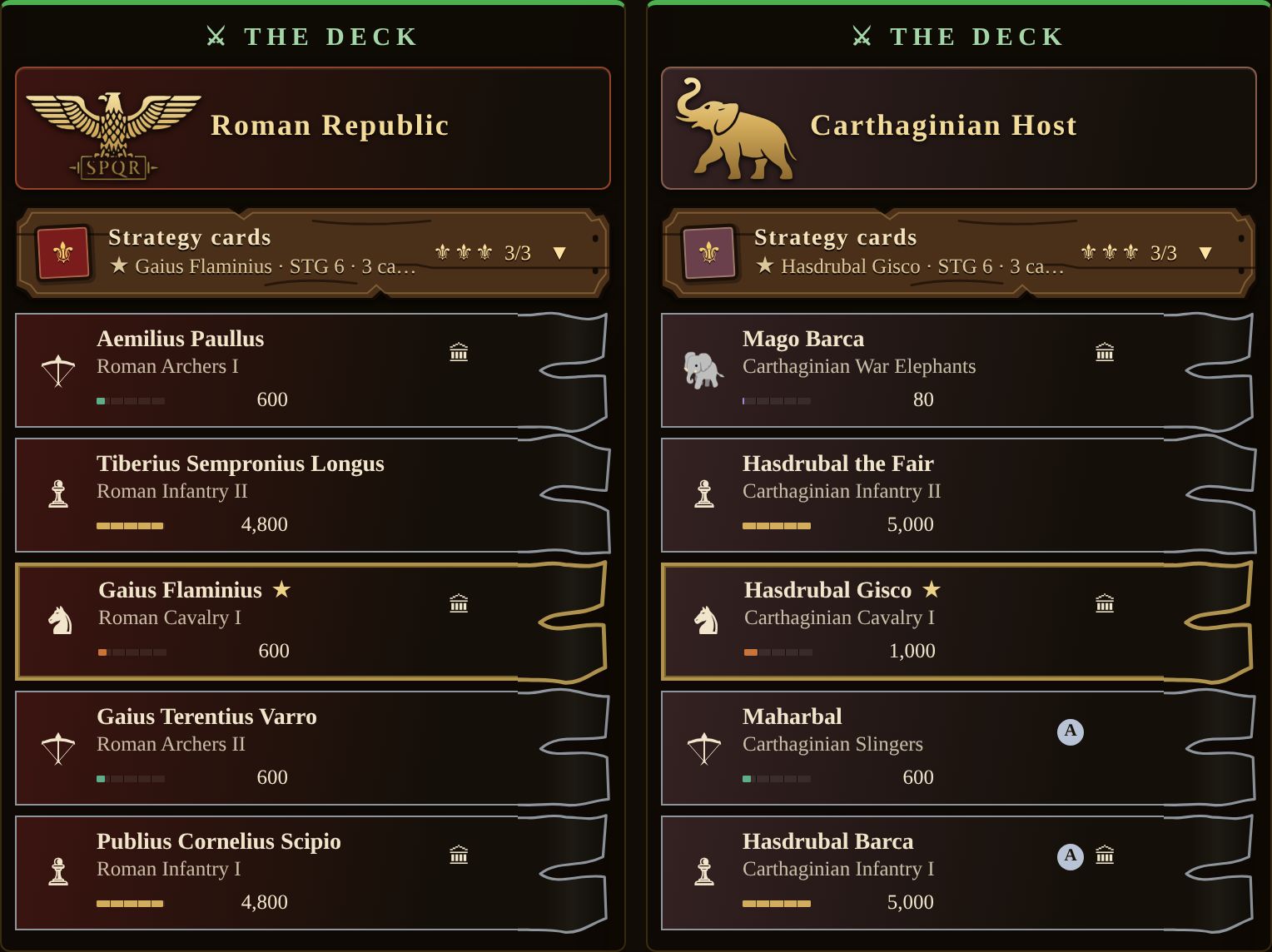
 Rome
 Carthage
Card backs of Chapter III. Each opens the civilization's page.
Questions people ask
How many Punic Wars were there?
Three: 264–241 BC, 218–201 BC and 149–146 BC.
Who won the Punic Wars?
Rome won all three. The third ended with the destruction of Carthage in 146 BC.
Why are they called the Punic Wars?
Punic comes from the Latin Poeni or Punici, the Roman name for the Carthaginians, whose ancestors were Phoenicians.
Did the Romans sow the ruins of Carthage with salt?
No ancient writer says so. The story appears only in modern times.
What does “Carthago delenda est” mean?
“Carthage must be destroyed”, the opinion with which the elder Cato is said to have ended his speeches in the Senate before the third war.
Notes
- Polybius, Histories 1.20–22.
- Polybius 1.62–63.
- Plutarch, Life of Cato the Elder 27.
- Appian, Punic Wars 130–135.
Further reading
- Polybius, The Histories, books 1, 3 and 7–15.
- Appian, Roman History, book 8 (The Punic Wars).
- Adrian Goldsworthy, The Fall of Carthage: The Punic Wars 265–146 BC (Cassell, 2003).
- Dexter Hoyos, Mastering the West: Rome and Carthage at War (Oxford, 2015).
- Richard Miles, Carthage Must Be Destroyed (Allen Lane, 2010).