

Pax Mongolica: Silk, Paper Money and Ideas Across Eurasia
Sumeru & Seed Editorial BoardThe Mongol conquests killed millions. They also created, for about a century, the most open set of routes across Eurasia the world had known — the age of Marco Polo, of a Nestorian monk at the court of France, and of Chinese and Persian scholars working side by side.

A little over a century after the destruction of Khwarazm, the Florentine merchant Francesco Pegolotti could write in his handbook for traders that the road from Tana, on the Sea of Azov, to Cathay was perfectly safe by day and by night.1 Pegolotti never made the journey himself, and he was writing in the 1330s, near the end of the period he described. But his confidence reflects something real. For about a century after the Mongol conquests, merchants, envoys, missionaries and scholars travelled across Eurasia in numbers never seen before. Historians call this the Pax Mongolica, the Mongol Peace.
Four khanates
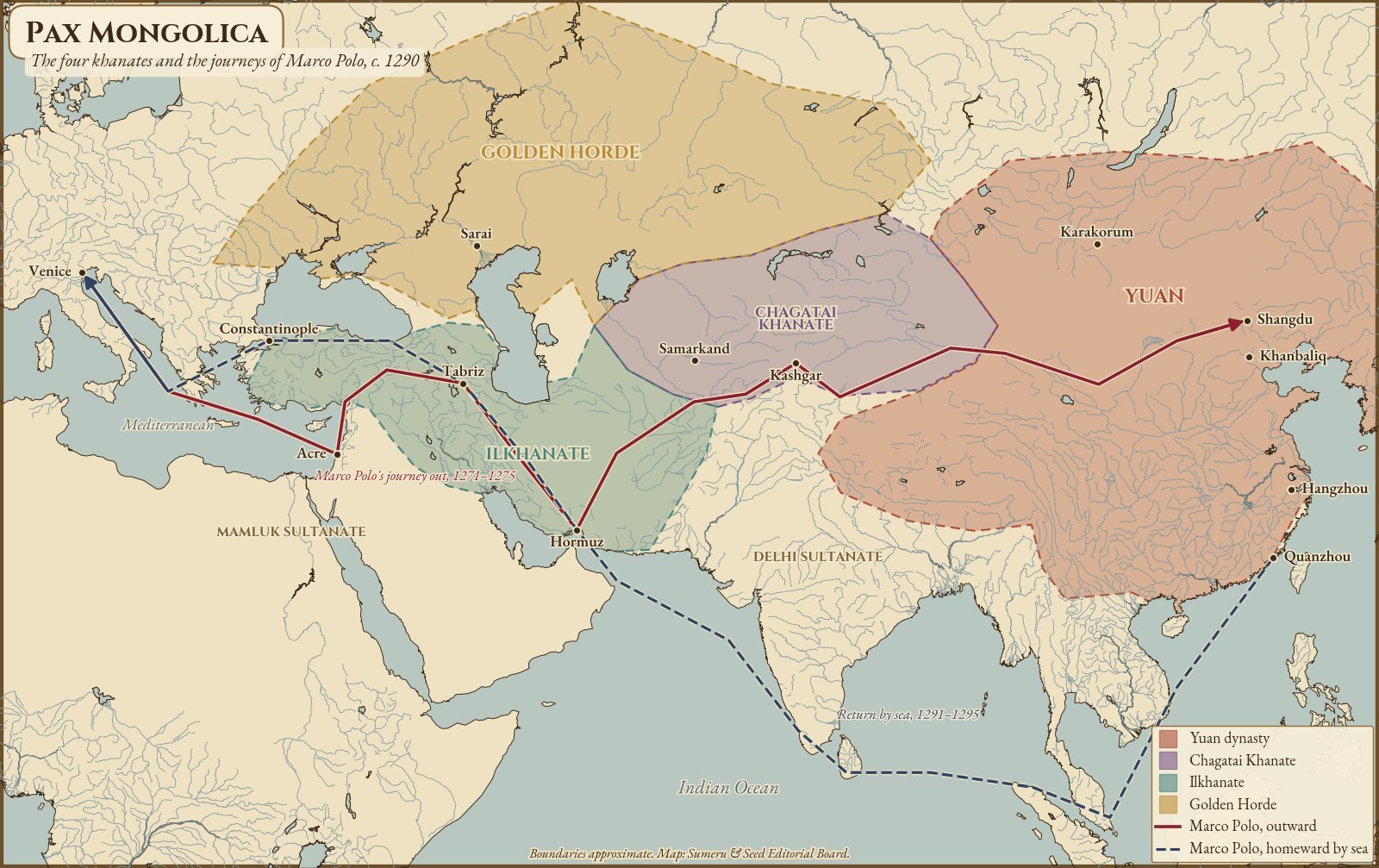
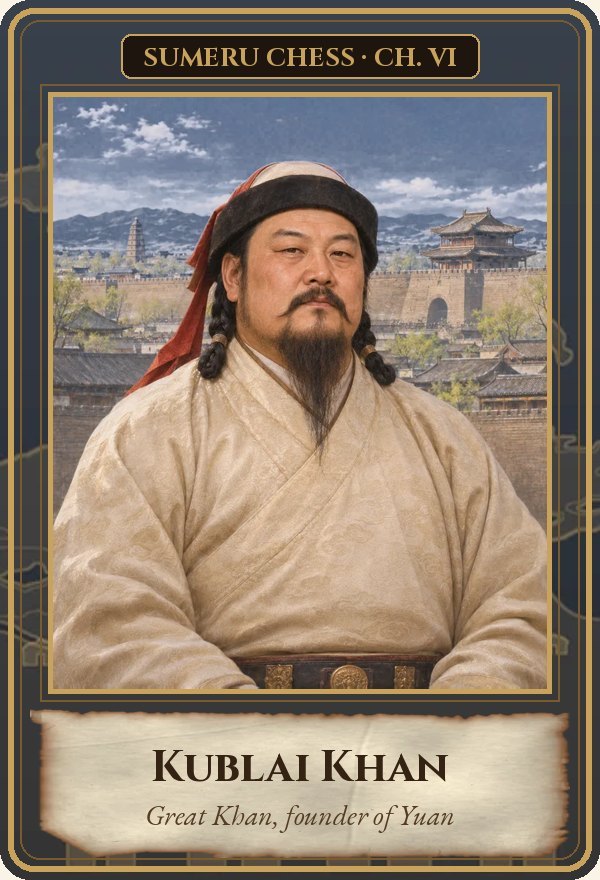
By the 1260s the empire of Genghis Khan's descendants had divided into four states. Kublai Khan (r. 1260–1294) ruled China and Mongolia and in 1271 proclaimed the Yuan dynasty, with his capital at Dadu (Khanbaliq, modern Beijing). The Ilkhans, descendants of Hülegü, ruled Iran and Iraq from Tabriz. The Golden Horde, the realm of Jochi's descendants, ruled the steppe from the Danube to Siberia from its capital Sarai on the Volga and collected tribute from the Rus princes. The Chagatai Khanate held Central Asia.2
The khanates often fought each other — the Golden Horde against the Ilkhans over the Caucasus, the Chagatai and their allies against Kublai. But they shared a common dynasty, common institutions such as the Yam relay roads and the paiza passports, and a common interest in trade, which they taxed and in which Mongol princes invested through merchant partners known as ortaq.3
Marco Polo
The most famous traveller of the age was a Venetian. Marco Polo left Venice with his father and uncle in 1271, travelled overland through the Ilkhanate, Central Asia and the Tarim Basin, and reached Kublai's summer capital Shangdu around 1275. He spent some seventeen years in China, returned by sea in 1291–1295 escorting a Mongol princess to the Ilkhan, and dictated his book while a prisoner of war in Genoa in 1298.4
Was Marco Polo really in China? Sceptics have pointed out that he does not mention the Great Wall, tea or foot-binding. But Hans Ulrich Vogel's detailed study of his descriptions of paper money, salt production and tax revenues has shown that they are so accurate, and so closely match Chinese sources, that they could hardly have been invented.5 Polo was most impressed by things that a merchant would notice: the size of cities like Hangzhou, the busy port of Quanzhou, the coal that burned like wood, and above all the paper money that the Great Khan forced everyone to accept.
Paper money
Paper money was not a Mongol invention — the Song had issued it since the eleventh century — but the Yuan made it the main currency of a vast empire. Kublai's chao notes were printed on mulberry-bark paper and were, in principle, convertible into silver. For several decades the system worked; later, over-issue led to inflation.6 The idea also travelled west. In 1294 the Ilkhan Gaykhatu, short of money, issued paper notes in Tabriz, complete with Chinese characters. The experiment failed within weeks as merchants closed their shops, but it is a striking sign of how far Chinese practices could spread under Mongol rule.
A monk from Beijing in Paris
Travel went both ways. Rabban Sauma, a monk of the Church of the East born near Beijing, set out with a companion on pilgrimage to Jerusalem around 1275. He never reached it, but in 1287 the Ilkhan Arghun sent him as ambassador to Europe to propose an alliance against the Mamluks. He met the Byzantine emperor in Constantinople, King Philip IV of France in Paris, King Edward I of England in Gascony and the new pope, Nicholas IV, in Rome — where he celebrated the Eucharist in his own rite.7 His account, preserved in Syriac, is a mirror image of Marco Polo's: a Chinese-born traveller describing Europe.
From the cards of Sumeru Chess, Chapter VI.
Scholars and sciences
The most important exchanges were intellectual. In Iran, the Ilkhans built an observatory at Maragha, directed by the great Persian astronomer Nasir al-Din Tusi, where Chinese astronomers also worked. The Ilkhanid vizier Rashid al-Din, a physician of Jewish origin who converted to Islam, wrote the Compendium of Chronicles, the first attempt at a history of the whole known world, including China, India, the Franks and the Mongols, using informants such as the Mongol official Bolad, who had come from Kublai's court.8 Thomas Allsen showed how Chinese medicine, agriculture, cuisine and cartography reached Iran, and Persian astronomy and Islamic medicine reached China, through these channels.9
The dark side
The Pax Mongolica was built on conquest and maintained by force, and the same routes that carried silk and scholars carried disease. In the 1340s the Black Death spread along the trade routes of the Golden Horde to the Black Sea; a Genoese source claimed that the Mongols besieging Caffa catapulted plague-ridden corpses into the city.10 Whether or not that story is true, the plague reached Italy in 1347 and killed perhaps a third or more of Europe's population. In the following decades the khanates collapsed: the Ilkhanate in 1335, the Yuan in 1368. The age of open routes came to an end.
Legacy
The Mongol era left Eurasia more connected than it had found it. European interest in "Cathay," stimulated by Marco Polo, inspired later explorers — Columbus carried an annotated copy of Polo's book. Janet Abu-Lughod argued that the thirteenth century saw a "world system" of linked trading circuits from Flanders to China, decades before European expansion.11 The empire that began with the slaughter of Otrar ended by joining the ends of the Old World.
Notes
- Francesco Balducci Pegolotti, La pratica della mercatura, ed. Allan Evans (Cambridge, MA: Mediaeval Academy of America, 1936); English translation of the Cathay itinerary in Henry Yule, Cathay and the Way Thither, vol. 3, rev. Henri Cordier (London: Hakluyt Society, 1914). ↩
- Morris Rossabi, Khubilai Khan: His Life and Times (Berkeley: University of California Press, 1988); Timothy May, The Mongol Empire (Edinburgh: Edinburgh University Press, 2018). ↩
- Thomas T. Allsen, Commodity and Exchange in the Mongol Empire: A Cultural History of Islamic Textiles (Cambridge: Cambridge University Press, 1997). ↩
- Marco Polo, The Description of the World, trans. A. C. Moule and Paul Pelliot (London: Routledge, 1938); trans. Ronald Latham, The Travels of Marco Polo (Harmondsworth: Penguin, 1958). ↩
- Hans Ulrich Vogel, Marco Polo Was in China: New Evidence from Currencies, Salts and Revenues (Leiden: Brill, 2013). ↩
- Richard von Glahn, Fountain of Fortune: Money and Monetary Policy in China, 1000–1700 (Berkeley: University of California Press, 1996). ↩
- Morris Rossabi, Voyager from Xanadu: Rabban Sauma and the First Journey from China to the West (Tokyo: Kodansha, 1992). ↩
- Rashid al-Din, Jami' al-tawarikh, trans. W. M. Thackston (Cambridge, MA: Harvard University, 1998–1999). ↩
- Thomas T. Allsen, Culture and Conquest in Mongol Eurasia (Cambridge: Cambridge University Press, 2001). ↩
- Gabriele de' Mussi, Historia de morbo, trans. in Rosemary Horrox, ed., The Black Death (Manchester: Manchester University Press, 1994). ↩
- Janet L. Abu-Lughod, Before European Hegemony: The World System A.D. 1250–1350 (New York: Oxford University Press, 1989). ↩
Further Reading
- Thomas T. Allsen, Culture and Conquest in Mongol Eurasia (Cambridge University Press, 2001).
- Morris Rossabi, Voyager from Xanadu (Kodansha, 1992; University of California Press, 2010).
- Janet L. Abu-Lughod, Before European Hegemony (Oxford University Press, 1989).
- Hans Ulrich Vogel, Marco Polo Was in China (Brill, 2013).