

Four Empires Across Eurasia: Rome, Parthia, the Kushans and Han China
Sumeru & Seed Editorial BoardAround 100 CE four great states ruled a continuous belt of territory from the Atlantic to the Pacific. How big were they, how were they governed, and how much did they know about one another?
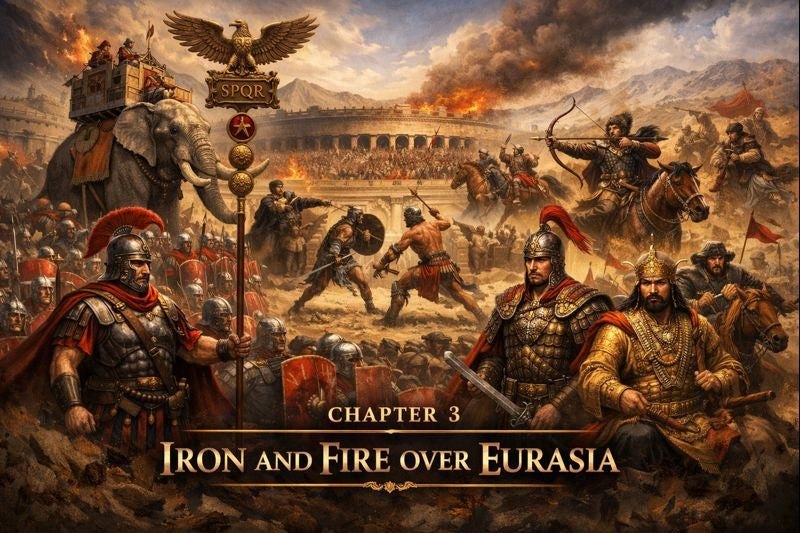
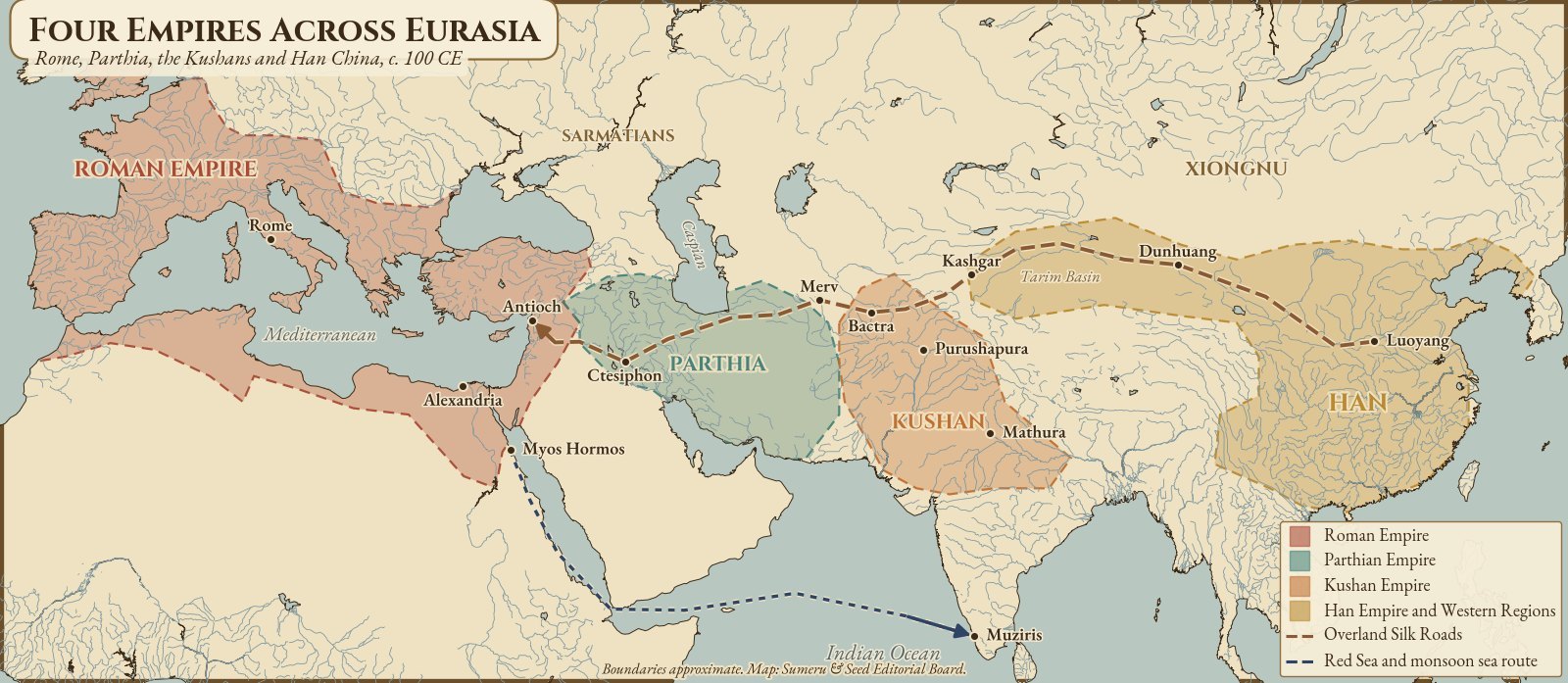
Around the year 100 CE, a traveller with enough time and luck could have walked from the Atlantic coast of Spain to the Yellow Sea while passing through the territory of only four great states. In the west was the Roman Empire under Trajan. Beyond the Euphrates lay the Parthian or Arsacid Empire. In Bactria and northern India ruled the Kushans. And from the Pamirs to the Pacific stretched the empire of the Eastern Han. Never before had so much of Eurasia been organised into so few political units, and never before had they been so aware of one another. This essay compares the four — their size, their government, their armies and their knowledge of each other.
How big?
The political scientist Rein Taagepera, who estimated the areas of historical empires from atlas maps, put the Roman Empire at its greatest extent (117 CE) at about 5 million square kilometres and the Han at its height at about 6 million.1 Parthia and the Kushan realm were smaller, perhaps a few million square kilometres each, though their frontiers are much harder to draw. Population is even harder to measure. The Han, uniquely, has left a census: the Book of Han records that in 2 CE the registered population was 59,594,978 people in 12,233,062 households.2 For Rome there is no comparable figure, but most historians estimate between 45 and 70 million people in the second century CE.3 Rome and Han, in other words, each governed something like a quarter of humanity.
How were they governed?
Rome and Han are the two best documented, and the comparison between them has become a field of its own.4 Both were ruled by an emperor whose authority was in theory absolute. Both governed through a relatively small salaried elite — Rome through senators and equestrians sent out as governors and procurators, Han through officials selected by recommendation and trained in the Confucian classics. Both depended above all on taxing farmers.
The differences were just as important. The Han state reached deeper into society: it registered every household, levied a poll tax and land tax, and demanded labour service and military service from adult men. Rome, by contrast, governed largely through self-governing cities, which collected taxes and kept order on its behalf; its central bureaucracy was tiny by Chinese standards. The Han ideal was a unified moral order flowing from the emperor; the Roman ideal was a commonwealth of cities under Roman law, in which citizenship was steadily extended until, in 212 CE, almost all free inhabitants became Roman citizens.
Parthia worked differently again. The Arsacid kings ruled a loose federation in which great noble houses — the Suren, the Karin and others — held hereditary lands and raised their own cavalry, while Greek cities such as Seleucia on the Tigris enjoyed self-government. The system was flexible and hard to conquer, as Rome repeatedly discovered, but also prone to civil war.5 The Kushans, the youngest of the four, grew out of the Yuezhi nomads who had settled in Bactria in the second century BCE; the Chinese Book of the Later Han tells how one of their five chiefs, Qiujiuque (Kujula Kadphises), united the others and invaded India.6 Their kings combined Iranian, Greek and Indian titles — including the Chinese-sounding "son of heaven" — and issued gold coins showing gods from all these traditions.
Armies on the frontiers
Each empire faced its most dangerous enemies on the steppe or across a long frontier. Rome kept around 300,000–400,000 soldiers, half of them citizen legionaries and half auxiliaries, almost all stationed along the Rhine, the Danube and the eastern frontier.7 The Han, after a long struggle against the Xiongnu confederation, relied on garrisons along the walls of the north-west, on settler-soldiers in the Gansu corridor, and on alliances with steppe peoples; under the general Ban Chao it re-established control of the oasis cities of the Tarim Basin in the 70s–90s CE. Parthia's strength lay in its heavy armoured cavalry (cataphracts) and horse archers, which destroyed a Roman army at Carrhae in 53 BCE. The Kushans fought with a mix of nomad cavalry and Indian infantry and elephants.
Did they know each other?
They knew of each other, but mostly at second hand. The Romans called the Chinese Seres, "silk people," and imagined them as a gentle, long-lived race at the end of the world. Pliny the Elder complained that India, China and Arabia drained the empire of 100 million sesterces a year in exchange for luxuries.8 A Greek merchant's handbook of the first century CE, the Periplus of the Erythraean Sea, describes the ports of the Red Sea, Arabia and India and mentions a great inland city of "Thina" from which silk came overland.9
The Chinese, in turn, knew of Rome as Daqin, "Great Qin," a rich and well-governed country in the far west. In 97 CE Ban Chao sent an envoy, Gan Ying, to reach it; he got as far as the shore of a great sea in Parthian territory, where sailors persuaded him that the voyage could take two years, and he turned back.10 Historians have long suspected that the Parthians, who profited as middlemen, had good reason to discourage him. In 166 CE the Book of the Later Han records that an embassy from the king of Daqin, "Andun" — probably Marcus Aurelius Antoninus — arrived by sea through Rinan in what is now central Vietnam, bringing ivory, rhinoceros horn and tortoiseshell.11 It was almost certainly a group of private merchants claiming to speak for the emperor, but it is the first recorded direct contact between the two ends of Eurasia.
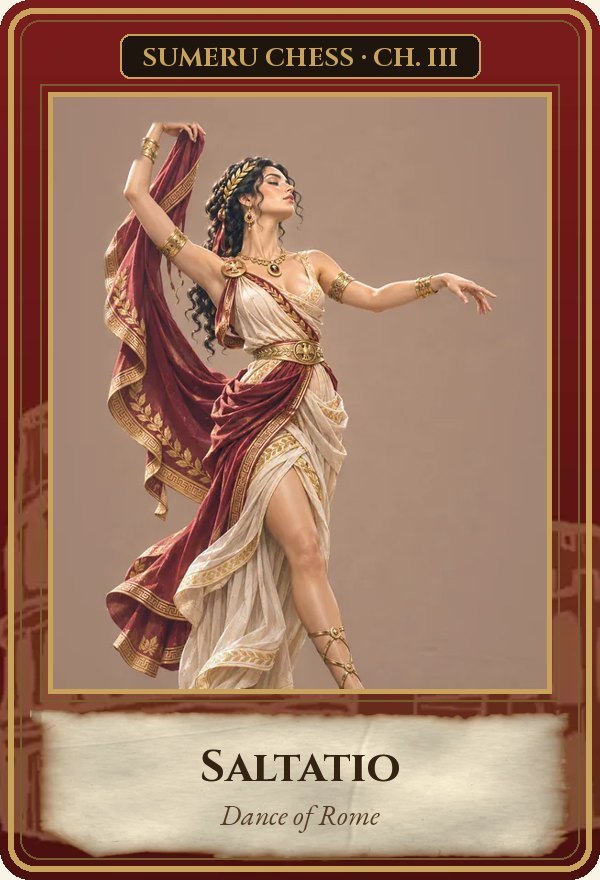
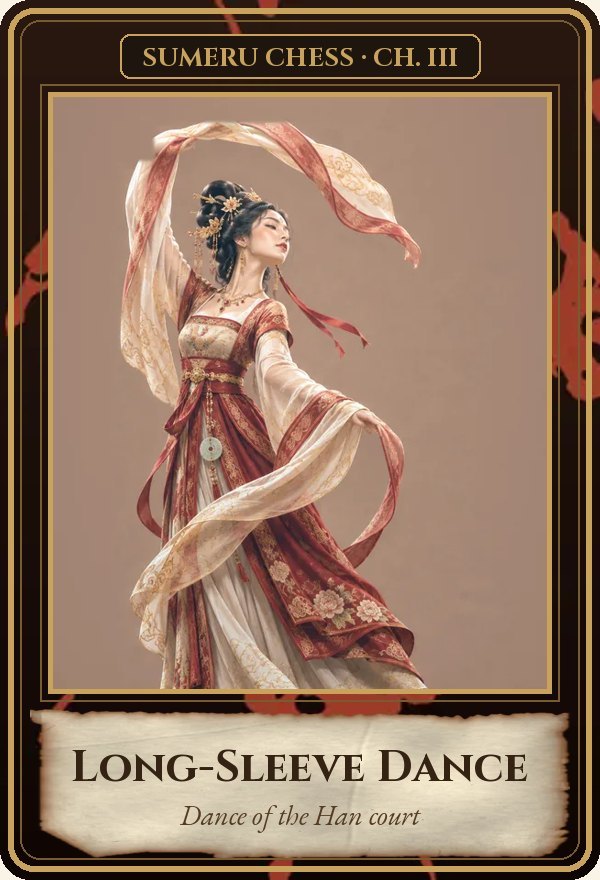
From the cards of Sumeru Chess, Chapter III.
A connected world, and its fragility
The four empires were linked not only by trade but by shared dangers. The same decades that saw the "Antun" embassy also saw the Antonine Plague devastate the Roman world from 165 CE, and a series of epidemics strike Han China. Within a century all four empires were in crisis: the Han collapsed into warlord states after 189 CE, Parthia was overthrown by the Sasanians in 224, the Kushan realm was reduced to a Sasanian vassal, and Rome entered the turbulent third century. Whether these crises were connected — by disease, by climate or by the movements of steppe peoples — is one of the great open questions of ancient history.12
What is clear is that the second century CE was a moment of unprecedented connection. For the first time, a piece of silk woven in Henan could be worn in Rome, a Roman glass vessel could end up in a tomb near Luoyang, and a Buddhist monk from the Kushan lands could sit in Luoyang translating sutras into Chinese. The other essays in this chapter look more closely at two of those links: the clash of Rome and Parthia at Carrhae, and the Kushan bridge between India and China.
Notes
- Rein Taagepera, "Size and Duration of Empires: Growth-Decline Curves, 600 B.C. to 600 A.D.," Social Science History 3, no. 3/4 (1979): 115–138. ↩
- Ban Gu, Hanshu 28B (Treatise on Geography). See Michael Loewe, The Government of the Qin and Han Empires, 221 BCE–220 CE (Indianapolis: Hackett, 2006). ↩
- Walter Scheidel, "Demography," in Walter Scheidel, Ian Morris and Richard Saller, eds., The Cambridge Economic History of the Greco-Roman World (Cambridge: Cambridge University Press, 2007), 38–86. ↩
- Walter Scheidel, ed., Rome and China: Comparative Perspectives on Ancient World Empires (New York: Oxford University Press, 2009), and State Power in Ancient China and Rome (New York: Oxford University Press, 2015). ↩
- Neilson C. Debevoise, A Political History of Parthia (Chicago: University of Chicago Press, 1938); Josef Wiesehöfer, Ancient Persia from 550 BC to 650 AD, trans. Azizeh Azodi (London: I. B. Tauris, 1996). ↩
- Fan Ye, Hou Hanshu 88 (Account of the Western Regions). ↩
- For army size see Yann Le Bohec, The Imperial Roman Army (London: Batsford, 1994). ↩
- Pliny the Elder, Natural History 12.84; see also 6.101 on India alone. ↩
- Lionel Casson, The Periplus Maris Erythraei: Text with Introduction, Translation, and Commentary (Princeton: Princeton University Press, 1989), § 64. ↩
- Hou Hanshu 88; John E. Hill, Through the Jade Gate to Rome: A Study of the Silk Routes during the Later Han Dynasty (Charleston: BookSurge, 2009), translates the account. ↩
- Hou Hanshu 88, under the ninth year of Yanxi (166 CE). ↩
- Kyle Harper, The Fate of Rome: Climate, Disease, and the End of an Empire (Princeton: Princeton University Press, 2017). ↩
Further Reading
- Walter Scheidel, ed., Rome and China: Comparative Perspectives on Ancient World Empires (Oxford University Press, 2009).
- Valerie Hansen, The Silk Road: A New History (Oxford University Press, 2012).
- Raoul McLaughlin, Rome and the Distant East: Trade Routes to the Ancient Lands of Arabia, India and China (Continuum, 2010).
- Mark Edward Lewis, The Early Chinese Empires: Qin and Han (Harvard University Press, 2007).