
Edges of the Known World: India, the Scythian Steppe and Warring-States China, c. 330–221 BCE
Sumeru & Seed Editorial BoardWhen Alexander's army turned back at the Beas, it stood at the edge of the Greek map — but not of the world. Beyond it, a new Indian empire, the riders of the steppe and seven Chinese kingdoms were living through their own age of iron and ambition.
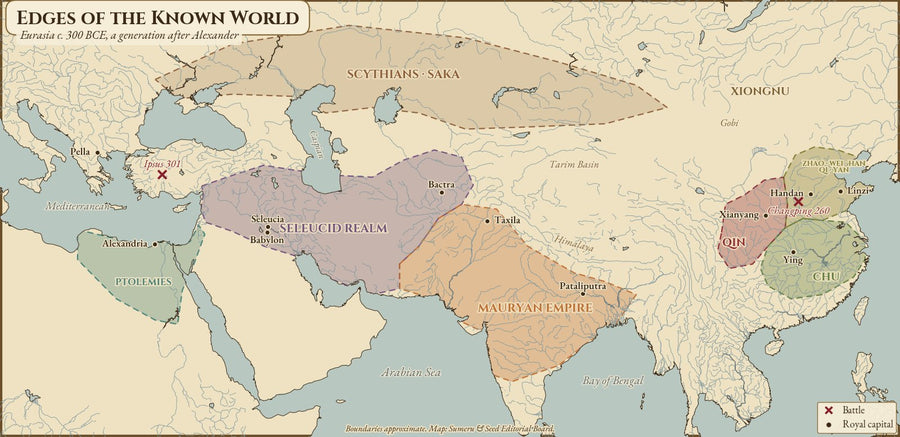
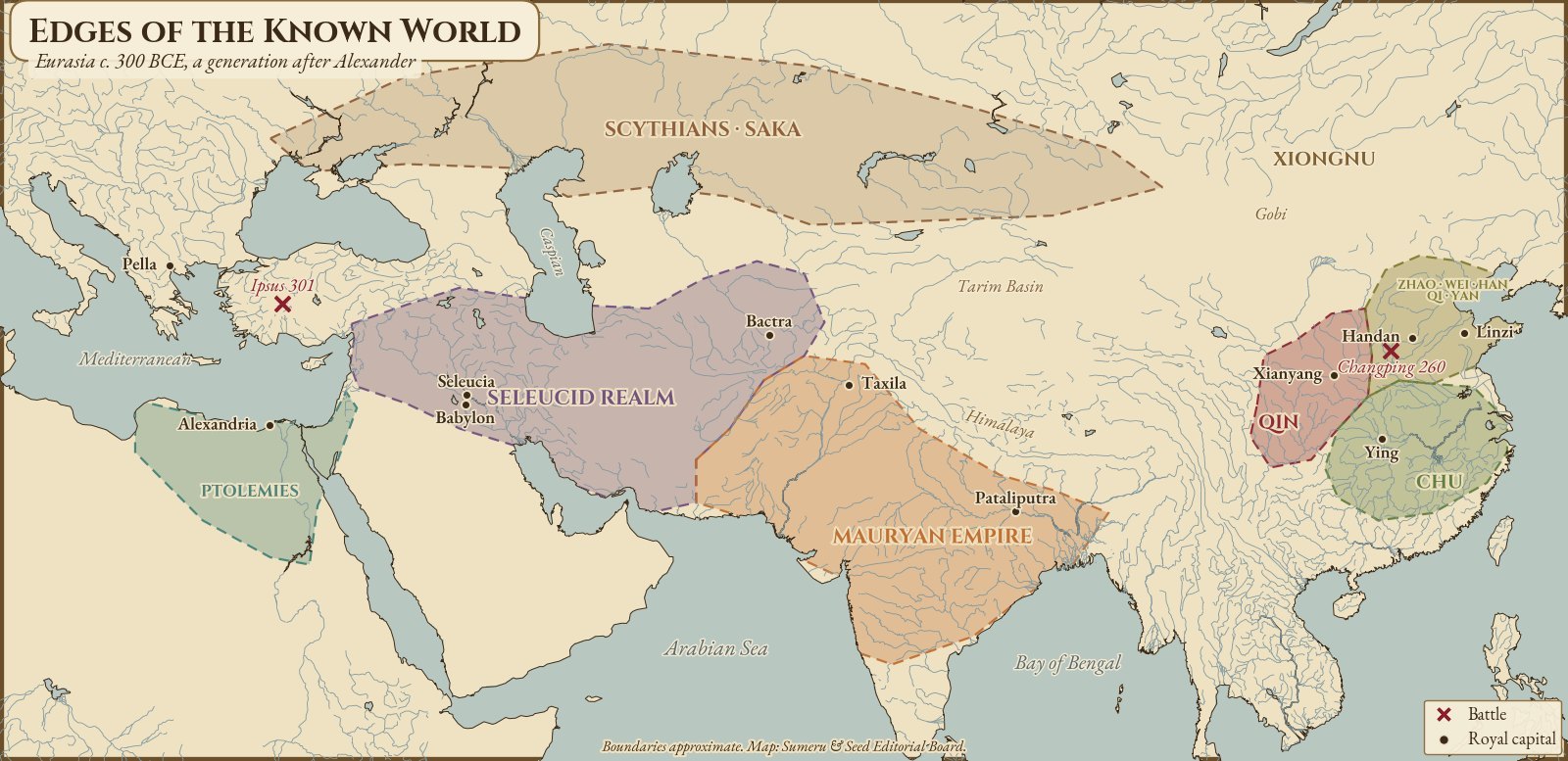
Greek geographers of Alexander's time believed that India was the eastern end of the inhabited world and that beyond it lay the encircling Ocean. They were wrong by some 4,000 kilometres. The decades on either side of 300 BCE were a turning point not only for the Mediterranean and Iran but across Eurasia. In India, the first empire to unite most of the subcontinent was taking shape. On the steppe, the Scythian world was at its height. And in China, seven warring kingdoms were moving towards the unification of 221 BCE. No one in these regions knew the whole picture, but they were linked by trade, by migration and, at the edges, by war.
India: from Alexander to Chandragupta
Alexander's campaign in the Punjab lasted barely two years and left almost no trace in Indian literature. Its indirect consequences were large. Plutarch reports that a young man called Androcottus — the Greek form of Chandragupta — saw Alexander in the Punjab and later said that the king could easily have conquered India, because the ruler of the Ganges valley was hated for his low birth and wickedness.1 Within a few years of Alexander's death, Chandragupta Maurya had overthrown the Nanda dynasty of Magadha and taken control of the north-western territories the Macedonians left behind.
In about 305 BCE Seleucus I, the Macedonian ruler of the eastern satrapies, marched to the Indus to recover them. Instead he made peace. According to Strabo, Seleucus ceded the lands west of the Indus as far as Arachosia (around Kandahar) and received 500 war elephants in return.2 Those elephants helped Seleucus win the battle of Ipsus in 301 BCE, which decided the division of Alexander's empire. Few episodes show more clearly how closely the histories of the Mediterranean and India were tied together.
Seleucus sent an ambassador, Megasthenes, to Chandragupta's capital at Pataliputra (modern Patna) on the Ganges. His Indica is lost, but long extracts survive in Strabo, Arrian and Diodorus. Megasthenes described a city some fifteen kilometres long behind a timber palisade, a professional army with elephants and chariots, an elaborate administration with officials in charge of roads, markets and foreigners, and a society divided into seven classes.3 Not everything he wrote is reliable, but archaeologists have found remains of the timber palisade at Pataliputra, and his account of a powerful, highly organised state is consistent with the Indian evidence. Chandragupta's grandson Ashoka (r. c. 268–232 BCE) would rule almost the entire subcontinent and leave the earliest deciphered Indian inscriptions, including edicts in Greek and Aramaic at Kandahar.4
The steppe: the world of the Scythians
North of the Black Sea and the Caspian lay the steppe, a belt of grassland running from Hungary to Mongolia. Its peoples — the Greeks called those near them Scythians, the Persians called the eastern ones Saka — were mounted pastoralists who fought as horse archers. Herodotus devoted most of his fourth book to them, describing their nomadic life, their gold-rich royal burials and their tactic of retreating before invaders until the enemy exhausted himself, as Darius I discovered when he invaded around 513 BCE.5
Archaeology has confirmed much of what Herodotus wrote. The great burial mounds (kurgans) of the Black Sea steppe, such as Solokha and Chertomlyk, and the frozen tombs of Pazyryk in the Altai mountains have preserved gold work, textiles, saddles and even tattooed bodies.6 Scythian art, with its animals twisted into spirals, spread across the whole steppe, a sign of how far ideas and goods could move along the grassland. Alexander's general Zopyrion was killed with his army in about 331 BCE fighting Scythians near Olbia, and Alexander himself fought the Saka on the Syr Darya in 329.7 At the far eastern end of the same steppe, Chinese kingdoms were learning the same lessons at the same time.
China: the Warring States
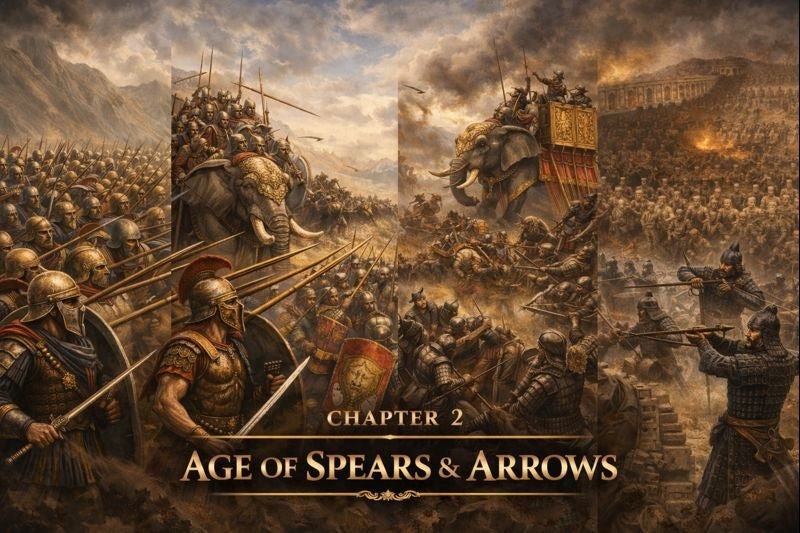
In China the centuries from 475 to 221 BCE are known as the Warring States period (Zhanguo). The old Zhou kingship had become a ceremonial shell, and a handful of large territorial states — Qin, Chu, Qi, Yan, Zhao, Wei and Han — fought for supremacy. War on this scale transformed them. Armies grew from chariot-borne aristocrats to mass infantry levies numbering in the hundreds of thousands; iron tools and weapons, the crossbow with its bronze trigger mechanism, and cavalry (adopted by King Wuling of Zhao in 307 BCE, explicitly copying the nomads' "Hu dress and mounted archery") changed the battlefield.8
The state that profited most was Qin, in the Wei valley in the west. From the reforms of Shang Yang in the 350s BCE onwards, Qin ranked its people by military merit, registered households for taxation and service, divided land into standard plots and imposed collective responsibility for crimes. Historians call this the creation of a "Legalist" state; Mark Edward Lewis has described it as a society organised for war.9 At Changping in 260 BCE Qin defeated Zhao in one of the bloodiest battles of the ancient world; Sima Qian's figure of 400,000 Zhao prisoners killed is surely inflated, but the scale of the disaster is not in doubt.10
Chu, in the Yangzi valley, was Qin's greatest rival. It was the largest of the states in territory, with a distinctive culture of shamanic poetry (the Chuci, "Songs of Chu," associated with Qu Yuan), lacquer, silk and bronze. Manuscripts excavated from Chu tombs at Guodian and elsewhere have transformed our knowledge of early Chinese thought.11 Chu fell to Qin in 223 BCE. Two years later the king of Qin declared himself the First Emperor, Qin Shi Huangdi, and imposed standard weights, measures, coinage, axle widths and script across his new empire.
Parallel worlds
It is tempting to compare Alexander and Qin Shi Huang, born about a century apart, and the comparison is instructive. Both inherited reformed armies from predecessors; both destroyed long-established orders within a few years. But their legacies were opposite. Alexander's empire broke apart the moment he died, while the Qin unification, despite the dynasty's collapse in 206 BCE, created a political idea of a single China that every later dynasty inherited. The difference lay less in the men than in the states behind them: Qin had spent a century building an administration that could survive its conquests; Macedon had not.12
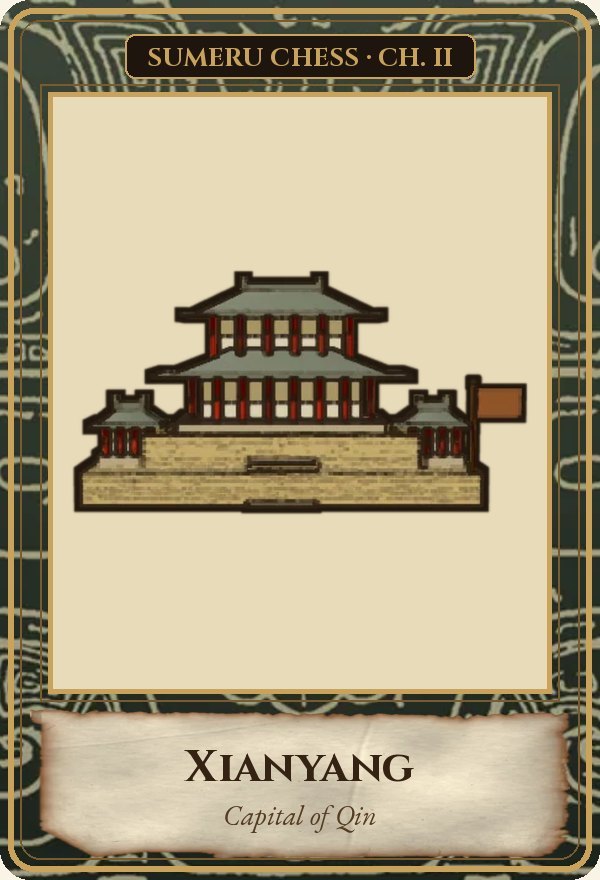
From the cards of Sumeru Chess, Chapter II.
The three regions were not isolated. Greek kings ruled in Bactria from about 250 BCE and struck coins that circulated to the borders of India; Chinese silk was already reaching Siberian tombs at Pazyryk; and the steppe connected all of them. A century after the period covered by this chapter, the Han envoy Zhang Qian would travel west through the same lands and find Bactrian markets selling cloth from Sichuan. The world that Alexander thought he had reached the end of was, in fact, already beginning to join up.
Notes
- Plutarch, Alexander 62.4. ↩
- Strabo, Geography 15.2.9; compare Appian, Syrian Wars 55. On the date and terms see Romila Thapar, Early India: From the Origins to AD 1300 (Berkeley: University of California Press, 2002), and Paul J. Kosmin, The Land of the Elephant Kings: Space, Territory, and Ideology in the Seleucid Empire (Cambridge, MA: Harvard University Press, 2014). ↩
- Megasthenes, fragments in Strabo 15.1.35–60, Arrian, Indica 10–12, and Diodorus 2.35–42. ↩
- Romila Thapar, Aśoka and the Decline of the Mauryas (Oxford: Oxford University Press, 1961); on the Kandahar inscriptions, Kosmin, Land of the Elephant Kings. ↩
- Herodotus, Histories 4.1–144; Darius' expedition at 4.83–142. ↩
- Renate Rolle, The World of the Scythians, trans. F. G. Walls (Berkeley: University of California Press, 1989); Sergei I. Rudenko, Frozen Tombs of Siberia: The Pazyryk Burials of Iron-Age Horsemen (Berkeley: University of California Press, 1970). ↩
- Justin, Epitome 12.2.16–17 and 37.3.2 (Zopyrion); Arrian, Anabasis 4.4 (the Syr Darya). ↩
- Sima Qian, Shiji 43 (the house of Zhao); Nicola Di Cosmo, Ancient China and Its Enemies: The Rise of Nomadic Power in East Asian History (Cambridge: Cambridge University Press, 2002). ↩
- Mark Edward Lewis, Sanctioned Violence in Early China (Albany: State University of New York Press, 1990), and The Early Chinese Empires: Qin and Han (Cambridge, MA: Harvard University Press, 2007). ↩
- Shiji 73 (biography of Bai Qi). ↩
- Constance A. Cook and John S. Major, eds., Defining Chu: Image and Reality in Ancient China (Honolulu: University of Hawai'i Press, 1999). ↩
- For a sustained comparison of state-building see Walter Scheidel, ed., Rome and China: Comparative Perspectives on Ancient World Empires (New York: Oxford University Press, 2009). ↩
Further Reading
- Romila Thapar, Early India: From the Origins to AD 1300 (University of California Press, 2002).
- Mark Edward Lewis, The Early Chinese Empires: Qin and Han (Harvard University Press, 2007).
- Nicola Di Cosmo, Ancient China and Its Enemies (Cambridge University Press, 2002).
- Barry Cunliffe, The Scythians: Nomad Warriors of the Steppe (Oxford University Press, 2019).