
The Battle of Talas, 751: The Caliphate Meets the Tang
Sumeru & Seed Editorial BoardField Report · Chapter IV · July 751 · The Talas valley, Central Asia
Two great empires met only once on a battlefield — on the banks of a Central Asian river. For five days the Tang army held; then its Karluk allies turned on it, and the Chinese general fled with a few thousand men.
Part I · The battle
Result An Abbasid victory.
Why it is remembered
- The only battle of the two empires. The caliphate and the Tang, the two greatest powers of their time, fought each other directly just this once.
- The turncoats. In the middle of the battle the Karluk Turks went over to the Arabs and attacked the Tang from behind.
- A legend about paper. Muslim writers later said captured Chinese papermakers brought their craft to Samarkand. Paper was probably already known there — but the story shows how the battle was remembered.
In 750 the Abbasids overthrew the Umayyads; in Central Asia the Tang general Gao Xianzhi, famous for his crossing of the Pamirs in 747, had just executed the king of Tashkent. The king's son appealed to the Arabs.1
Gao marched west with Tang troops and allies from Ferghana and the Karluks, and met the Abbasid army by the Talas river.2
The battle, step by step
- The armies meet. The Tang and the Abbasid forces face each other across the Talas.
- Five days of fighting. Neither side gives way.
- The Karluks change sides. The Karluk troops attack the Tang from the rear; the Tang army is caught between them and the Arabs.3
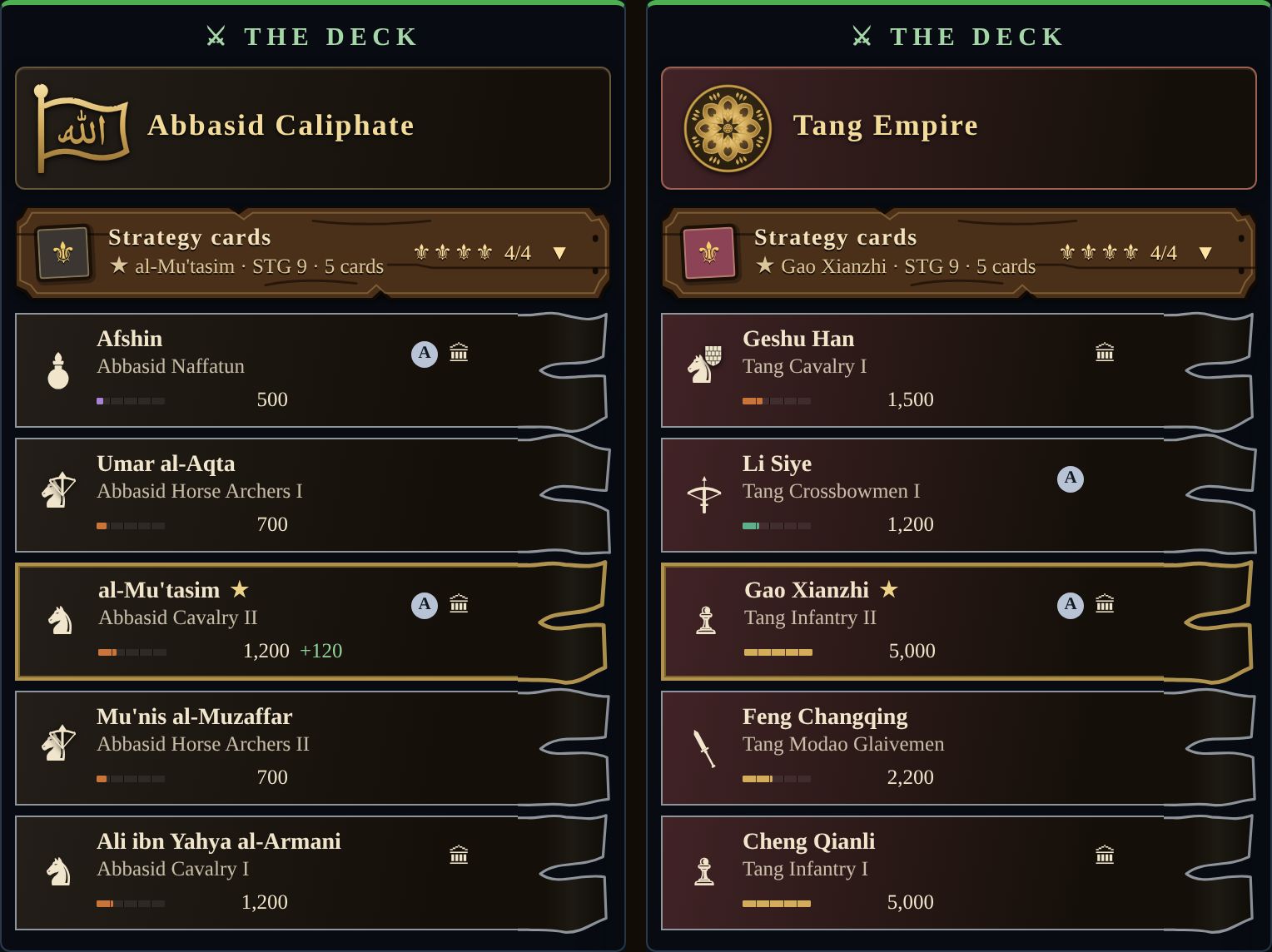
- The escape. Li Siye clears the road through the crowded pass for Gao and the survivors, a few thousand men.4
What followed
Among the prisoners was Du Huan 杜環, who travelled through the caliphate and returned to China a decade later to write the Jingxing ji 經行記, one of the earliest Chinese accounts of the Islamic world. The Tang did not lose Central Asia at Talas: the An Lushan rebellion of 755 did that, by calling the frontier armies home.5
Part II · Play it in Sumeru Chess
Talas on the chessboard
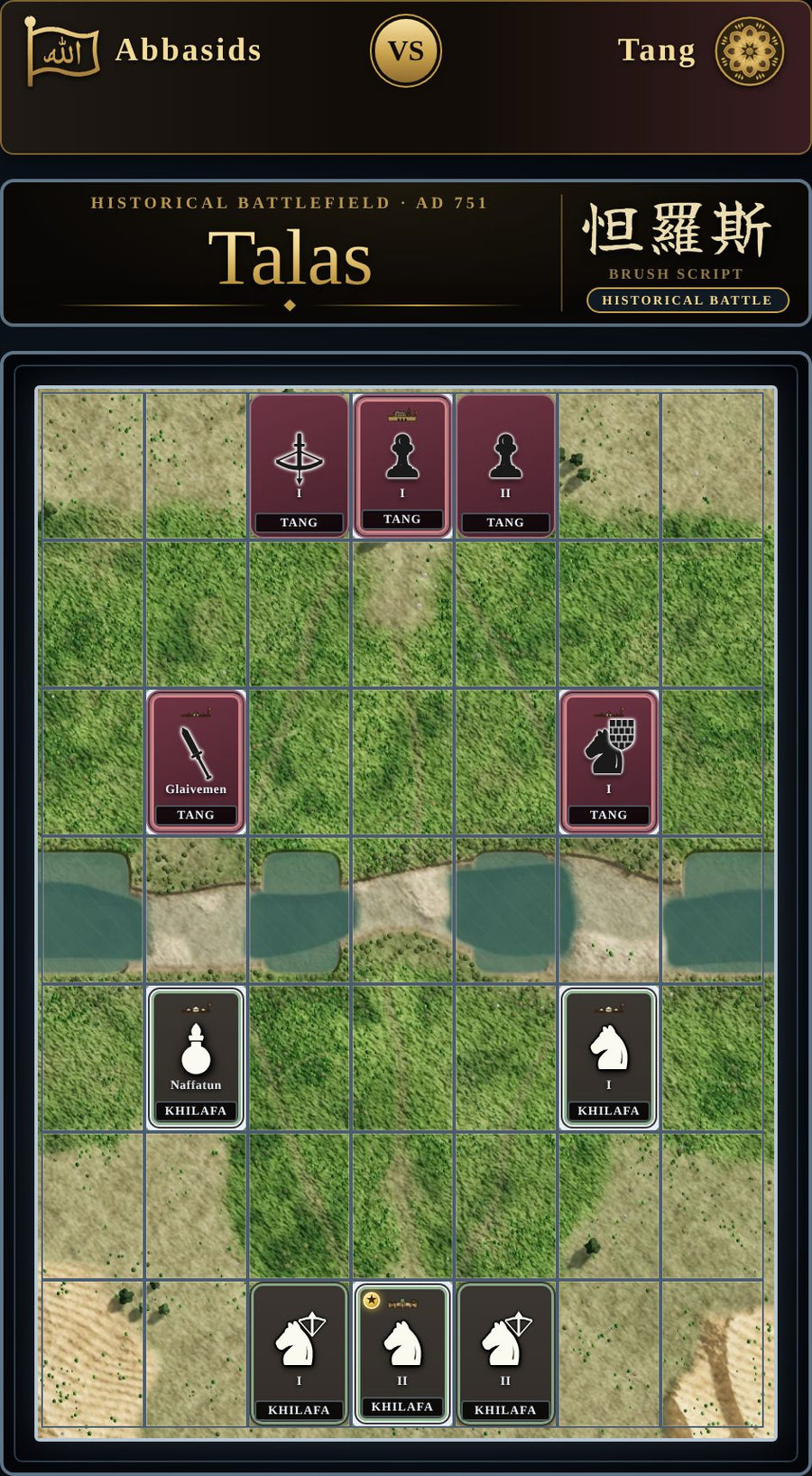
Talas is one of the historical battlefields of Chapter IV of Sumeru Chess, the Age of Raven & Falcon. It is a 7 × 7 board drawn from the real ground: the Abbasids side deploys from Taraz, the Tang side from Anxi Camp.
- The river stops movement; a defender standing in it fights at -1 DEF (horse) or -2 DEF (foot).
- Fords are the crossing places of the river.
Where to find it
- Conquest Campaign. Lead Abbasids against Tang, or Tang against Abbasids: Talas is the first of the two historical battles of that war (the other is Suyab), and the war ends at the enemy capital.
Fight it like history
- Watch your flank and rear. Talas was lost from behind. Keep an army where it can answer a blow from the side.
- The river stops movement. A defender standing in it fights at -1 DEF (horse) or -2 DEF (foot). Cross at the fords.
- Spend your strategy points late. They never refill.
Chapter IV is for Sumeru Premium members — one membership opens every chapter of Sumeru Chess and Imperion 1776. Anyone can read its rulebook and browse its cards.
Play Chapter IVOpen the Card CollectionNotes and sources (5)
- Jiu Tangshu 109; Zizhi tongjian 216; al-Tabari for the Abbasid side. ↩
- Zizhi tongjian 216. ↩
- Zizhi tongjian 216; Jiu Tangshu 109. ↩
- Jiu Tangshu 109 (biography of Li Siye). ↩
- Du Huan, Jingxing ji, quoted in Du You, Tongdian 193; on the paper story see Jonathan Bloom, Paper Before Print (Yale, 2001). ↩
Further reading
- Christopher I. Beckwith, The Tibetan Empire in Central Asia (Princeton, 1987).
- Jonathan M. Bloom, Paper Before Print (Yale, 2001).