

The Battle of Mount Vesuvius, 73 BC: Spartacus Breaks the Blockade
Sumeru & Seed Editorial BoardField Report · Chapter III · 73 BC · Campania, Italy
Trapped on a mountain with one path down — and a Roman army sitting on it — the escaped gladiators of Capua made ladders of wild vines, climbed down the cliffs at night and fell on the Roman camp from behind.
Part I · The battle
Result A rebel victory that turned a breakout of gladiators into a war.
Why it is remembered
- The impossible way down. Glaber guarded the only path off the mountain. The rebels went down the cliff instead, on ropes and ladders of vine.
- A camp without a guard. The Romans had not even fortified properly; they were attacked from where no enemy could come.
- The spark. Slaves and herdsmen flocked to the winners. Within two years Spartacus led an army of tens of thousands.
In 73 BC some seventy gladiators of the training school of Lentulus Batiatus at Capua broke out with kitchen knives and spits, seized wagons of gladiators' weapons, and chose as leaders the Thracian Spartacus and two Gauls, Crixus and Oenomaus.1
They took refuge on Vesuvius, then a green, quiet mountain. Rome sent the praetor Glaber with 3,000 men, who blocked the single path up and waited for hunger to finish the job.2
The battle, step by step
- The blockade. Glaber camps across the only road down; the rebels are trapped on the summit.
- The vine ladders. The rebels cut the wild vines growing on the mountain and twist them into ladders long enough to reach the plain below the cliffs.3
- The descent. One by one they climb down in the dark; the last man lowers their weapons.
- The attack from behind. The rebels circle round and strike the Roman camp, which is not expecting an enemy from that side. Glaber's men flee; the camp is taken.4
What followed
Rome sent the praetor Publius Varinius next; his legates were beaten in turn, and Spartacus' army grew with every victory, sweeping through Campania and Lucania. Two consuls were defeated in 72 BC before the Senate gave the war to Marcus Licinius Crassus.5
Part II · Play it with Imperium Cards
Mount Vesuvius with the physical cards
The battle of Mount Vesuvius is part of Edition II · The Third Servile War, with the Champion of the Arena booster. Play the escape as Spartacus, or hold the Roman blockade. The card battle below has been with the set since its first printing.


In 73 BC, Spartacus and 70 gladiators were trapped on Vesuvius's summit by a Roman blockade. With no path down, they wove ropes from wild vines, descended the sheer cliffs unseen, and emerged behind Roman lines — routing an entire legion in minutes and igniting the largest slave revolt in history.
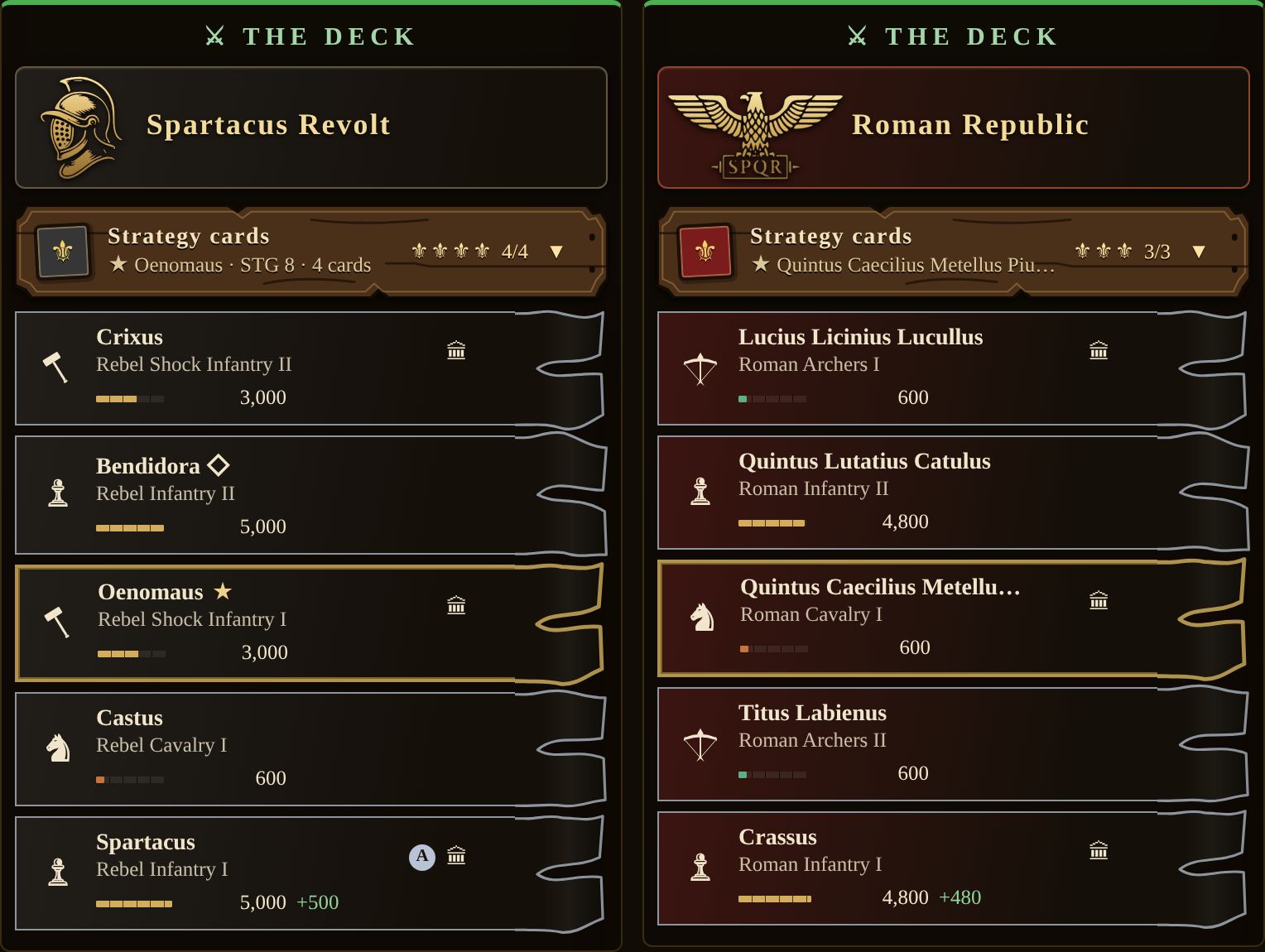
Order of battle
Battle sequence
- Phase IRomans block the only path — rebels trapped on summit
- Phase IISpartacus weaves ropes from wild vines
- Phase IIIGladiators descend sheer cliffs unseen
- Phase IVRebels emerge behind Roman lines — legion routed
A decisive rebel victory through terrain exploitation and daring — the spark that ignited the largest slave revolt in Roman history.
Could you have held the blockade?
Recreate Spartacus's impossible escape with Edition II


Part III · Play it in Sumeru Chess
Mount Vesuvius on the chessboard
Mount Vesuvius is one of the historical battlefields of Chapter III of Sumeru Chess, the Age of Iron & Glory. It is a 7 × 7 board drawn from the real ground: the Spartacus side deploys from Vesuvius, the Rome side from Pompeii.
- Hills give a defender +1 DEF, and cavalry and elephants cannot climb them.
- Forest stops movement, and an army inside is hidden unless one of yours stands next to it.
Where to find it
- Conquest Campaign. Lead Spartacus against Rome, or Rome against Spartacus: Mount Vesuvius is the first of the two historical battles of that war (the other is the Siler River), and the war ends at the enemy capital.
- Single Battle. Choose Spartacus against Rome and set Battlefield to Random: Mount Vesuvius is one of the four historical fields the game draws for this pair.
Fight it like history
- Use the forest. An army inside a forest is hidden unless one of yours stands next to it — the nearest thing on the board to a night descent.
- The hills favour the defender. They give +1 DEF, and cavalry cannot climb them. Do not attack uphill if you can go round.
- Strike the rear. An enemy army pinned from one side by your melee army dies to a second attack (2 vs 1), no card needed.
Chapter III is free to play in your browser, no download: Rome and Carthage are open to everyone; the other powers of the age come with Sumeru Premium.
Play Chapter IIIOpen the Card CollectionNotes and sources (5)
- Plutarch, Crassus 8; Appian, Civil Wars 1.116. ↩
- Plutarch, Crassus 9; Florus 2.8. ↩
- Plutarch, Crassus 9; Frontinus, Stratagems 1.5.21. ↩
- Plutarch, Crassus 9. ↩
- Plutarch, Crassus 9–10; Appian, Civil Wars 1.116–118. ↩
Further reading
- Barry Strauss, The Spartacus War (Simon & Schuster, 2009).
- Brent D. Shaw, Spartacus and the Slave Wars: A Brief History with Documents (Bedford/St. Martin's, 2001).