
The Battle of Mohi, 1241: The Mongols Destroy the Army of Hungary
Sumeru & Seed Editorial BoardField Report · Chapter VI · 11 April 1241 · The Sajó river, Hungary
The Hungarians held the only bridge over the Sajó and camped behind a ring of wagons. The Mongols cleared the bridge with stone-throwers, sent a second army across the river downstream in the dark — and left one gap in the ring for the Hungarians to run through.
Part I · The battle
Result A crushing Mongol victory; Hungary lay open for a year.
Why it is remembered
- Artillery in a field battle. The Mongols used stone-throwers to sweep the defenders off the Sajó bridge — one of the first such uses in a European battle.
- Two armies, one plan. While Batu fought for the bridge, Subutai crossed downstream and came in behind the Hungarians.
- The open gap. Surrounded in their wagon camp, the Hungarians saw a way out — and were cut down along the road as they fled.
In 1241 the Mongols invaded Poland and Hungary at once. Two days after one army destroyed the Poles at Legnica, the main army under Batu and Subutai fell back before King Béla to the Sajó river, then turned.1
Béla camped on the west bank in a laager of wagons chained together and guarded the bridge. Coloman and Archbishop Ugrin drove back a first Mongol attack on it at night.2
The battle, step by step
- The bridge. At dawn Batu's men force the bridge with seven stone-throwers and arrows.3
- The second army. Subutai crosses the river downstream on a hastily built bridge and comes up behind the Hungarian camp.
- The wagon ring. Surrounded, the Hungarians crowd inside their laager under arrows and fire.
- The gap. The Mongols leave an opening to the west. The Hungarians pour through it and are hunted down on the road to Pest for two days.4
What followed
Béla escaped to the Adriatic coast; the Mongols ravaged Hungary through the winter and crossed the frozen Danube. In 1242 news came that the Great Khan Ögedei had died, and Batu led his armies back east. Béla rebuilt the kingdom with stone castles.5
Part II · Play it in Sumeru Chess
Mohi on the chessboard
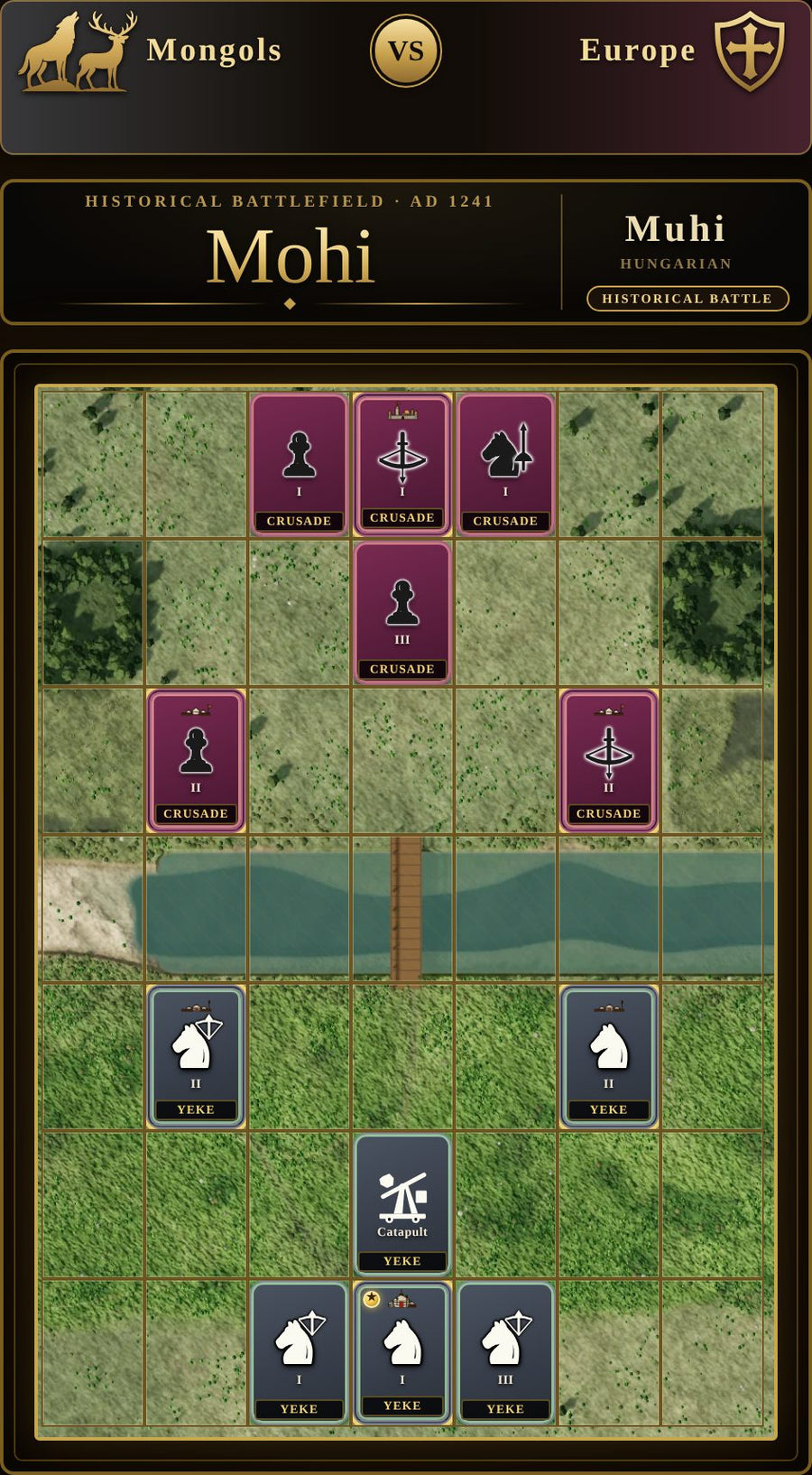
Mohi is one of the historical battlefields of Chapter VI of Sumeru Chess, the Age of Storm & Ashes. It is a 7 × 7 board drawn from the real ground: the Europe side deploys from The Sajó Bridge, the Mongols side from Mongol Camp.
- Forest stops movement, and an army inside is hidden unless one of yours stands next to it.
- The river stops movement; a defender standing in it fights at -1 DEF (horse) or -2 DEF (foot).
- Fords are the crossing places of the river.
Where to find it
- Conquest Campaign. Lead Mongols against Europe, or Europe against Mongols: Mohi is the second of the two historical battles of that war (the other is Legnica), and the war ends at the enemy capital.
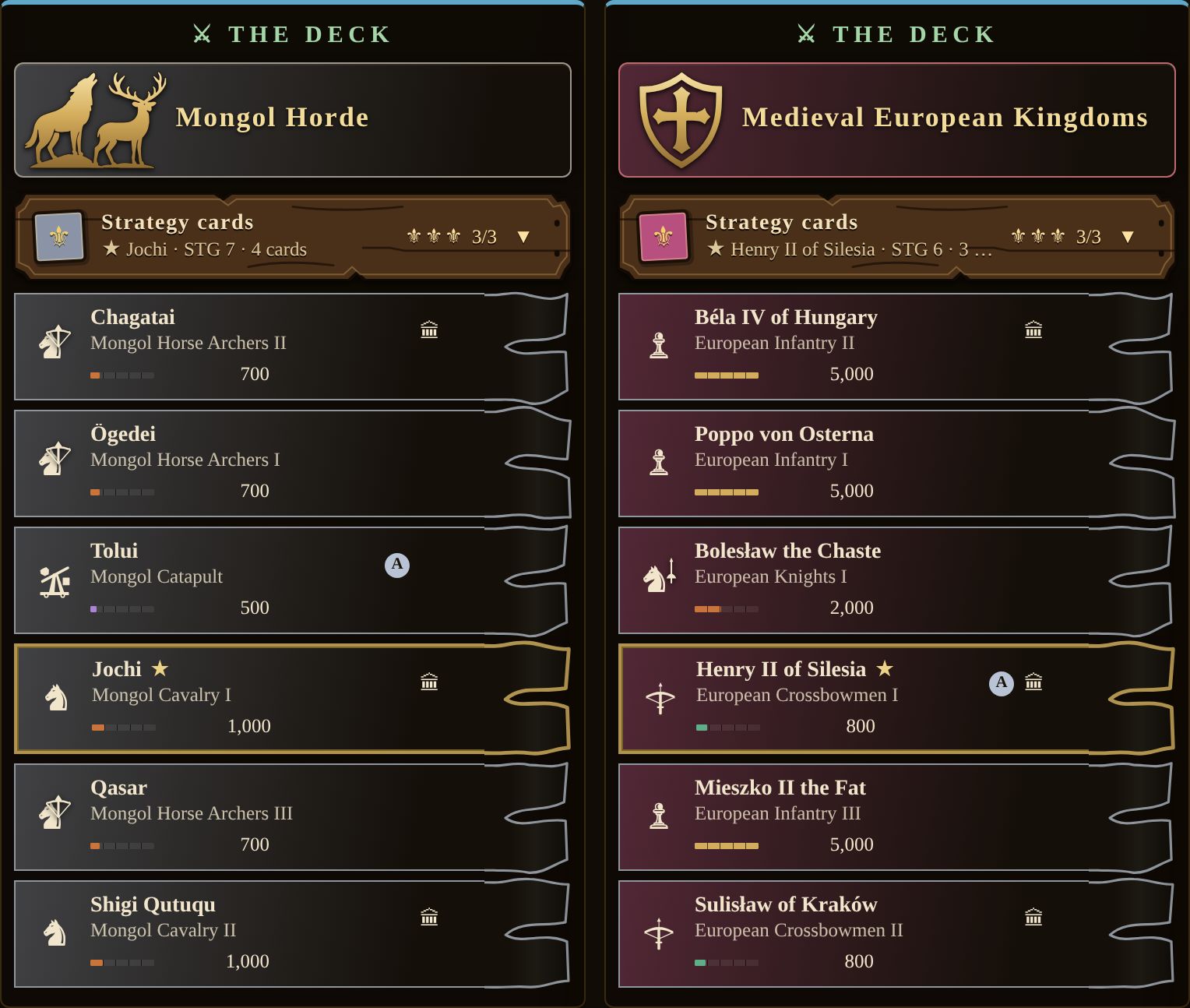
Fight it like history
- Force the crossing. The river stops movement, and a defender standing in it fights at -1 DEF (horse) or -2 DEF (foot). Use the ford — and missiles to clear it.
- Come from two sides. An army pinned by one of yours dies to a second attack (2 vs 1), no card needed.
- Use the forest. An army inside is hidden unless one of yours stands next to it.
Chapter VI is free to play in your browser, no download: the Mongols and Khwarazm are open to everyone; the other powers of the age come with Sumeru Premium.
Play Chapter VIOpen the Card CollectionNotes and sources (5)
- Rogerius, Carmen miserabile 28; Thomas of Split, Historia Salonitana 36. ↩
- Thomas of Split 36; Rogerius 29. ↩
- Thomas of Split 36–37; Juvaini; Rashid al-Din. ↩
- Thomas of Split 37; Rogerius 30–31. ↩
- Rogerius 33–40; Thomas of Split 38–39. ↩
Further reading
- Timothy May, The Mongol Conquests in World History (Reaktion, 2012).
- Peter Jackson, The Mongols and the West, 1221–1410 (Pearson, 2005).