
The Battle of Mobei, 119 BC: Han China Strikes Across the Gobi
Sumeru & Seed Editorial BoardField Report · Chapter III · 119 BC · North of the Gobi, Mongolia
Emperor Wu sent two armies of 50,000 horsemen each across the Gobi desert to find the Xiongnu in their own homeland. Wei Qing caught the chanyu at dusk in a sandstorm; Huo Qubing rode two thousand li and climbed a sacred mountain to proclaim the victory.
Part I · The battle
Result A great Han victory: the Xiongnu court withdrew far to the north and no longer threatened the frontier for years.
Why it is remembered
- A war carried into the enemy's country. For the first time a Chinese army crossed the Gobi and fought the nomads on their own ground.
- The wagon fortress. Wei Qing ringed his camp with armoured wagons (武刚车) to hold off the Xiongnu charge, then sent his cavalry round both flanks.
- Feng Langjuxu. Huo Qubing pursued the eastern Xiongnu to Mount Langjuxu and made a sacrifice there — 封狼居胥 became the Chinese phrase for the highest military achievement.
After the victories of 127 and 121 BC that won the Ordos and the Hexi Corridor, the Xiongnu chanyu withdrew north of the Gobi, believing the Han would never cross it. Emperor Wu raised the largest cavalry force in Chinese history to prove him wrong.1
Wei Qing marched from Dingxiang, Huo Qubing from Dai. The chanyu, warned, sent his baggage north and waited with his best troops on the far side of the desert — for Wei Qing.2
The battle, step by step
- The wagon ring. Wei Qing finds the chanyu's army drawn up waiting. He forms his armoured wagons into a ring and sends 5,000 horsemen out to meet some 10,000 Xiongnu riders.3
- The sandstorm. At sunset a gale blows sand into both armies' faces. Wei Qing sends his cavalry wheeling round both of the chanyu's wings.
- The chanyu flees. Seeing himself surrounded, Yizhixie breaks out to the north-west at dusk with a few hundred riders. The Han pursue through the night.
- Zhao Xin's city. Wei Qing reaches the fortress named after the Han deserter Zhao Xin, takes its grain, then burns it.4
- Huo Qubing's ride. In the east Huo Qubing defeats the Worthy King of the Left, rides beyond Mount Langjuxu and reaches the shore of the great lake Hanhai.5
What followed
The Xiongnu never recovered their old power on the frontier; the Han extended their commanderies westward along the Silk Road. But the cost in horses was crushing, and Huo Qubing died two years later, at only twenty-three or twenty-four.6
Part II · Play it in Sumeru Chess
Mobei on the chessboard
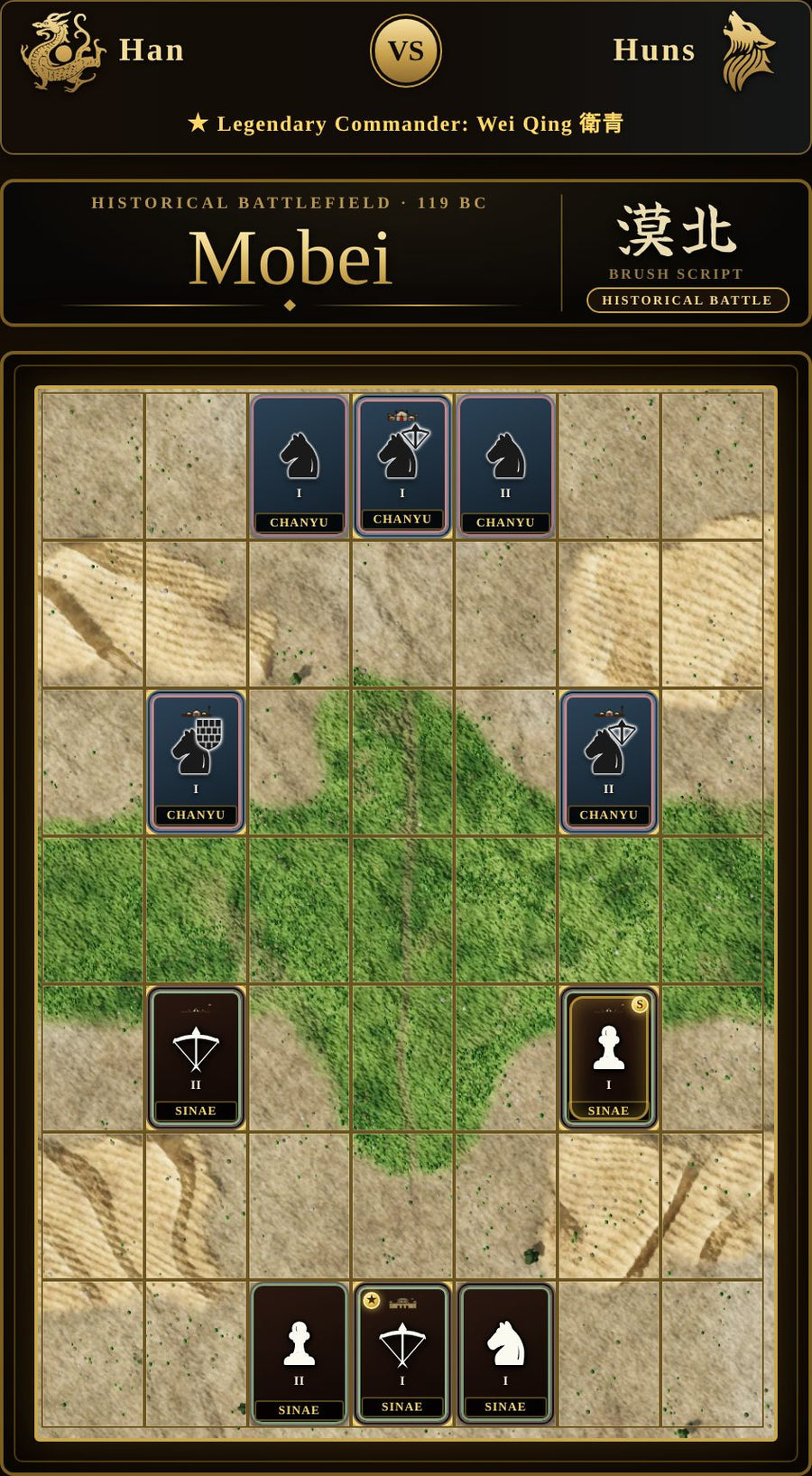
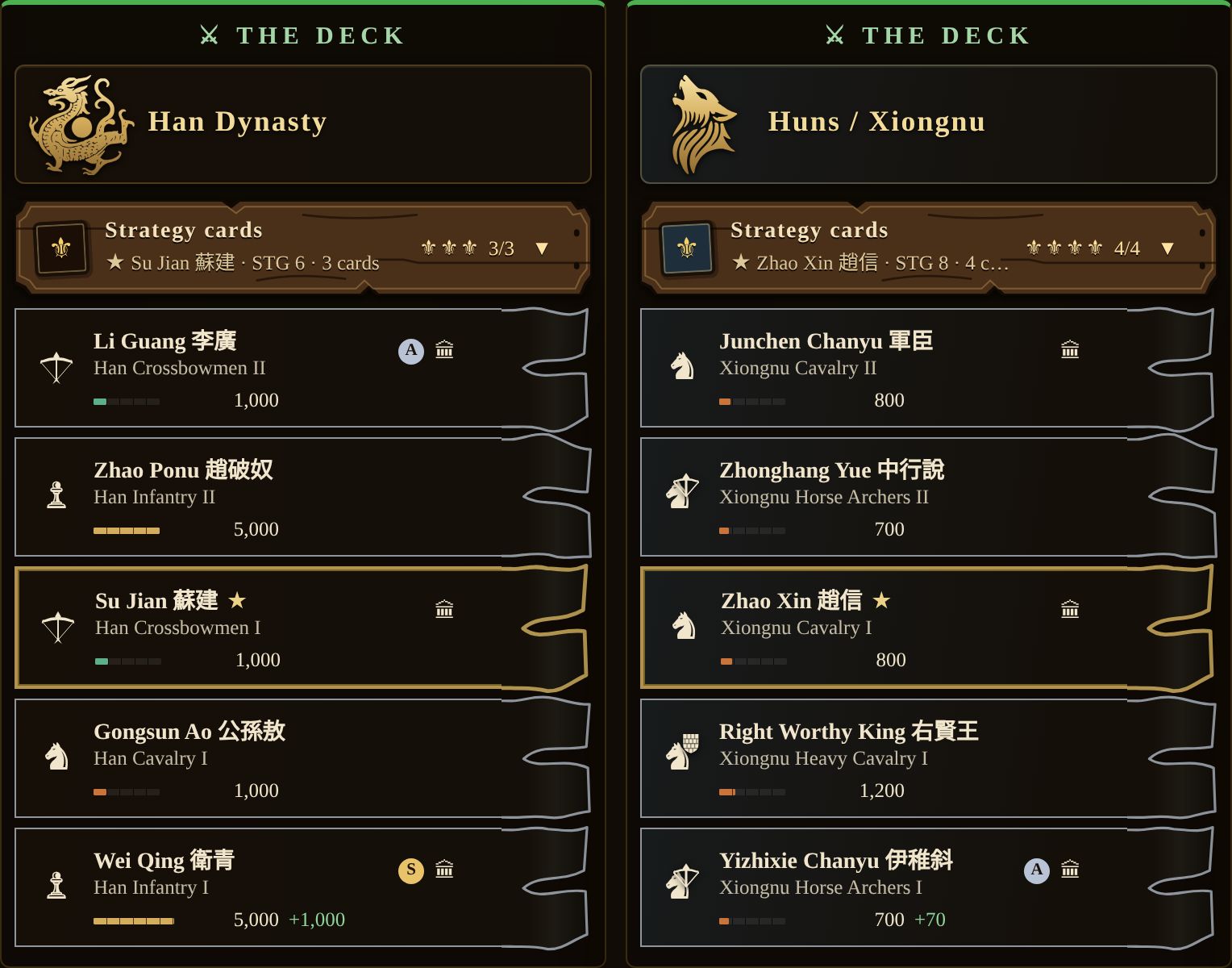
Mobei is one of the historical battlefields of Chapter III of Sumeru Chess, the Age of Iron & Glory. It is a 7 × 7 board drawn from the real ground: the Huns side deploys from Zhao Xin City 赵信城, the Han side from Dingxiang 定襄.
- Rocks are impassable.
Where to find it
- Conquest Campaign. Lead Han against Huns, or Huns against Han: Mobei is the second of the two historical battles of that war (the other is Hexi 河西), and the war ends at the enemy capital.
- Single Battle. Choose Han against Huns and set Battlefield to Random: Mobei is one of the four historical fields the game draws for this pair.
Fight it like history
- Make your own fortress. Wei Qing held the open steppe with wagons. On the board, keep your line together and let the enemy attack it.
- Swing round the wings. A flank attack on an army your infantry already pins destroys it outright (2 vs 1).
- The rocks are impassable — they split the Mobei board in two. Choose your side of them before you advance.
Chapter III is free to play in your browser, no download: Rome and Carthage are open to everyone; the other powers of the age come with Sumeru Premium.
Play Chapter IIIOpen the Card CollectionNotes and sources (6)
- Sima Qian, Shiji 110 (Xiongnu) and 111 (Wei Qing and Huo Qubing). ↩
- Shiji 111; Hanshu 55. ↩
- Shiji 111. ↩
- Shiji 111. ↩
- Shiji 111; Hanshu 55. ↩
- Shiji 111; Hanshu 94. ↩
Further reading
- Sima Qian, Records of the Grand Historian: Han Dynasty II, trans. Burton Watson (Columbia), chapters 110–111.
- Nicola Di Cosmo, Ancient China and Its Enemies (Cambridge, 2002).