
The Battle of Arsuf, 1191: Richard the Lionheart against Saladin
Sumeru & Seed Editorial BoardField Report · Chapter V · 7 September 1191 · The coast of Palestine
With the sea on one side and Saladin's horse archers on the other, Richard's army marched south in a moving fortress, crossbowmen outside, knights inside. At Arsuf the knights finally charged — and Saladin learned what the heavy horse of the West could do.
Part I · The battle
Result A crusader victory; Jaffa was taken, but the road to Jerusalem stayed closed.
Why it is remembered
- The fighting march. For two weeks the army moved at walking pace with the fleet offshore, its crossbowmen holding the archers off while the knights kept their horses fresh.
- Discipline under arrows. Saladin's archers tried every day to provoke a charge. The knights waited — almost to the end.
- The charge that broke ranks. Two Hospitallers charged without orders; Richard turned their charge into a general one, and then held his knights back from a fatal pursuit.
After taking Acre in July 1191 Richard marched for Jaffa, the port for Jerusalem. Saladin shadowed the army along the coast road, attacking its rearguard day after day.1
On 7 September, as the column came out of the woods north of Arsuf onto the open plain, Saladin threw his whole army at it.2
The battle, step by step
- The attack. Waves of horse archers and foot attack the rear and flank; the Hospitallers in the rearguard suffer most.
- The knights wait. Richard holds the charge until the enemy is close and tired; the Hospitallers beg to be released.3
- The charge. Two knights of the rearguard break ranks and charge; the Hospitallers follow. Richard sends the whole army after them.4
- Rallied twice. The Ayyubid army breaks; Richard halts, re-forms and charges again when Saladin's guard counter-attacks, and stops the pursuit at the edge of the woods.5
What followed
Richard took Jaffa three days later. Twice his army came within sight of Jerusalem, and twice he turned back, fearing he could not hold it. In 1192 he and Saladin made a truce: the crusaders kept the coast, and Christian pilgrims could visit Jerusalem.6
Part II · Play it in Sumeru Chess
Arsuf on the chessboard
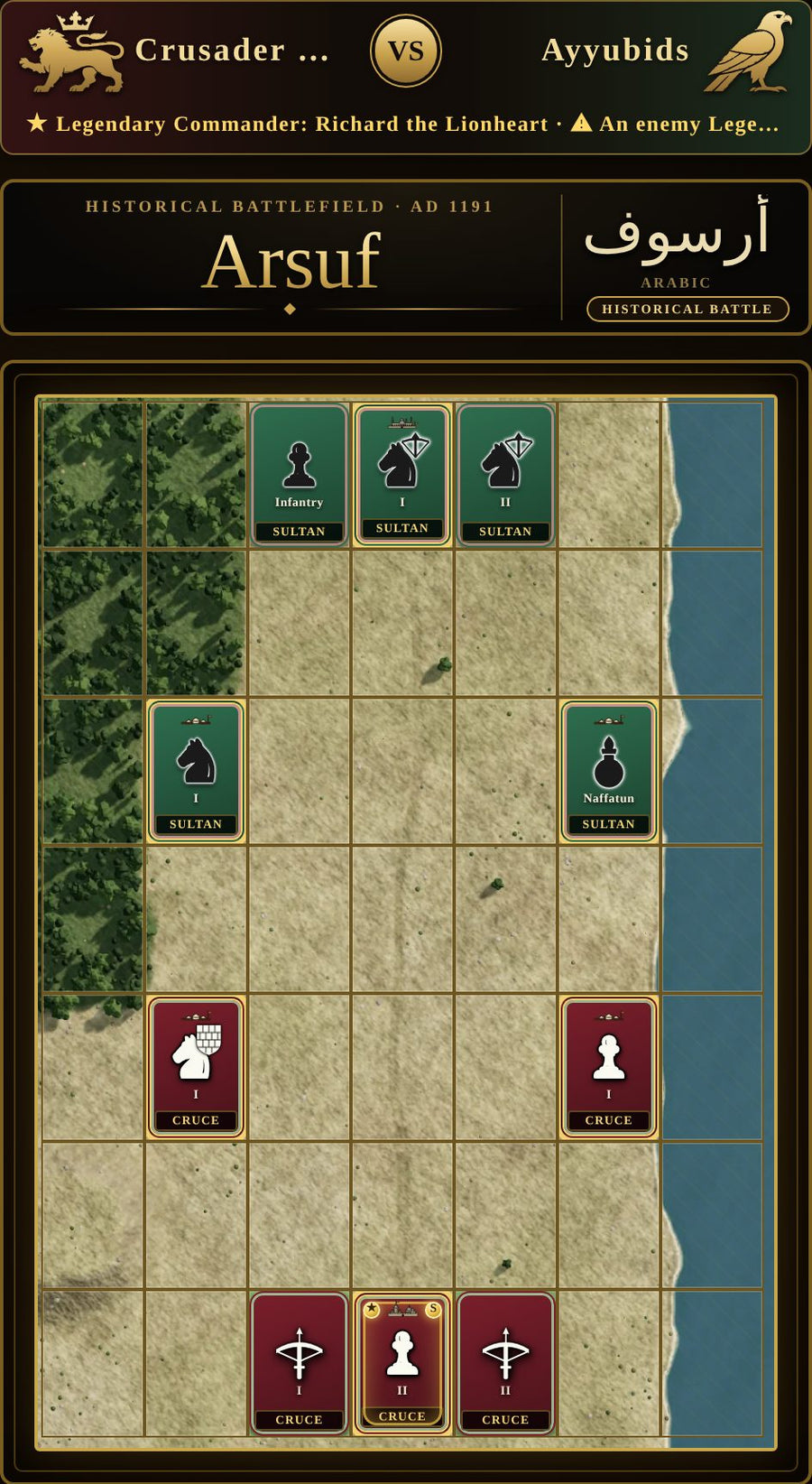
Arsuf is one of the historical battlefields of Chapter V of Sumeru Chess, the Age of Faith & Fire. It is a 7 × 7 board drawn from the real ground: the Crusader Kings side deploys from The Fighting March, the Ayyubids side from Forest of Arsuf.
- Hills give a defender +1 DEF, and cavalry cannot climb them.
- Forest stops movement, and an army inside is hidden unless one of yours stands next to it.
- No army can enter the sea.
Where to find it
- Conquest Campaign. Lead Crusader Kings against Ayyubids, or Ayyubids against Crusader Kings: Arsuf is the second of the two historical battles of that war (the other is the siege of Acre), and the war ends at the enemy capital.
Fight it like history
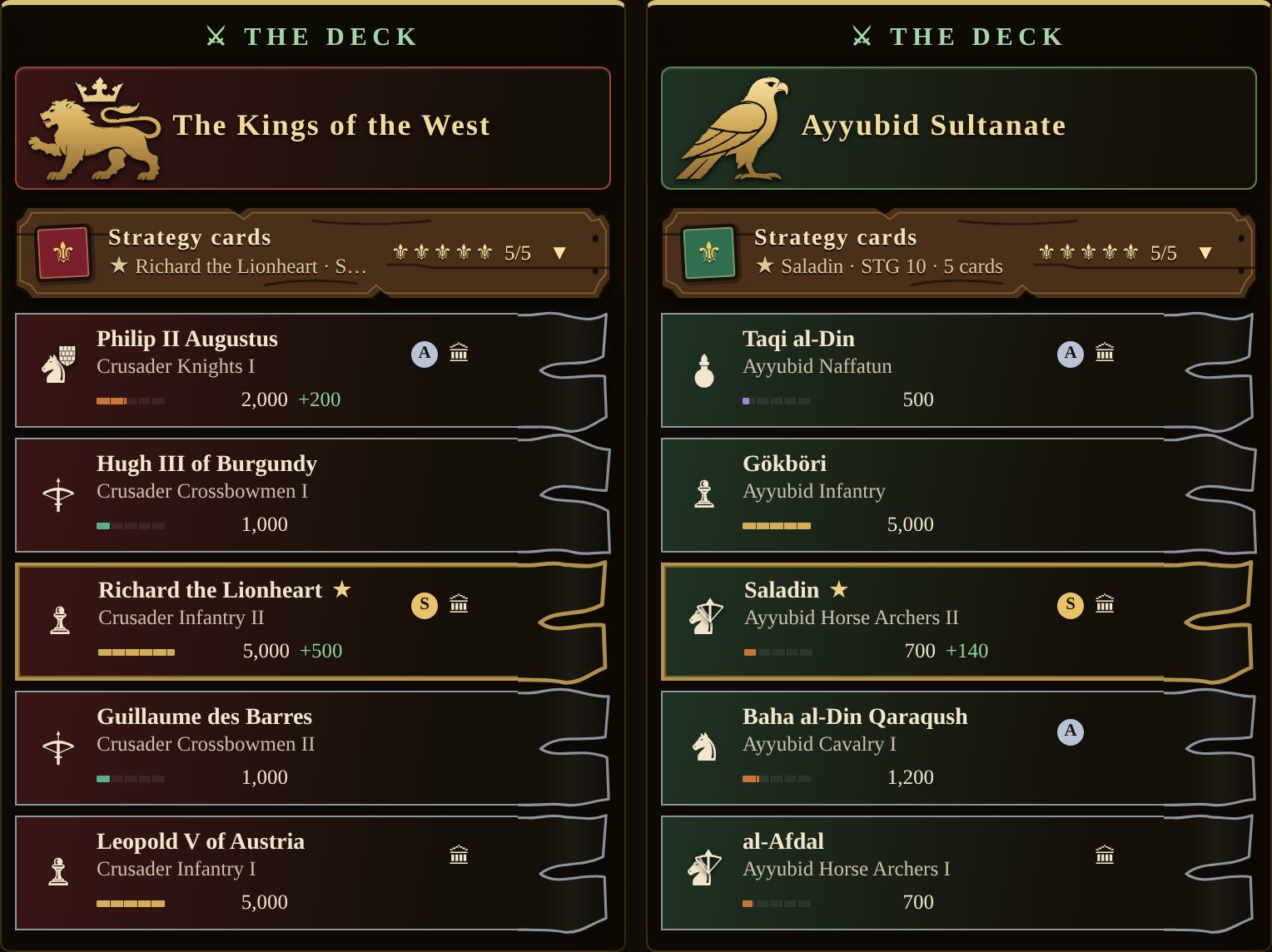
- Keep your heavy horse for one blow. A charge thrown too early is wasted; a charge at the right moment wins the battle.
- Use the forest. An army inside is hidden unless one of yours stands next to it — the Ayyubids waited in the woods of Arsuf.
- The sea protects a flank. No army can enter it; march along it and you can be attacked from one side only.
Chapter V is for Sumeru Premium members — one membership opens every chapter of Sumeru Chess and Imperion 1776. Anyone can read its rulebook and browse its cards.
Play Chapter VOpen the Card CollectionNotes and sources (6)
- Itinerarium Peregrinorum 4.12–17; Ibn Shaddad. ↩
- Itinerarium 4.17–18; Ambroise, Estoire de la guerre sainte. ↩
- Itinerarium 4.18. ↩
- Itinerarium 4.19; Ambroise. ↩
- Itinerarium 4.19; Ibn Shaddad. ↩
- Ibn Shaddad; Itinerarium 4.20–6.28. ↩
Further reading
- Helen Nicholson (trans.), Chronicle of the Third Crusade (Itinerarium Peregrinorum) (Ashgate, 1997).
- John Gillingham, Richard I (Yale, 1999).
- Thomas Asbridge, The Crusades (Simon & Schuster, 2010).