
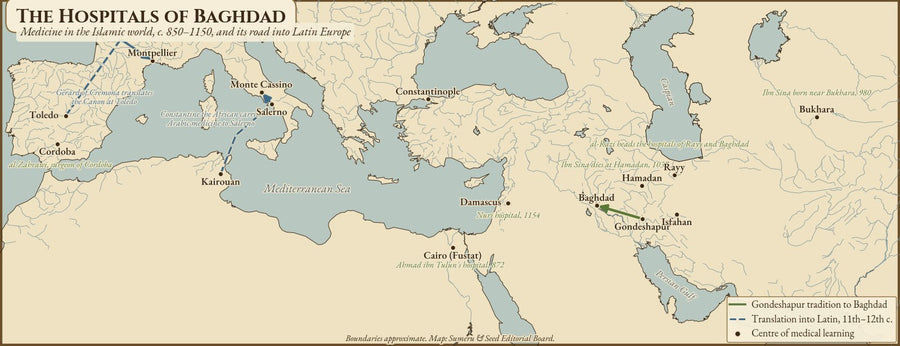
The Hospitals of Baghdad: al-Razi, Ibn Sina and Medicine in the Islamic World
Sumeru & Seed Editorial BoardBetween the ninth and twelfth centuries, physicians in Baghdad, Rayy, Bukhara, Cairo and Cordoba translated Greek medicine, tested it against their own experience and built hospitals open to all. Their books were still being taught in Europe five hundred years later.

According to a story told three centuries later, when the physician Abu Bakr al-Razi was asked to choose a site for a new hospital in Baghdad, he hung pieces of fresh meat in different quarters of the city and chose the place where the meat rotted most slowly.1 The anecdote is probably not true — the biographer attached it to a hospital founded after al-Razi's death. But it captures something about the medicine of the Islamic world in its classical age: a confidence that the inherited learning of the Greeks could be tested, criticised and improved by observation, and a determination to put that learning to work in institutions for the care of the sick.
From Gondeshapur to Baghdad
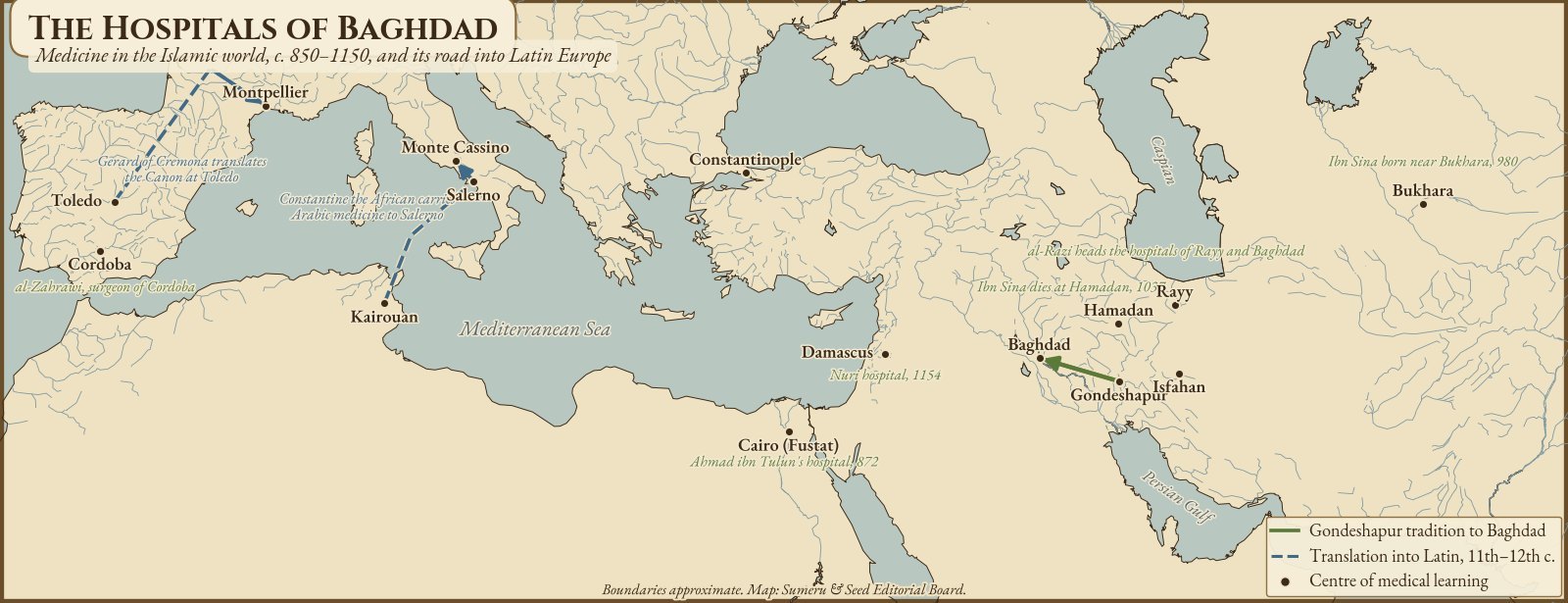
When the Abbasids founded Baghdad in 762, the most famous medical tradition in their realm was that of Gondeshapur in south-western Iran, where Christian physicians of the Church of the East practised medicine based on Greek texts translated into Syriac. In 765 the caliph al-Mansur, suffering from a stomach complaint, summoned the head of the Gondeshapur hospital, Jurjis ibn Bukhtishu. His descendants served as court physicians in Baghdad for two centuries.2
Under the caliphs Harun al-Rashid and al-Ma'mun, an extraordinary translation movement turned Greek science and philosophy into Arabic. The greatest of the translators, Hunayn ibn Ishaq (d. 873), a Christian from al-Hira, wrote a letter listing 129 works of Galen and describing how he and his circle had searched for Greek manuscripts and translated them, first into Syriac and then into Arabic.3 Dimitri Gutas has shown that this movement was driven by the needs and interests of Baghdad's elite, not by a few enthusiastic caliphs: rulers, officials and doctors paid for translations because the knowledge was useful.4
The bimaristan
The Islamic hospital, the bimaristan (from a Persian word meaning "place of the sick"), was one of the great institutions of medieval Islamic cities. The first in Baghdad was founded in the time of Harun al-Rashid around 800. Ahmad ibn Tulun built one in Fustat (old Cairo) in 872; the Buyid ruler Adud al-Dawla founded the great al-Adudi hospital in Baghdad in 982; Nur al-Din founded one in Damascus in 1154 that still stands; and in 1284 the Mamluk sultan Qalawun built the huge Mansuri hospital in Cairo.5
These were not places merely to die. They were funded by charitable endowments (waqf), treated patients without charge, had separate wards for men and women and for different kinds of illness, including mental illness, and employed physicians, surgeons, oculists and pharmacists. Many also taught medicine. Historians debate how far their roots lay in Byzantine and Syriac Christian charitable hospitals, and Michael Dols and Ahmed Ragab have warned against romanticising them.6 But they were among the most advanced medical institutions of the medieval world.
Al-Razi: the doubter
Abu Bakr Muhammad ibn Zakariya al-Razi (c. 854–925), known in Latin as Rhazes, came from Rayy, near modern Tehran, and directed hospitals in Rayy and Baghdad. His enormous Comprehensive Book (al-Hawi), compiled from his notes after his death, collects the opinions of earlier authorities on each disease and adds his own case histories. His short Treatise on Smallpox and Measles is the first known work to distinguish clearly between the two diseases.7
Al-Razi admired Galen, but he also wrote a book called Doubts about Galen, in which he listed points where his own experience contradicted the master. Science, he argued, progresses; later physicians who study the books of their predecessors and add their own observations must surpass them.8

From the cards of Sumeru Chess, Chapter IV.
Ibn Sina: the systematiser
Abu Ali al-Husayn ibn Sina (980–1037), known in Latin as Avicenna, was born near Bukhara under the Samanid dynasty. According to his autobiography, he had mastered medicine by the age of sixteen and was treating the Samanid ruler by eighteen. He spent his life moving between the courts of Iran — Gurganj, Rayy, Hamadan, Isfahan — serving as physician and sometimes as vizier, and died at Hamadan.9
His Canon of Medicine (al-Qanun fi al-tibb) organised the whole of medicine — Galenic theory, anatomy, diseases from head to foot, and some 800 simple drugs — into a single, logically ordered encyclopaedia in five books. Its clarity made it the most successful medical textbook ever written. Ibn Sina was also a philosopher, and the Canon is shaped by his effort to reconcile medicine with Aristotelian logic.
From Cordoba and Kairouan to the Latin West
In the west of the Islamic world, Abu al-Qasim al-Zahrawi (d. c. 1013), known in Latin as Albucasis, a physician at Cordoba, wrote a medical encyclopaedia, al-Tasrif, whose last book on surgery, with drawings of some two hundred instruments, became a standard surgical text in Europe.10
Arabic medicine entered Latin Europe through two main channels. In the late eleventh century Constantine the African, a convert from North Africa who became a monk at Monte Cassino, translated Arabic medical works, including the Royal Book of al-Majusi, which he presented as the Pantegni; they became the basis of teaching at the medical school of Salerno. In the twelfth century Gerard of Cremona and other translators in Toledo turned the Canon, al-Razi's works and al-Zahrawi's surgery into Latin.11 The Canon was still being taught at universities such as Montpellier and Leuven in the seventeenth century.
Legacy
The physicians of the Islamic world did not simply preserve Greek medicine; they criticised it, reorganised it and added to it, and they built the hospitals in which it was practised. In the thirteenth century the Damascene physician Ibn al-Nafis went further and, in a commentary on the Canon, described the passage of blood from the right side of the heart to the left through the lungs — contradicting both Galen and Ibn Sina.12 Medicine, as al-Razi had argued, was a science that could progress.
Notes
- Ibn Abi Usaybi'a, Uyun al-anba' fi tabaqat al-atibba'; trans. Emilie Savage-Smith, Simon Swain and G. J. van Gelder, eds., A Literary History of Medicine: The 'Uyun al-anba' fi tabaqat al-atibba' of Ibn Abi Usaybi'ah (Leiden: Brill, 2020). ↩
- Peter E. Pormann and Emilie Savage-Smith, Medieval Islamic Medicine (Edinburgh: Edinburgh University Press, 2007). ↩
- Hunayn ibn Ishaq, Risala on the Galen translations; John C. Lamoreaux, ed. and trans., Hunayn ibn Ishaq on His Galen Translations (Provo, UT: Brigham Young University Press, 2016). ↩
- Dimitri Gutas, Greek Thought, Arabic Culture: The Graeco-Arabic Translation Movement in Baghdad and Early 'Abbasid Society (London: Routledge, 1998). ↩
- Ahmed Ragab, The Medieval Islamic Hospital: Medicine, Religion, and Charity (Cambridge: Cambridge University Press, 2015). ↩
- Michael W. Dols, "The Origins of the Islamic Hospital: Myth and Reality," Bulletin of the History of Medicine 61, no. 3 (1987): 367–390; Ragab, Medieval Islamic Hospital. ↩
- Pormann and Savage-Smith, Medieval Islamic Medicine. ↩
- Al-Razi, Kitab al-Shukuk ala Jalinus; see Pormann and Savage-Smith, Medieval Islamic Medicine. ↩
- William E. Gohlman, ed. and trans., The Life of Ibn Sina: A Critical Edition and Annotated Translation (Albany: State University of New York Press, 1974). ↩
- M. S. Spink and G. L. Lewis, eds. and trans., Albucasis on Surgery and Instruments (London: Wellcome Institute of the History of Medicine, 1973). ↩
- Danielle Jacquart and Françoise Micheau, La médecine arabe et l'Occident médiéval (Paris: Maisonneuve et Larose, 1990). ↩
- Pormann and Savage-Smith, Medieval Islamic Medicine. ↩
Further Reading
- Peter E. Pormann and Emilie Savage-Smith, Medieval Islamic Medicine (Edinburgh University Press, 2007).
- Ahmed Ragab, The Medieval Islamic Hospital (Cambridge University Press, 2015).
- Dimitri Gutas, Greek Thought, Arabic Culture (Routledge, 1998).
- Nancy G. Siraisi, Avicenna in Renaissance Italy: The Canon and Medical Teaching in Italian Universities after 1500 (Princeton University Press, 1987).